This book review first appeared in the Fall 2025 issue of The Hemingway Review, the twice-a-year journal published by the Ernest Hemingway Foundation and Society.
By Steve Paul
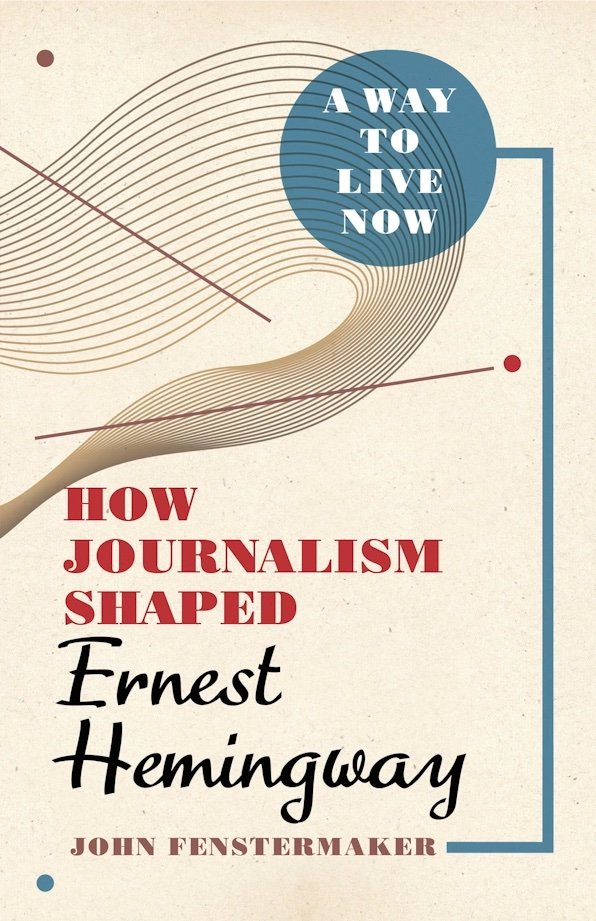
A Way to Live Now: How Journalism Shaped Ernest Hemingway. By John Fenstermaker. Louisiana State UP, 2025. 243 pages. Hardcover $45.00.
As a reader enters John Fenstermaker’s A Way to Live Now, he or she might, like the present reviewer, be prepared to encounter the familiar story of how Hemingway’s work as a newspaper reporter and commentator contributed to his literary stature.
Sure, there is a recap here of Hemingway’s early writing experiences in high school in Oak Park, Illinois. In numerous by-lined appearances in the school newspaper, for example, the teenager often tried on a breezy voice under the influence of popular humorist Ring Lardner, a kind of adolescent slouch that lingered for years. In three notable works of short fiction in his school’s Tabula yearbook, Hemingway developed themes of endurance, violence, and moral consequences that could be seen resonating in his mature fiction decades later.
Then came his apprenticeship, in 1917-1918, at the daily Kansas City Star, where as a reporter he learned to “use short sentences,” according to the newspaper’s famed style sheet, and to observe the urban experience closely, directly and colorfully in the gritty streets, the police stations, the hospital emergency rooms.[1]
After the Great War, in the early 1920s, there were his staff and freelance assignments for the Toronto Star’s daily and weekly editions. That period included a somewhat unhappy stint in Canada, where Hemingway and first wife Hadley gave birth to their son John ( “Bumby”), followed by their return to Paris, where he continued to write for the Toronto paper as he also revved up his excursions into fiction. Hemingway’s journalistic correspondence from all over Europe yielded a collection of serious reporting from war and post-war zones and semi-serious commentary and analyses of various social scenes.
So the background journalism, which recurred during Spain’s civil war and World War II, becomes essential experience in the larger Hemingway story and in the shaping of his world views, as Fenstermaker frames it.
“Ernest Hemingway’s journalism and fiction must be understood as the offspring of a single creative intellect,” Fenstermaker writes in his Introduction (2).
Beyond that, Fenstermaker, a professor emeritus at Florida State University, has something more unexpected in mind in this extended, multi-part essay. By the time he reaches the 1930s on the Hemingway timeline, about halfway through the book (though pre-figured in the Introduction), he unspools another thread, one that becomes his central focus.
In 1933—in the early years of the Great Depression, that is—Arnold Gingrich introduced a slick magazine for upwardly mobile men, Esquire, and presented Hemingway, one of the most famous of American authors, as a featured, contributor. Thus began, as Fenstermaker illustrates, a decades-long association that bolstered Hemingway’s celebrity image as traveler, sportsman, style-setter, man about the world, and, not least, peerless writer.
Thus we are led into a kind of multi-dimensional space that offers fleeting aspects of Hemingway biography along with close readings of his work to investigate the evolution of his persona, or personae, and his various narrative voices. Fenstermaker discusses both Hemingway’s literary contributions to the magazine, alongside other publications, and the many ways that Gingrich and Esquire promoted his star columnist throughout the writer’s lifetime and long after.
From 1933 to 1939, Esquire published twenty-five Hemingway essays and six short stories, which, Fenstermaker writes, “in volume, scope, and timeliness, constitute a unique writing achievement: a continuously unfolding ‘apologia’; a major body of work” (7).
Esquire began as a quarterly and quickly shifted to monthly publication, largely based on the attraction of Hemingway. “His name,” Fenstermaker writes, “helped raise and sustain monthly sales exceeding all expectations, despite its Depression-era price of fifty cents” (118). By the mid-1930s, Esquire was selling a half million copies a month.
Hemingway had free rein to write what he wanted and as he wanted, and he took full advantage of the liberties to turn his Esquire “Letters” into reflections on just about everything but most importantly himself. He wrote from Paris and Cuba and the Wyoming mountains. He dwelt on the natural world, the Gulf Stream, and the prospect of war (he saw it coming, but wished we’d stay out of it). He presented himself as acute observer, as a learned man of science, and as an accomplished writer in competition with the literary greats of the past.
While his fan base clearly grew, Hemingway also became a target for the professional class of critics, some of whom “were the most consistently brutal and unforgiving overall” (125). Edmund Wilson, his onetime champion, was unrelenting about the disappointing turn Hemingway took throughout the 1930s. Heywood Broun, in the New York World Telegram, was exemplary in his frank assessment: “I do not like the man, and yet I must admit that I know no other phony in the whole course of English letters who could write so well concerning things about which he had not the slightest comprehension” (125). Fenstermaker helpfully itemizes two of Broun’s target subjects—bullfighting and boxing.
Hemingway eventually gave up his essay series, but contributed what Fenstermaker terms his masterpiece of short fiction, “The Snows of Kilimanjaro,” and five other stories before essentially stepping away from Esquire circa 1939.
After Esquire came Hemingway’s third and fourth marriages, with their respective trials, along with For Whom the Bell Tolls, the war in France and Germany and his sold descriptive accounts, The Old Man and the Sea, the Nobel Prize, and the ups and painful downs of the 1950s.
Fenstermaker highlights Hemingway’s work in literary and social terms. There is the Esquire-influenced theme of manhood and male identity, of course, but he also makes room to touch on how Hemingway treated and forefronted his fictional female characters. War and fishing, trauma and hedonism, fathers and sons, folly and fortunes—Fenstermaker presents the whole Hemingway in somewhat fragmented parts. He calls on biographer Michael Reynolds for a career assessment: “Before he burned out, he lived constantly out on the edge of the American experience” (qtd, 194).
Beginning in the 1950s, and accelerating his efforts after Hemingway’s death in 1961, Gingrich would capitalize on the magazine’s association with Hemingway and keep his celebrity reputation and his work alive before the reading public. Fenstermaker tells us more than once that Gingrich featured Hemingway in various forms some sixty times over thirty-four issues, culminating in the publication of Esquire’s fortieth anniversary edition in 1973, which prominently featured his prize writer, now a dozen years in the grave.
A Way to Live Now is not so much a guide to leading the good and complicated life, as we so often find in Hemingway’s work, but a quilted reading of his winding narrative journey. Fenstermaker’s book emphasizes the making of Hemingway’s public image, his self-image, and his legacy, one that, after all these years, still commands fresh attention.
[1] It was awkward to encounter Fenstermaker quoting my own studies of Hemingway’s Kansas City experience while listing in his bibliography a related Hemingway Review article but not the actual source, my book Hemingway at Eighteen.