FIrst posted on my Substack site awhile back as part two of a piece headlined “A Boston Triptych.”
By STEVE PAUL
(C) 2026
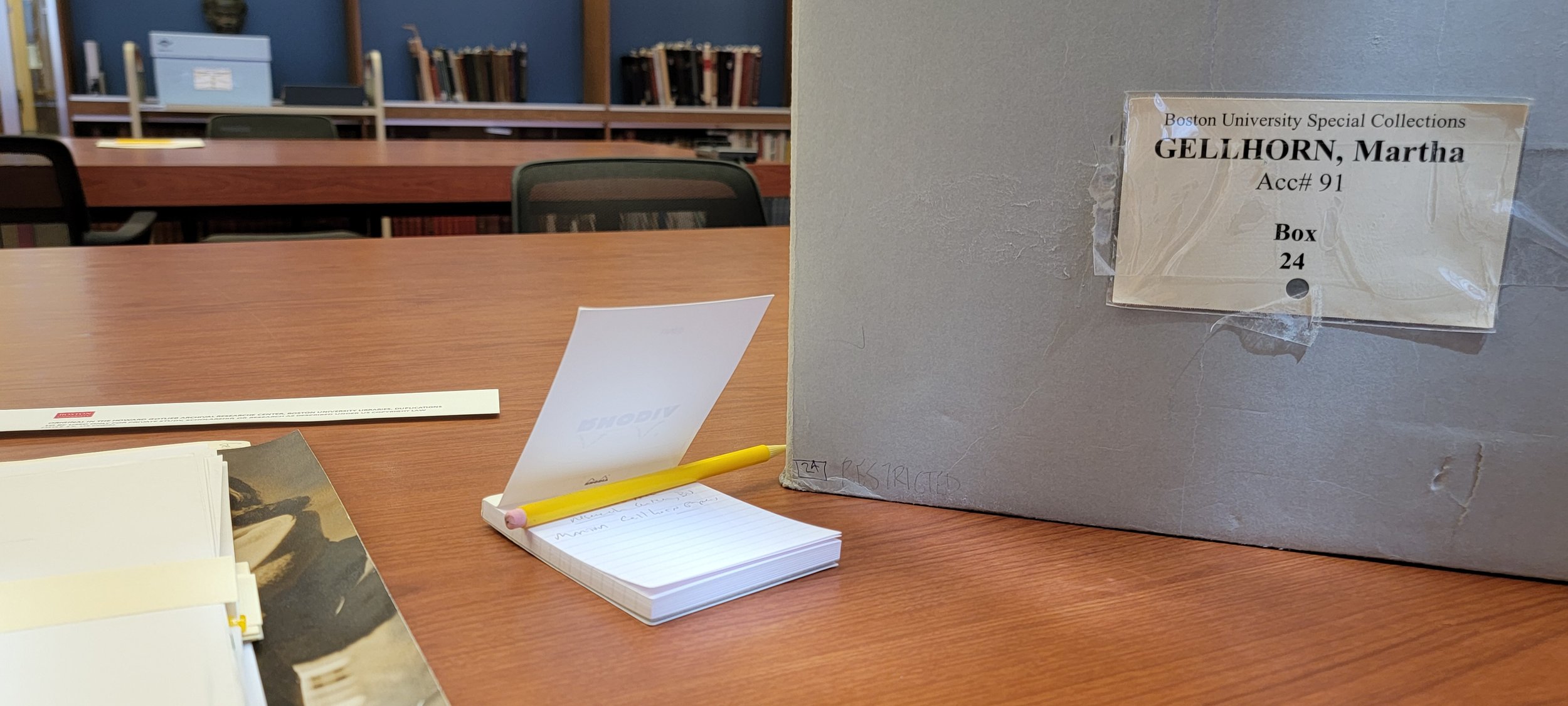
Biographers live for rooting around in old, musty papers, which provide untold details and opportunities for unexpected surprises that can’t possibly be invented by generative AI “writers.” A recent excursion included a satisfying few hours parachuting into Martha Gellhorn’s papers at Boston University’s Howard Gotlieb Archival Research Center.
I’d heard that some of her papers had only recently been opened to researchers so I was hoping to find anything that might relate to a Hemingway project I’ve been working on. Gellhorn, you’ll recall, while establishing her own career as a much-traveled, fearless foreign correspondent, became Ernest Hemingway’s third and unhappiest wife. Their life together spanned nearly eight years in the late 1930s and early ‘40s, including a three-year affair and a marriage in the Cheyenne, Wyoming, train station. Gellhorn is the one who found and restored the house atop a hill outside Havana, Cuba, that became Hemingway’s famous Finca Vigia residence for two decades.
A few things I learned while making selective dives into nearly a dozen large boxes of paper-filled file folders:
+ Gellhorn was a dedicated diarist and careful observer. Some biographers and other writers have had the advantage of drawing from this material. Had I had more time, I might’ve looked at good swaths of it, but I needed to stay focused and none of the diaries appeared to stem from the period in which I was interested.
+ The collection includes only a handful of letters from Hemingway, which eventually will be published in the chronologically appropriate volumes of the Hemingway Letters Project. We’ve so far seen six volumes in the Letters series from Cambridge University Press, which plans for eleven more. Gellhorn at some point must have been involved in trying to organize her papers. A couple of the letters—Hemingway’s last to her and a later letter to Gellhorn’s mother, include her hand-written snarky annotations.
+ Interesting to see that Gellhorn kept up a correspondence with Hemingway’s son Patrick, whom she first probably met when he was roughly eleven years old, on a hunting trip in Sun Valley, Idaho. Patrick, who was born in Kansas City in 1928 and died in Montana just last fall (2025), operated a safari camp in Tanganyika (now Tanzania), and some of their letters relate to Gellhorn’s travels throughout Africa. My friend Dr. Hilary K. Justice, the scholar in residence at the JFK Library’s Hemingway Collection, confirmed for me in a recent conversation that Marty and Patrick, affectionately known as Mouse, maintained a fondness for each other despite the onerous behavior of his father.
+ Gellhorn wrote for many magazines over the years. Her World War II articles for Collier’s are usually seen as exemplary, but her travels to other war zones around the globe are frequently eye-opening. I’m particularly interested in spending some time with two items I found in her files—copies of enlightening and possibly heart-wrenching pieces she wrote from the Gaza Strip (“lovely, huge, lunatic asylum”) and Vietnam in the late 1960s. The latter, she wrote to a critical correspondent, involved “the dirtiest war” she had ever experienced, adding that she had never reported in occupied Europe during the Nazi reign.
+ An illuminating comment about Hemingway’s health appears in a letter to Gellhorn from someone who apparently was her financial adviser. We have long known that Hemingway’s disturbing decline in the 1950s and ultimate mental troubles leading to suicide in 1961, stemmed from a series of head injuries beginning at least as far back as the mortar shell explosion on the night of July 8, 1918 in Italy. One major brain trauma occurred during the second of two plane crashes Hemingway experienced during African travels with wife Mary in 1954. But here, in 1945, Gellhorn’s adviser tells her that Hemingway apologized for being slow to reply about something because “he has had headaches from his series of concussions.”
+ Gellhorn and Hemingway had the cutest nicknames for each other, which appear in their salutations or sign-offs in various letters and which I had never noticed before: Rabby, Bongie, Schatzy, Peeby. Her later memoir, Travels with Myself and Another, begins with an account of their journey to China early in their marriage in which she refers to Hemingway throughout as U.C., for Unwilling Companion. Undoubtedly her usual references to him and his to her in the years after their breakup were not nearly so jolly.
As a longtime researcher and writer in Hemingway’s world, I’ve not spent nearly enough quality time with Gellhorn, but my visit to her papers has given me reason to take another close look.