This article first appeared on my Substack site, March 23, 2026.
By STEVE PAUL
(c) 2026
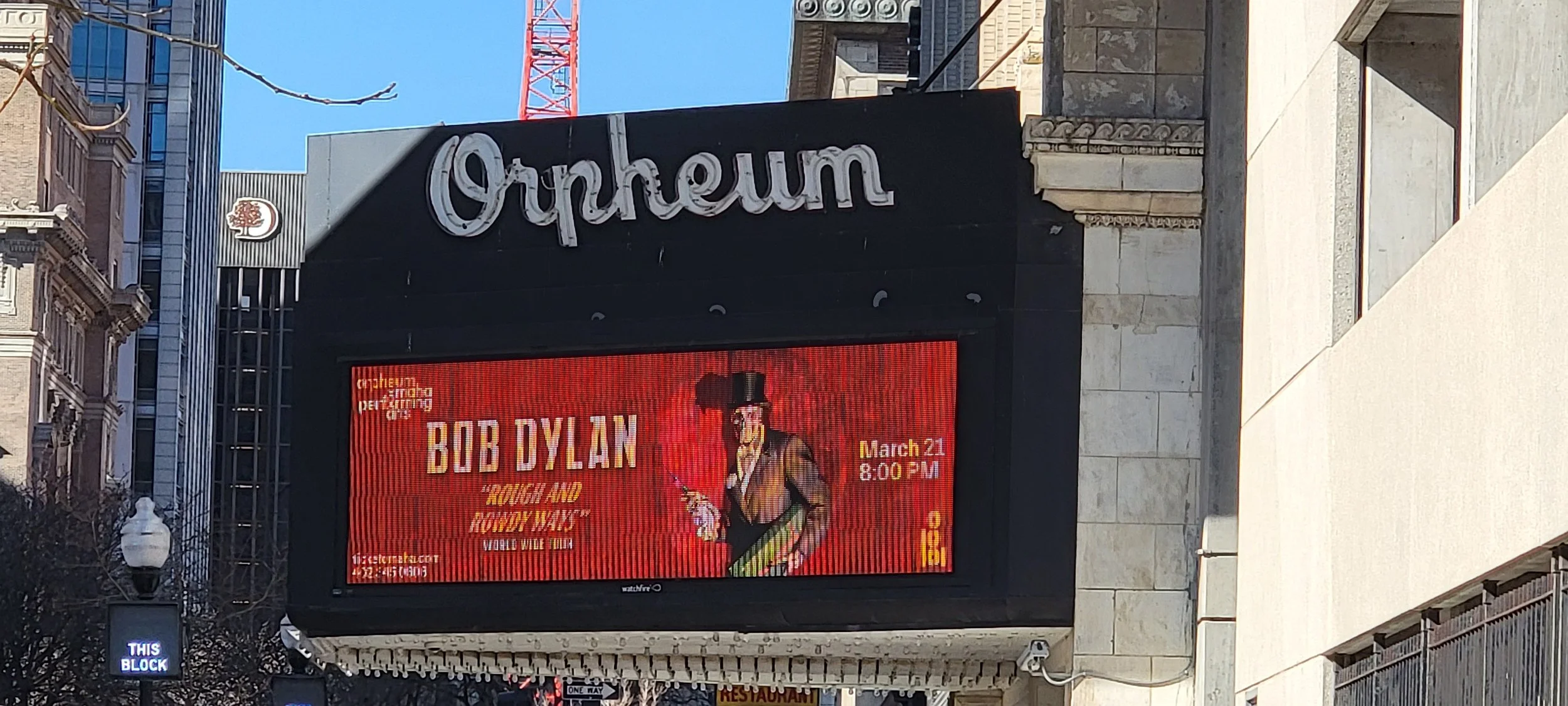
To feed my late-in-life obsession with Bob Dylan, I drove up to Omaha (three hours straight) to catch the opening night of the latest leg of his Rough and Rowdy Ways Tour. I’m a relative piker in Dylan World, having experienced only five previous concerts since he began this “never-ending” sequence in November 2021 and one Dylan appearance in the Outlaw Festival (summer 2025), in which he has headlined with Willie Nelson.
Still, like many Dylan fans with several Rough and Rowdy shows chalked up, I approached the concert warily. I wasn’t even sure I wanted to hear it, especially if it offered little more than what we’d heard already, new arrangements and the odd cover or back-catalogue dip notwithstanding. Dylan has played nearly 300 of these shows, and along with the concerts I’ve caught in person an untold number of bootleg recordings can be found in numerous places online. Some shows have been more thrilling than others, but all of them provide an opportunity to pay tribute to the octogenarian (he’ll turn 85 in May) Nobel Prize laureate who has shaped the vital soundtrack of at least three generations of audiences over the last 65 years.
So, of course, I talked myself into it and settled early into my seat, second row center of the loge, nicely overlooking the stage and the grand, ornate trappings of Omaha’s Orpheum Theater.
I’d already met a couple of first-time Rough and Rowdy attendees, Lance, from Boulder, Colorado, who’d brought his teenage-son, Dylan (!). On my recommendation, after encountering them on the sidewalk earlier, they listened to the Rough and Rowdy Ways album before returning to the theater for the show, so they were prepped and eager (though, sorry to say, I didn’t see them after for their reactions).
Dylan opened the show with “I’ll Be Your Baby Tonight” (yes he will, you might want to say), which has been a typical opener for a while now. The song dates back to Dylan’s “John Wesley Harding” album of late 1967, with which I’ve been spending some quality time lately.
When I recognized that the second song was “The Man in the Long Black Coat,” from the “Oh Mercy” album of 1989, I began to suspect that we might be in for something special. This was a first for this tour, but I didn’t realize until later, that Dylan hadn’t played it in concert since 2013. With its intimations of death and deviltry, the song fits right into Dylan’s thematic darkness and actually serves as a precursor to “Black Rider,” which comes along 30 years later on the “Rough and Rowdy Ways” album and which we would hear just a few songs later.”
As it turned out, Dylan did mix things up in this show. He chopped a good 20 minutes off the usual length of prior outings, coming in at slightly under 90 minutes and playing 16 songs, down from a typical 17. He dropped three of the “Rough and Rowdy Ways” songs from the program – “My Own Version of You,” “Goodbye Jimmy Reed,” and (one of my favorites) “Mother of Muses.” He also dropped some of the older songs that were regulars in the tour concerts, such as “It’s All Over Now, Baby Blue,” “It Ain’t Me Babe,” and “Watching the River Flow.” In their stead, he melded in five songs he’d played in the Outlaw sets, four of his varied classics and one cover. These were “All Along the Watchtower” (another “John Wesley Harding” great), a standout “Don’t Think Twice, It’s All Right,” “Soon After Midnight,” “Love Sick” (sizzling) and Samuel Smith’s (via Bo Diddley) “I Can Tell.”
As has been reported elsewhere, Dylan, mostly sitting or standing at an electric keyboard rather than an upright or grand piano, had recurring issues with a microphone stand and occasionally his voice dropped out. (The problem reportedly got worse a night later in Sioux Falls, South Dakota.) But generally Dylan’s vocal sound in the Omaha show was forceful and reflected commitment to his songs. He’s not just going through the motions. He gave several of the “Rough and Rowdy Ways” tracks, especially “I’ve Made Up My Mind to Give Myself to You,” a kind of intimate-ballad treatment.
Overall, this was not a radical departure from what Dylan had been doing in these two separate tours of late. But all together we can appreciate the fresh program as another leg gets under way, a freshness spanning six decades of Dylan’s career and revealing the power and appeal of his inordinately vast songbook.
And I can guarantee that no one—absolutely no one—could have predicted that Dylan would introduce a new rocking number from the depths of his late-1950s favorites: Eddie Cochran’s “Nervous Breakdown.” He had never played it in concert before (according to the helpfully comprehensive database at bobdylan.com). And here it was in a climactic position, second to the last, before the regular closer “Every Grain of Sand.”
Perhaps Dylan wants us to consider, at least ironically, the state of his head space as he makes his astonishingly vigoroous way through his ninth decade. In “Nervous Breakdown,” a doctor tells the song’s narrator that he’s “just gotta slow down/ you can’t keep a traipsin’ all over town.” The doctor calls him “a total wreck” and the narrator certainly agrees.
Dylan might have taken it literally as he messed with the microphone again during “Every Grain of Sand,” but he picked up the harmonica for the first time all night near the end of that closing song and gave some crowd-pleasing blasts announcing, “total wreck” or not, that he’s still here.