This piece was first published in an email newsletter produced by my friend Lonnie Shalton, a Kansas City political historian and baseball fan since the 1950s. As I mention, he asked me to present a take on Bob Dylan pegged to his tour stop at Kansas City’s Starlight Theatre, an outdoor showplace where I’d previously seen Dylan nearly a decade ago. Lonnie’s interest is in the music—see his affiliated website LonniesJukebox.com—and I attempted to share some highlights from Dylan’s 65-year career. — sbp
By STEVE PAUL
Bob Dylan turned 85 years old on May 24 this year, just a couple of weeks before setting out on another concert tour. For nearly five years, Dylan has been traveling to highlight many of the songs from his exceptional album Rough and Rowdy Ways, released in 2020. He has racked up close to 300 concerts over several legs of that tour and added dozens more by participating in Willie Nelson’s annual Outlaw Festival in recent summers.
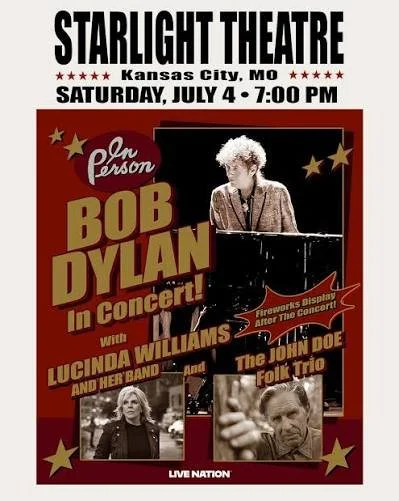
This summer Dylan has fashioned his own version of an Outlaw tour, by inviting the likes of Lucinda Williams and John Doe (of the LA band X) to open the shows. In these Dylan summer shows, Dylan presents setlists with fewer songs from Rough and Rowdy Ways and a growing number of songs from his back catalog plus occasionally surprising covers.
As the July 4 concert at Starlight Theatre in Kansas City approached, your Hot Stove host asked me to step in to pitch some heat and curveballs about Dylan. (I included a photo I’d taken a few years ago of a baseball bat, signed by Dylan, at the Louisville Slugger Museum in Kentucky.)
The Starlight concert followed the pattern and the set list of Dylan’s most recent shows even after he downsized his band to include just one electric guitarist to replace two departed long-time sidemen. The songs have been a bit slower, his own piano playing restrained, and his voice has been placed nicely up front in the sound mix. One significant and strange difference was the unexpected accompaniment of holiday fireworks erupting outside the theater throughout much of Dylan’s show. If he noticed, he and the band didn’t seem fazed. The songs included five tracks from Rough and Rowdy Ways, covers including the Bo Diddley-related “I Can Tell” and recent additions from Dylan’s back catalog, notably “It Ain’t Me, Babe” and the closing number “I Shall Be Released,” which hammered a dominant theme of mortality. Audience members erupted in glee when Dylan pulled out his harp on that song and earlier on “Under the Red Sky,” an under-appreciated story song, with a sweet guitar line by newcomer Joel Paterson, that might have been one of the lovelier highlights except for the surprise explosions under the open Swope Park sky. (Confirmed by a bootlegged and remastered recording of the concert that suppresses much of the fireworks action—the remastered concert audio is now findable on YT.)
As for the Dylan overview, I’ll spare you the recap of his career and the rich intellectual details of Dylan thought and Dylan music that I’ve gathered in a relatively deep immersion in recent years. Suffice to say that I’ve had my ups and downs with Dylan’s chameleon and magpie moves since the mid-1960s, but my regard for him and his place in US cultural history has grown immensely.
Besides, what Lonnie really wanted is for me to get straight to the music and offer some choice Dylan listening.
With giant new releases of alternate takes, rediscovered recordings, and variations on just about everything over the last six and a half decades, zeroing in on a timeline of Dylan’s history has become extremely difficult. I’ll skip some of the well-worn and cherished tracks (“Tambourine Man,” “Blowin’ in the Wind”) in search of some lesser-known takes representing several periods in Dylan’s ever-evolving career.
To appreciate Dylan’s early appeal, it’s instructive and goosebump-inducing to listen to his 1963 Carnegie Hall concert. “Boots of Spanish Leather,” “Don’t Think Twice, It’s All Right,” “A Hard Rain’s Gonna Fall”—this is peak early Dylan with various emotional threads stemming from his love life and the anxieties of the times. Want to think about Dylan’s timelessness? Here’s “With God on Our Side.”
Dylan’s Blood on the Tracks (1974) is often considered one of his best ever, steeped in the breakup of his marriage and other tales of love and life gone awry. In our current political environment, I can’t ever refrain from hearing the refrain from “Idiot Wind” (concert version from the mid-‘70s).
The 1980s present a problematic period for Dylan followers as he emerged from his so-called Christian period, revved up his rocking sound, flailed for new identities as he toured with the Grateful Dead and Tom Petty, took, apparently, too many drugs, and yet still recorded no small amount of memorable music. At the Bob Dylan Center in Tulsa I have been mesmerized several times watching a restored video of one track, “When the Night Comes Falling From the Sky,” a rather vivid and complex breakup song from his 1986 tour with Petty, complete with sizzling backup singers and the man in black leather vest with a dangling earring. The link is to a different but still thrilling take of the same song from that tour.
On his current tour, Dylan reached back to his underappreciated 1989 album Oh Mercy to add the vaguely religious and portentous “The Man in the Long Black Coat” to his setlist. I heard it last March on its tour debut in Omaha and again Saturday night at Starlight. The link is to a bootleg from Omaha. I posted a little take on the Omaha show here.
Robert Polito’s new book, After the Flood: Inside Bob Dylan’s Memory Palace, is an impressive, thoughtful performance but probably goes a little too deep into the literary underpinnings and mysteries for casual Dylan fans. His take essentially is that Dylan’s second 30 years as an artist and performer, beginning in the 1990s, are just as vibrant and important, perhaps more so, as his first three decades.
The decade began with two acoustic albums—Good as I Been to You and World Gone Wrong—in which Dylan resets by covering old blues and folk songs as he did at the very beginning of his career. Then his songwriting begins to solidify again, and his albums, including a second one (after Oh Mercy) produced by Daniel Lanois, become startling fresh and essential. See especially Time Out of Mind, Love and Theft, and Modern Times, which ends with “Ain’t Talkin’”.
A decade ago, Dylan produced three consecutive albums paying tribute to Frank Sinatra (and perhaps secretly to Billie Holiday, as I suggested in a conference paper and recent Substack post). And when the pandemic year began disrupting everything, Dylan startled the music world with the release of “Murder Most Foul,” a 16-minute meditation on the assassination of President John F. Kennedy and the tapestry of American culture that unfolded ever since. He soon followed with Rough and Rowdy Ways, which included “Murder Most Foul” on one disc and 9 new and fascinatingly Dylanesque songs on the other. I happen to think it stands with Dylan’s very best albums, and Robert Polito certainly argues something similar. He suggests the record can rightly be seen as a more worthy Nobel Prize lecture on his art than the pat speech he submitted to Stockholm three years earlier. (See, or hear, the Whitmanesque “I Contain Multitudes” and such classical nods as “Crossing the Rubicon” and “Mother of Muses.”)
After touring on the record for so long, Dylan is now mixing it up, and I was sorry he dropped one of its highlights from the setlist—“Key West (Philosopher Pirate).” Then again, his varying performances of the song in concert rarely approach the sound he recorded for the record. Still, it’s epic (9 minutes) Dylan at his peak as a surrealist poet grounded in literary allusion and personal meditation.
Speaking of long Dylan tracks, I’m always impressed to discover new and established artists taking on Dylan’s work as if it’s a rite of passage. I loved a pandemic-era record of Dylan covers—the Australian-Nashvillean Emma Swift’s Blonde on the Tracks, which was so up to date it included “I Contain Multitudes” from Rough and Rowdy Ways. I’ve been fortunate to attend a couple of Dylan tribute concerts in Tulsa, both of which included Emma and her hub Robyn Hitchcock, another formidable Dylan stylist. In February, the concert was devoted to the 60th anniversary of Blonde on Blonde, one of my gateway Dylan albums. I was able to capture a lovely version of “Sad-Eyed Lady of the Lowlands” delivered by Natalie Merchant. Listen to this and just tell me that Dylan no longer matters.