The Truman Library is putting some significant American documents on display this spring (April 20–May 24) as part of the 250th anniversary of the nation’s founding. Along with such treasures as a broadside marking the Treaty of Paris (1983), which ended the Revolutionary War, the Louisiana Purchase, and numerous consequential Supreme Court decisions, the library is pulling out of storage one of its more unusual holdings—the painter Elaine de Kooning’s portrait of President John F. Kennedy. The president sat for de Kooning over the winter holidays in late 1962 and early 1963 and she spent much of the following year producing numerous sketches and more than 30 canvases. The Library acquired the portrait in 1965 and de Kooning was on hand to present it to Harry Truman himself in a photo op in Independence.
The portrait doesn’t go on display very often. I had the chance to see it up close a couple of years ago when I was digging into the painting’s history and tripping over a parallel story that I couldn’t resist telling. I wrote a two-part series for KC Studio magazine, which appeared November-December 2024 and January-February 2025.
I’ve combined the two texts (making some slight edits along the way) into a single piece here.
While gathering material and sifting archival sands for the book project I’m currently immersed in, a digression presented itself, as they often and relentlessly do. If you are more laser-focused and on-task than I am, you might have let the impulse go. But that would be you. I couldn’t help myself. So I pinballed from one thing to another.
The first thing I was searching for was a poem by William Stafford, the Kansas and Oregon sage, which he wrote following the assassination of President John F. Kennedy in 1963. The second thing, united to the first by a random leap of mind and of digital data-mining, was a portrait of JFK made by the painter Elaine de Kooning. Sixty years ago, in January 1965, she presented the Kennedy portrait to former President Harry S Truman and his Truman Library in Independence.
Now this bit of local history would most likely have led me to tell the straightforward story of de Kooning’s painting and the happy occurrence of its little-remembered residency in the presidential museum in our midst. (It’s not often on display.) That indeed was the plan. But, again, the underlining thread here is my old and comforting friend serendipity—how chance and coincidence manage to make our lives unpredictable if not ever-intriguing.
It happened like this. At a late summer poetry reading, in a cozy Kansas City cocktail lounge, I listened to Jenny Molberg begin to describe her current interest in reclaiming the stories of female artists who happened to be overshadowed or ignored because they were married to artists who got all the attention. I wondered what she might have known about Elaine de Kooning. Flash forward a millisecond when she revealed that she knew much about Elaine de Kooning, because Elaine de Kooning was a friend of her family. Elaine de Kooning painted portraits of at least four of Molberg’s family members, including her beloved grandmother. That was merely the beginning.
Jenny Molberg, Ph.D., is on the English and creative writing faculty at the University of Central Missouri in Warrensburg. She’s editor of the literary journal Pleiades and author of three books of poetry. (2026 updates, she now teaches at Emerson College in Boston and is editor-in-chief of its literary magazine, Ploughshares.) Most recent of those books is The Court of No Record (Louisiana State University Press), some of which she highlighted in September in the monthly Speakeasy poetry series at Swordfish Tom’s, the basement-level, hipster-magnet home of high-grade cocktails in the Crossroads. Her poetry is brash, bawdy, brutally honest about violence done to women, and has a self-defined bitchiness. It’s full-throated, 21st-century feminist, that is.
Molberg is also in her second year of a writing residency at the Charlotte Street Foundation. While on sabbatical last spring she read the book Ninth Street Women, by Mary Gabriel, a group portrait of de Kooning and four other painter friends in her New York world. That jump-started her interest. Then, a chance discovery made while talking with a fellow Charlotte Street artist helped her decide that “Elaine was speaking to me.”
De Kooning was an accomplished though often less-regarded member of the circle of artists who defined the Abstract Expressionist movement of the 1950s, including her husband, Willem de Kooning. She carved out a specialty in figure painting and soulful portraits, making memorable canvases of artists and writers such as Alex Katz, Fairfield Porter, Frank O’Hara, John Ashbery, and her husband. Porter once noted how portraiture liberated de Kooning and well served her unique talents as a painter. In 1963, the year she labored over her JFK project, she also painted a heroically scaled group portrait, stretching nearly 14 feet wide. It presented the figures of nine young, otherwise anonymous men—most were revealed to be patients in a drug rehabilitation facility—titled “The Burghers of Amsterdam Avenue.”
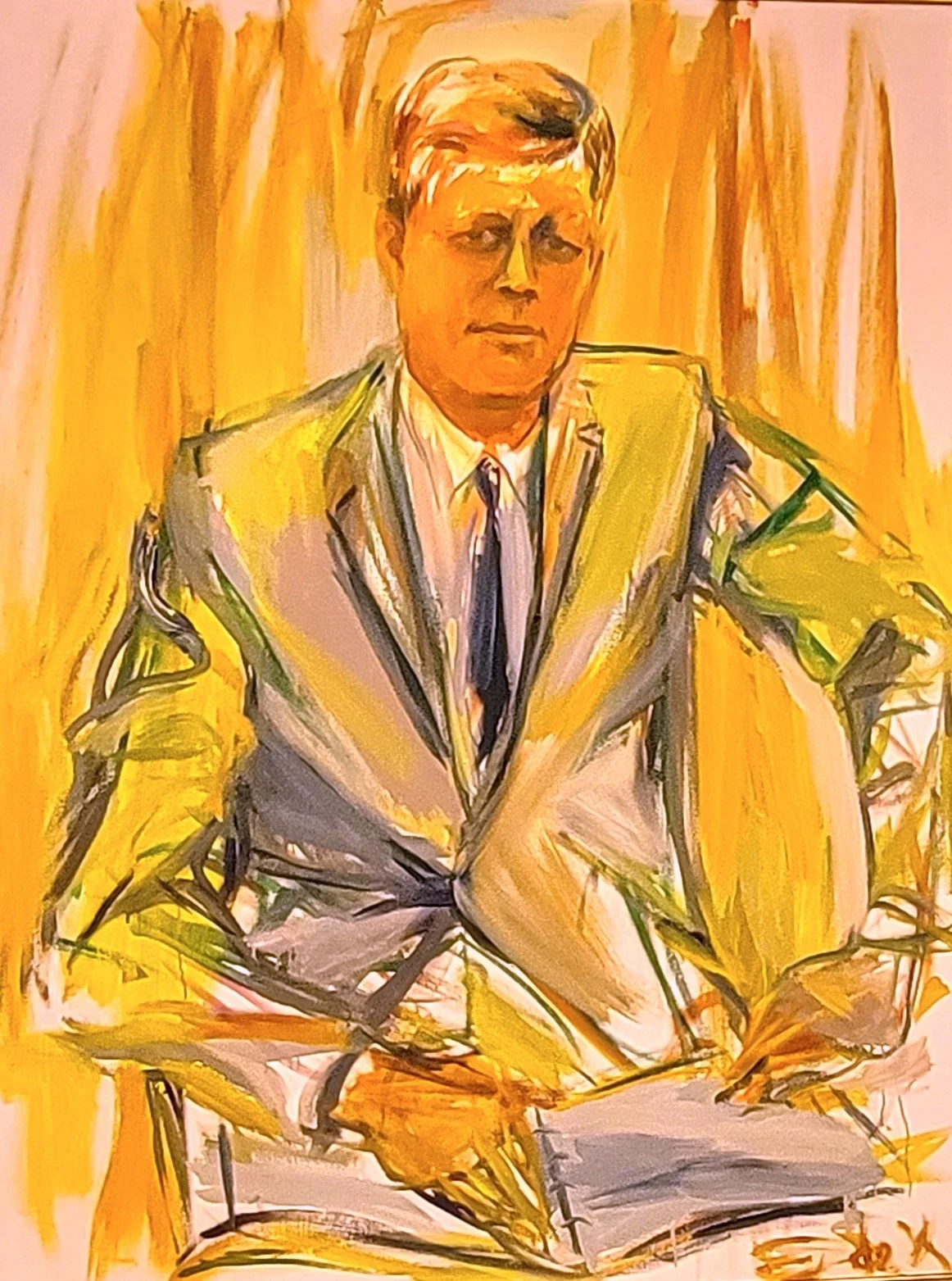
The Truman Library’s Kennedy portrait by Elaine de Kooning.
De Kooning met and painted Molberg’s family members beginning in the late 1960s, a few years after the Kennedy work elevated her market for commissioned portraits. A great aunt, Yvonne Collins, was married to a Texas insurance mogul and art collector, who commissioned his wife’s portrait in 1967. Grandmother Sue Deakins, of Tyler, Texas, sat for de Kooning two years later. She was a onetime English teacher who would instill in Molberg her love of reading and literature. Sue Deakins was deeply interested in the arts, and in 1972 she arranged an exhibit of de Kooning’s portraits at the Tyler Museum of Art. There was a memorable gathering at the Deakins home, Molberg tells me, of which stories are told that largely involve the fact that de Kooning had not yet given up drinking.
Molberg’s family members still possess many works by de Kooning, including several of the countless charcoal sketches, drawings and preliminary paintings she made in preparing for the final JFK oil portraits. Sue Deakins corresponded with de Kooning for years, until the artist’s death from lung cancer, at almost 71, in 1989. Deakins is alive and well, now 89 in Dallas, having moved there recently from Tyler to be closer to her daughter, Molberg’s mother. Molberg, of course, has the family scrapbooks and de Kooning’s letters to enrich her own work.
All of that material evidence and intellectual energy have become Molberg’s passion as she works toward a book of personal essays and poems tracing de Kooning’s presence in her own life. Thanks to an Inspiration Grant from Arts KC she was able to travel earlier this year to de Kooning’s former home and studio, still largely preserved by a new owner, in the Long Island, New York, enclave of East Hampton.
And she was pleasantly surprised—what? another coincidence?—to learn that de Kooning’s memorable portraits of John F. Kennedy include not only the full-length painting that hangs at the National Portrait Gallery in Washington and those in the hands of her family, but also the one right here at the Truman Library.
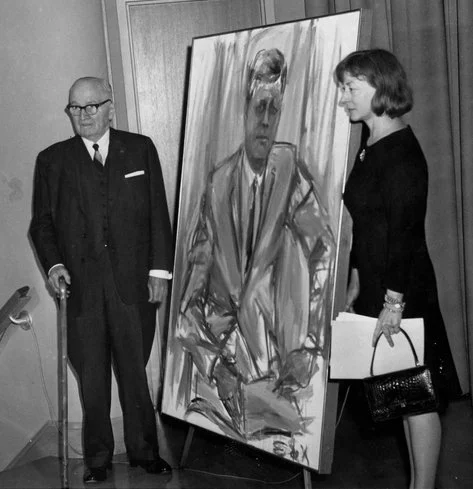
Former President Harry Truman with Elaine de Kooning and her JFK portrait, Feb. 11, 1965. (Harry S Truman Librrary)
Part II
On Feb. 11, 1965, Harry S Truman met the painter Elaine de Kooning for the first time as she presented her new portrait of another American president, John F. Kennedy, to the Truman Library in Independence.
In the preserved video of the dedication ceremony, there is laughter during a photo opp when Truman is encouraged to move from where he stood on one side of the painting to join de Kooning on the other end.
In the moment, Truman refrained from commenting on the painting per se, but he thanked de Kooning for the hard work and noted how the portrait would expand the institution’s holdings relating to the history of the U.S. presidency.
De Kooning said she was honored to have her work in the vicinity of Thomas Hart Benton’s recent-vintage library mural, “Independence and the Opening of the West,” which she called “his masterpiece.” And she expressed hope that Truman would “get used to my portrait,” recognizing its expressionistic freedoms and jaunty colors as a departure from traditionally heroic, realistic renderings of important people.
She went on to describe her painstaking process over many months to capture the radiant essence and dignity of the late president as a man ready to spring into action.
The Truman Library’s painting—and all of de Kooning’s other JFK paintings and sketches she made at the time—began as a commission suggested in 1962 by a New York art dealer, Robert Graham. Graham was visiting the library that fall with Benton when the discussion began with its administrators. Graham had a school-boy connection with President Kennedy, which helped move things along.
If Graham expected push-back from either Kennedy or Harry Truman on his promotion of de Kooning as the portrait artist, it never materialized, according to the gallerist’s correspondence in both the Archives of American Art and the Truman Library.
And as Cathy Curtis, author of a recent biography of de Kooning, writes, “In a practical sense, her reputation for rapidly completing a portrait made her the ideal artist to paint a famously restless head of state.”
At the time, when the subject was brought up at the White House, the president was too busy to sit for an artist, though an opportunity arose during the Christmas holidays while the Kennedy family would be at the winter White House in Palm Beach, Fla.
De Kooning spent a reported 20 hours over nearly two weeks jumping from her sketchpad, where she put charcoal to work, to her easels, where she began oil paintings. Her sessions with the president were often informal but also took place when he was conducting business. During one meeting, a conference on Medicare, she sketched him while standing on a ladder. After the live sessions, she spent most of 1963 working on nothing else but her multiple canvases—“thirty-six canvases going at once,” she’d say.
In the spring of 2024, Jenny Molberg, a Kansas City poet and teacher on a year-long sabbatical from the University of Central Missouri in Warrensburg, stood in the high-ceilinged, naturally lighted studio space in East Hampton, Long Island, where de Kooning eventually settled. Molberg has been following a trail that begins in the 1960s, when de Kooning painted portraits of Molberg’s grandfather and uncle, a great-aunt, and her beloved grandmother, who remained a friend of the artist for many years. De Kooning once gave a JFK sketch to her uncle as a memento, and it remains a cherished family possession.
Molberg has been working on poems and essays springing from her exploration into de Kooning’s life and work, planning eventually to produce a book.
“I've been really interested in what Elaine says about men as her subjects,” Molberg tells me, “especially in light of the fact that portrait painting may have seemed ‘domestic’ to her male contemporaries in the Abstract Expressionist movement (it was her way of making money when she lived beyond her means, which was...always). I think she thought a lot about the gender dynamics of a woman painter making portraits of men, when for so long men were the sole possessors of the muse/the nude female body/the sexualized body in art. Elaine once said, ‘Men always painted the opposite sex, and I wanted to paint men as objects.’”
One day last fall, Mark Adams, the Truman museum curator, and John Miller, its registrar, brought de Kooning’s JFK portrait out of temperature-controlled storage and placed it on a chair in a conference room. I sat across from it to see what I could see, to see what doesn’t come across in photographs or reproductions as I’d been encountering them in books and elsewhere.
I’d hoped to share the viewing with Jenny Molberg but our timelines didn’t mesh—my travels and deadlines, her travels and back surgery—and I knew she would have another opportunity during her own project’s trajectory.
As I sat there with the painting, I thought about that horrible day, the one that for those of us alive at the time, can’t be forgotten—Nov. 22, 1963. I was 10 years old, sitting in the fifth-grade classroom in the Longfellow School, Sanford, Maine, where a black and white television was soon rolled in on a cart.
I thought about Camelot, the promise of the “New Frontier,” the mythic aura of the Kennedy presidency with which de Kooning’s modern sensibilities aimed to connect on canvas. I thought, sorry to say, about the despicable caricature of a human being who has disrupted American life for a decade now in a narcissistic search to fill presidential shoes that have and will never fit him.
My eyes searched the painting up and down—it’s about four feet wide and nearly five and a half feet tall—to finally focus on the four-ring binder where Kennedy’s hands seemed to rest in mid-executive action.
I thought about the brilliance of de Kooning’s strategy to incorporate streaks of bright white, remnants of the Florida sun, which splashed through the patio where JFK sat and squirmed as she sketched and painted in early January 1963.
The white space offers breathing room in the painting, as if the light from above were telling us something about her subject, as if she were inviting viewers to fill those open areas with their own memories, visions, thoughts, and feelings about the fallen president and their own lives. Others may see in it a sense of incompletion that rightfully accompanies a life cut short
The writer Thurston Clarke, speaking a decade ago about his book, JFK’s Last Hundred Days, found a different conclusion in de Kooning’s experience. “I don't think you can ever get as far as you want to with Kennedy because he was secretive and so complicated, and he compartmentalized so much,” he told an audience at the John F. Kennedy Library and Museum in Boston. “In fact, if you look at the beginning of the book — I open with Elaine de Kooning, who was essentially driven crazy by trying to capture his essence into a single portrait for the Truman Library and ended up doing nothing but painting Kennedy for a whole year, doing 30 oil paintings, covering the walls of her studio with drawings and sketches and everything of Kennedy. So you can never get to the final thing.”
We can certainly argue with Clarke’s phrase that de Kooning was “doing nothing.” The evidence in front of me, in the Truman Library conference room, happens to argue otherwise.
In the end, the vectors of memory are unpredictable as they zing through that infinite universe between our ears. Artists and writers might be especially attuned to grasp those signals as they pass.
Anxiety over de Kooning’s portrait project increased after Kennedy’s death. De Kooning felt a new obligation to get it just right, but was somewhat paralyzed to continue, according to some accounts. Within days of the assassination Truman Library officials were hoping her portrait could be in their hands to go on public display as soon as possible. Yet it would be another year before Robert Graham and President Kennedy’s inner circle agreed on which of de Kooning’s paintings they preferred to go to the Truman Library. Another one would soon be acquired by Jacqueline Kennedy, and other versions eventually landed at the Kennedy Library in Boston, development plans for which were already under way, and the National Portrait Gallery in Washington, D.C.
De Kooning recounted her experience making the portrait in her introductory remarks in Independence.
“When I first laid eyes on President Kennedy, December 28, 1962, at ten o'clock in the morning, I arrived carrying the world's image of him. The one thing wrong with that image was that it missed the great color. The image was black, white and grey, and it missed the hoping great scale, the tremendous physical presence of the man. So for one split second I did not recognize him. He was bigger and more radiant than any reproduction had indicated.”
She also summed up her idea as it evolved: “The colors were chosen, not to convey a realistic sense of a gray flannel suit worn by a man with a tan—but rather to attempt to communicate the brightness and high color of the man as I saw him. Also, I wanted to capture his quality of readiness, as though he was about to spring from his chair. And to get the frown and the smile at once—the sharp, appraising glance.”
The day after the presentation in Independence, de Kooning’s painting took center stage in an exhibit for the public at the Kansas City Art Institute’s Charlotte Kemper Gallery. The sunny and striking portrait of Kennedy was accompanied by 38 other sketches and paintings and one abstract bronze sculpture. The exhibit ran for three weeks.
Jenny Molberg joined me on a brief research visit to the library at the Nelson-Atkins Museum, where we paged through the catalogue of that KCAI exhibit. Here was a full-page reproduction of the Truman painting; here was a photograph of de Kooning beginning a sketch of the president in Palm Beach; here were sketches dated Dec. 28, 1962, the first day of her project and the same date as the one in Molberg’s family.
Molberg’s reflections on de Kooning certainly embrace the JFK period, but she is traveling far beyond it.
“I've started thinking about the lyricism in her abstract paintings,” Molberg says, “but maybe more importantly about the narrative aspects of her portraiture. How is she reaching back into the history of portraiture, engaging with the canon (as it were)? How is she flipping gender expectations?”
Perhaps some of those questions will now come to mind whenever the public has a rare opportunity to view de Kooning’s JFK portrait at the Truman Library.
Postrcript: Jenny Molberg’s next book of poems, The Medium, will cover the ground she describes in this story, with Elaine de Kooning at its core. It is scheduled to be published by the Louisiana State University Press in February 2027.