poetry

How the Story of an Artist, a Painting, Two Presidents and a Contemporary Poet Unexpectedly Intertwines

The Truman Library is putting some significant American documents on display this spring (April 20–May 24) as part of the 250th anniversary of the nation’s founding. Along with such treasures as a broadside marking the Treaty of Paris (1983), which ended the Revolutionary War, the Louisiana Purchase, and numerous consequential Supreme Court decisions, the library is pulling out of storage one of its more unusual holdings—the painter Elaine de Kooning’s portrait of President John F. Kennedy. The president sat for de Kooning over the winter holidays in late 1962 and early 1963 and she spent much of the following year producing numerous sketches and more than 30 canvases. The Library acquired the portrait in 1965 and de Kooning was on hand to present it to Harry Truman himself in a photo op in Independence.

 The portrait doesn’t go on display very often. I had the chance to see it up close a couple of years ago when I was digging into the painting’s history and tripping over a parallel story that I couldn’t resist telling. I wrote a two-part series for KC Studio magazine, which appeared November-December 2024 and January-February 2025.

 I’ve combined the two texts (making some slight edits along the way) into a single piece here.


            While gathering material and sifting archival sands for the book project I’m currently immersed in, a digression presented itself, as they often and relentlessly do. If you are more laser-focused and on-task than I am, you might have let the impulse go. But that would be you. I couldn’t help myself. So I pinballed from one thing to another.

            The first thing I was searching for was a poem by William Stafford, the Kansas and Oregon sage, which he wrote following the assassination of President John F. Kennedy in 1963. The second thing, united to the first by a random leap of mind and of digital data-mining, was a portrait of JFK made by the painter Elaine de Kooning. Sixty years ago, in January 1965, she presented the Kennedy portrait to former President Harry S Truman and his Truman Library in Independence.

            Now this bit of local history would most likely have led me to tell the straightforward story of de Kooning’s painting and the happy occurrence of its little-remembered residency in the presidential museum in our midst. (It’s not often on display.) That indeed was the plan. But, again, the underlining thread here is my old and comforting friend serendipity—how chance and coincidence manage to make our lives unpredictable if not ever-intriguing.

            It happened like this. At a late summer poetry reading, in a cozy Kansas City cocktail lounge, I listened to Jenny Molberg begin to describe her current interest in reclaiming the stories of female artists who happened to be overshadowed or ignored because they were married to artists who got all the attention. I wondered what she might have known about Elaine de Kooning. Flash forward a millisecond when she revealed that she knew much about Elaine de Kooning, because Elaine de Kooning was a friend of her family. Elaine de Kooning painted portraits of at least four of Molberg’s family members, including her beloved grandmother. That was merely the beginning.

            Jenny Molberg, Ph.D., is on the English and creative writing faculty at the University of Central Missouri in Warrensburg. She’s editor of the literary journal Pleiades and author of three books of poetry. (2026 updates, she now teaches at Emerson College in Boston and is editor-in-chief of its literary magazine, Ploughshares.) Most recent of those books is The Court of No Record (Louisiana State University Press), some of which she highlighted in September in the monthly Speakeasy poetry series at Swordfish Tom’s, the basement-level, hipster-magnet home of high-grade cocktails in the Crossroads. Her poetry is brash, bawdy, brutally honest about violence done to women, and has a self-defined bitchiness. It’s full-throated, 21st-century feminist, that is.

            Molberg is also in her second year of a writing residency at the Charlotte Street Foundation. While on sabbatical last spring she read the book Ninth Street Women, by Mary Gabriel, a group portrait of de Kooning and four other painter friends in her New York world. That jump-started her interest. Then, a chance discovery made while talking with a fellow Charlotte Street artist helped her decide that “Elaine was speaking to me.”

De Kooning was an accomplished though often less-regarded member of the circle of artists who defined the Abstract Expressionist movement of the 1950s, including her husband, Willem de Kooning. She carved out a specialty in figure painting and soulful portraits, making memorable canvases of artists and writers such as Alex Katz, Fairfield Porter, Frank O’Hara, John Ashbery, and her husband. Porter once noted how portraiture liberated de Kooning and well served her unique talents as a painter. In 1963, the year she labored over her JFK project, she also painted a heroically scaled group portrait, stretching nearly 14 feet wide. It presented the figures of nine young, otherwise anonymous men—most were revealed to be patients in a drug rehabilitation facility—titled “The Burghers of Amsterdam Avenue.”
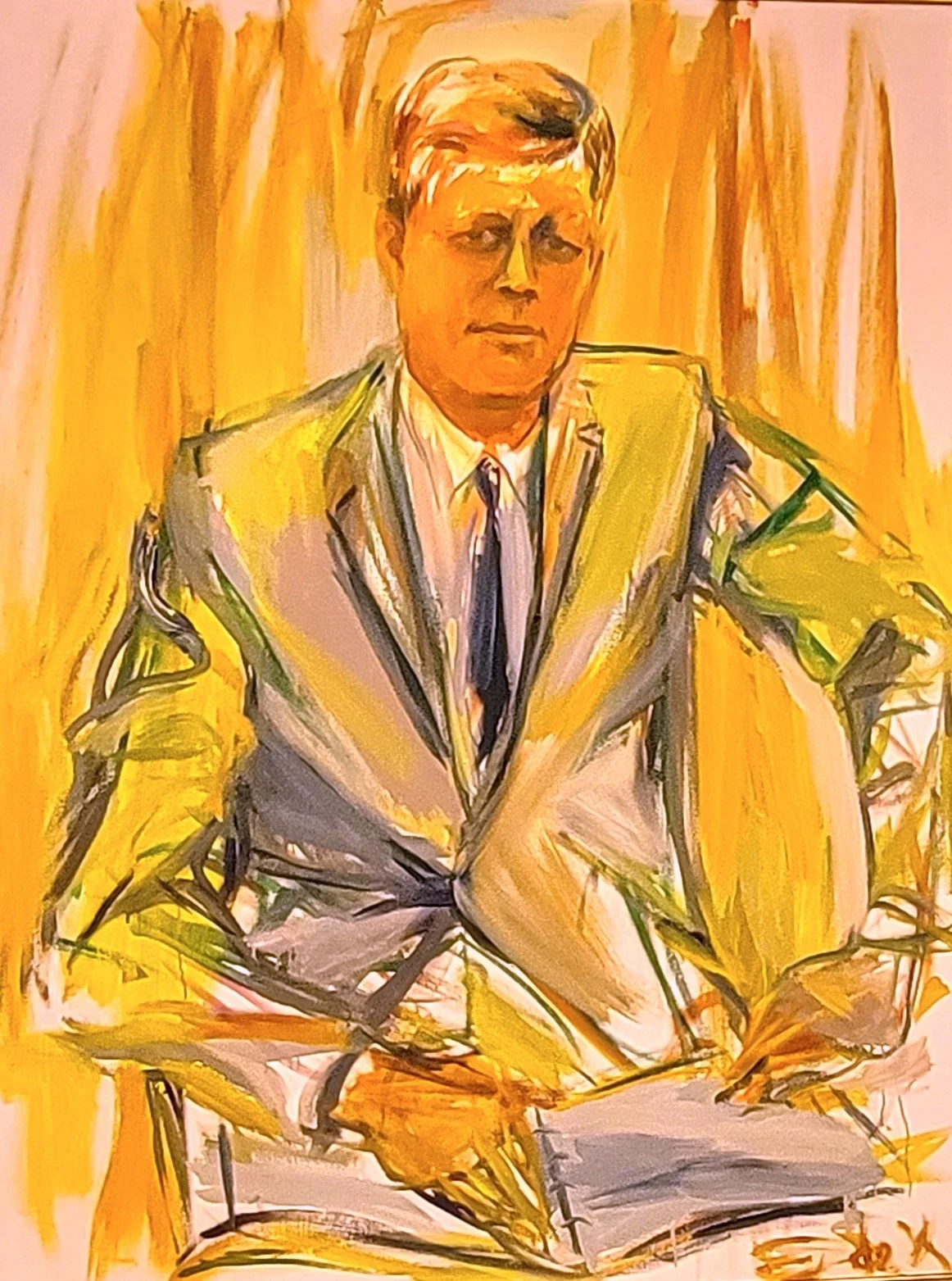
The Truman Library’s Kennedy portrait by Elaine de Kooning.

De Kooning met and painted Molberg’s family members beginning in the late 1960s, a few years after the Kennedy work elevated her market for commissioned portraits. A great aunt, Yvonne Collins, was married to a Texas insurance mogul and art collector, who commissioned his wife’s portrait in 1967. Grandmother Sue Deakins, of Tyler, Texas, sat for de Kooning two years later. She was a onetime English teacher who would instill in Molberg her love of reading and literature. Sue Deakins was deeply interested in the arts, and in 1972 she arranged an exhibit of de Kooning’s portraits at the Tyler Museum of Art. There was a memorable gathering at the Deakins home, Molberg tells me, of which stories are told that largely involve the fact that de Kooning had not yet given up drinking. 

            Molberg’s family members still possess many works by de Kooning, including several of the countless charcoal sketches, drawings and preliminary paintings she made in preparing for the final JFK oil portraits. Sue Deakins corresponded with de Kooning for years, until the artist’s death from lung cancer, at almost 71, in 1989. Deakins is alive and well, now 89 in Dallas, having moved there recently from Tyler to be closer to her daughter, Molberg’s mother. Molberg, of course, has the family scrapbooks and de Kooning’s letters to enrich her own work.

            All of that material evidence and intellectual energy have become Molberg’s passion as she works toward a book of personal essays and poems tracing de Kooning’s presence in her own life. Thanks to an Inspiration Grant from Arts KC she was able to travel earlier this year to de Kooning’s former home and studio, still largely preserved by a new owner, in the Long Island, New York, enclave of East Hampton.

            And she was pleasantly surprised—what? another coincidence?—to learn that de Kooning’s memorable portraits of John F. Kennedy include not only the full-length painting that hangs at the National Portrait Gallery in Washington and those in the hands of her family, but also the one right here at the Truman Library.
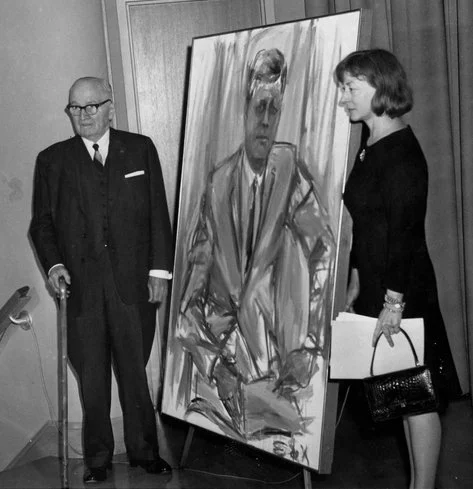
 

Former President Harry Truman with Elaine de Kooning and her JFK portrait, Feb. 11, 1965. (Harry S Truman Librrary)

Part II

            On Feb. 11, 1965, Harry S Truman met the painter Elaine de Kooning for the first time as she presented her new portrait of another American president, John F. Kennedy, to the Truman Library in Independence.

            In the preserved video of the dedication ceremony, there is laughter during a photo opp when Truman is encouraged to move from where he stood on one side of the painting to join de Kooning on the other end.

            In the moment, Truman refrained from commenting on the painting per se, but he thanked de Kooning for the hard work and noted how the portrait would expand the institution’s holdings relating to the history of the U.S. presidency.

            De Kooning said she was honored to have her work in the vicinity of Thomas Hart Benton’s recent-vintage library mural, “Independence and the Opening of the West,” which she called “his masterpiece.” And she expressed hope that Truman would “get used to my portrait,” recognizing its expressionistic freedoms and jaunty colors as a departure from traditionally heroic, realistic renderings of important people.

            She went on to describe her painstaking process over many months to capture the radiant essence and dignity of the late president as a man ready to spring into action.

            The Truman Library’s painting—and all of de Kooning’s other JFK paintings and sketches she made at the time—began as a commission suggested in 1962 by a New York art dealer, Robert Graham. Graham was visiting the library that fall with Benton when the discussion began with its administrators. Graham had a school-boy connection with President Kennedy, which helped move things along.

            If Graham expected push-back from either Kennedy or Harry Truman on his promotion of de Kooning as the portrait artist, it never materialized, according to the gallerist’s correspondence in both the Archives of American Art and the Truman Library.

            And as Cathy Curtis, author of a recent biography of de Kooning, writes, “In a practical sense, her reputation for rapidly completing a portrait made her the ideal artist to paint a famously restless head of state.”

            At the time, when the subject was brought up at the White House, the president was too busy to sit for an artist, though an opportunity arose during the Christmas holidays while the Kennedy family would be at the winter White House in Palm Beach, Fla.

            De Kooning spent a reported 20 hours over nearly two weeks jumping from her sketchpad, where she put charcoal to work, to her easels, where she began oil paintings. Her sessions with the president were often informal but also took place when he was conducting business. During one meeting, a conference on Medicare, she sketched him while standing on a ladder. After the live sessions, she spent most of 1963 working on nothing else but her multiple canvases—“thirty-six canvases going at once,” she’d say.

            In the spring of 2024, Jenny Molberg, a Kansas City poet and teacher on a year-long sabbatical from the University of Central Missouri in Warrensburg, stood in the high-ceilinged, naturally lighted studio space in East Hampton, Long Island, where de Kooning eventually settled. Molberg has been following a trail that begins in the 1960s, when de Kooning painted portraits of Molberg’s grandfather and uncle, a great-aunt, and her beloved grandmother, who remained a friend of the artist for many years. De Kooning once gave a JFK sketch to her uncle as a memento, and it remains a cherished family possession.

            Molberg has been working on poems and essays springing from her exploration into de Kooning’s life and work, planning eventually to produce a book.

            “I've been really interested in what Elaine says about men as her subjects,” Molberg tells me, “especially in light of the fact that portrait painting may have seemed ‘domestic’ to her male contemporaries in the Abstract Expressionist movement (it was her way of making money when she lived beyond her means, which was...always). I think she thought a lot about the gender dynamics of a woman painter making portraits of men, when for so long men were the sole possessors of the muse/the nude female body/the sexualized body in art. Elaine once said, ‘Men always painted the opposite sex, and I wanted to paint men as objects.’”

            One day last fall, Mark Adams, the Truman museum curator, and John Miller, its registrar, brought de Kooning’s JFK portrait out of temperature-controlled storage and placed it on a chair in a conference room. I sat across from it to see what I could see, to see what doesn’t come across in photographs or reproductions as I’d been encountering them in books and elsewhere.

            I’d hoped to share the viewing with Jenny Molberg but our timelines didn’t mesh—my travels and deadlines, her travels and back surgery—and I knew she would have another opportunity during her own project’s trajectory.

            As I sat there with the painting, I thought about that horrible day, the one that for those of us alive at the time, can’t be forgotten—Nov. 22, 1963. I was 10 years old, sitting in the fifth-grade classroom in the Longfellow School, Sanford, Maine, where a black and white television was soon rolled in on a cart.

            I thought about Camelot, the promise of the “New Frontier,” the mythic aura of the Kennedy presidency with which de Kooning’s modern sensibilities aimed to connect on canvas. I thought, sorry to say, about the despicable caricature of a human being who has disrupted American life for a decade now in a narcissistic search to fill presidential shoes that have and will never fit him.

            My eyes searched the painting up and down—it’s about four feet wide and nearly five and a half feet tall—to finally focus on the four-ring binder where Kennedy’s hands seemed to rest in mid-executive action.

            I thought about the brilliance of de Kooning’s strategy to incorporate streaks of bright white, remnants of the Florida sun, which splashed through the patio where JFK sat and squirmed as she sketched and painted in early January 1963.

            The white space offers breathing room in the painting, as if the light from above were telling us something about her subject, as if she were inviting viewers to fill those open areas with their own memories, visions, thoughts, and feelings about the fallen president and their own lives. Others may see in it a sense of incompletion that rightfully accompanies a life cut short

            The writer Thurston Clarke, speaking a decade ago about his book, JFK’s Last Hundred Days, found a different conclusion in de Kooning’s experience. I don't think you can ever get as far as you want to with Kennedy because he was secretive and so complicated, and he compartmentalized so much,” he told an audience at the John F. Kennedy Library and Museum in Boston. “In fact, if you look at the beginning of the book — I open with Elaine de Kooning, who was essentially driven crazy by trying to capture his essence into a single portrait for the Truman Library and ended up doing nothing but painting Kennedy for a whole year, doing 30 oil paintings, covering the walls of her studio with drawings and sketches and everything of Kennedy. So you can never get to the final thing.”

            We can certainly argue with Clarke’s phrase that de Kooning was “doing nothing.” The evidence in front of me, in the Truman Library conference room, happens to argue otherwise.

            In the end, the vectors of memory are unpredictable as they zing through that infinite universe between our ears. Artists and writers might be especially attuned to grasp those signals as they pass.


            Anxiety over de Kooning’s portrait project increased after Kennedy’s death. De Kooning felt a new obligation to get it just right, but was somewhat paralyzed to continue, according to some accounts. Within days of the assassination Truman Library officials were hoping her portrait could be in their hands to go on public display as soon as possible. Yet it would be another year before Robert Graham and President Kennedy’s inner circle agreed on which of de Kooning’s paintings they preferred to go to the Truman Library. Another one would soon be acquired by Jacqueline Kennedy, and other versions eventually landed at the Kennedy Library in Boston, development plans for which were already under way, and the National Portrait Gallery in Washington, D.C.

            De Kooning recounted her experience making the portrait in her introductory remarks in Independence.

            “When I first laid eyes on President Kennedy, December 28, 1962, at ten o'clock in the morning, I arrived carrying the world's image of him. The one thing wrong with that image was that it missed the great color. The image was black, white and grey, and it missed the hoping great scale, the tremendous physical presence of the man. So for one split second I did not recognize him. He was bigger and more radiant than any reproduction had indicated.”

            She also summed up her idea as it evolved: “The colors were chosen, not to convey a realistic sense of a gray flannel suit worn by a man with a tan—but rather to attempt to communicate the brightness and high color of the man as I saw him. Also, I wanted to capture his quality of readiness, as though he was about to spring from his chair. And to get the frown and the smile at once—the sharp, appraising glance.”

            The day after the presentation in Independence, de Kooning’s painting took center stage in an exhibit for the public at the Kansas City Art Institute’s Charlotte Kemper Gallery. The sunny and striking portrait of Kennedy was accompanied by 38 other sketches and paintings and one abstract bronze sculpture. The exhibit ran for three weeks.

            Jenny Molberg joined me on a brief research visit to the library at the Nelson-Atkins Museum, where we paged through the catalogue of that KCAI exhibit. Here was a full-page reproduction of the Truman painting; here was a photograph of de Kooning beginning a sketch of the president in Palm Beach; here were sketches dated Dec. 28, 1962, the first day of her project and the same date as the one in Molberg’s family.

            Molberg’s reflections on de Kooning certainly embrace the JFK period, but she is traveling far beyond it.

            “I've started thinking about the lyricism in her abstract paintings,” Molberg says, “but maybe more importantly about the narrative aspects of her portraiture. How is she reaching back into the history of portraiture, engaging with the canon (as it were)? How is she flipping gender expectations?”

            Perhaps some of those questions will now come to mind whenever the public has a rare opportunity to view de Kooning’s JFK portrait at the Truman Library.

Postrcript: Jenny Molberg’s next book of poems, The Medium, will cover the ground she describes in this story, with Elaine de Kooning at its core. It is scheduled to be published by the Louisiana State University Press in February 2027.
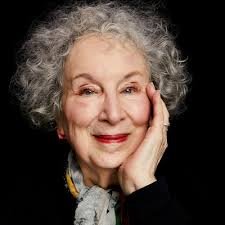
From the Archives: Reading and Interviewing Margaret Atwood, 1993-2022

By STEVE PAUL

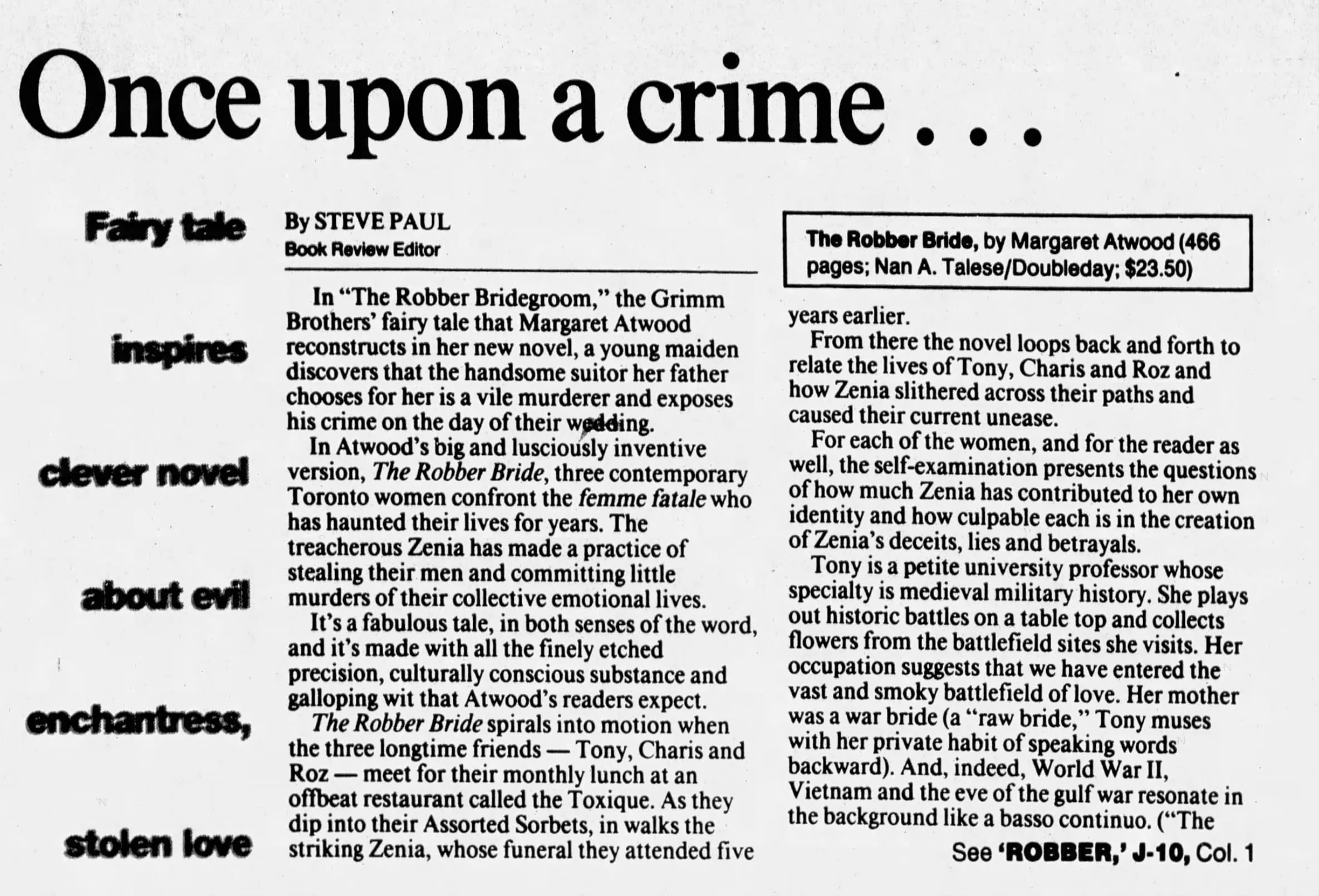
With Margaret Atwood coming to Kansas City soon for a library talk (Sept. 24), I thought I’d dredge up a couple of related old pieces. I had the opportunity to meet and interview Atwood in 1993 at the annual American Booksellers Association confab (now Book Expo) in Miami. Her novel The Robber Bride was coming out that fall and her publisher had sent me an early copy of the book—so-called advance review copies were not yet ready, so they sent me a dupe of the typed manuscript. I’ll concede that my reading of Atwood was rather conventional if not underwhelming from today’s perspective. Then again, the interview with her remains enlightening.

In talking about the essential status of mythology in contemporary story-telling, one of the driving forces of her writing, she illustrated:

“One of the founding stories of U.S. culture is the biblical quotation ‘by their fruits they shall know them.’ It was originally intended spiritually—you know good people by how they behave. But it was interpreted by the Puritans to mean you can tell good people by how rich they are, which is with us today. It underlies so much literature in this culture—the idea of sin and redemption.”

Find reproductions of the two pieces, published Nov. 14, 1993 in the Kansas City Star, in three images below.

In more recent years, I had the pleasure of encountering Atwood at the Key West Literary Seminar. She spoke again about myth and fable. In my memory she talked about the movie “Aquaman” as a product of myth. The movie had just recently come out and she suggested that she watched it so we wouldn’t have to. (I still haven’t gotten around to it.) One morning in Key West, we ended up at a Duval Street CVS at the same time, where I met her husband, the writer Graeme Gibson. He would die just months later, as I recall.

Atwood happens to make a cameo appearance in my biography-in-progress of William Stafford. This goes back a ways to Atwood’s years as an emerging poet and fiction writer (her first novel was published in 1969). Shortly after being named Poetry Consultant to the Library of Congress for 1970-71, what we now call the U.S. Poet Laureate, Stafford put Atwood’s name on a short list of writers he would like to host during his tenure. He wanted to make sure women were represented on what was very much a male-dominated field. Sure enough, one of the first reading programs Stafford hosted in the fall of 1970 brought together Atwood and Galway Kinnell.

In 2022 I wrote to Atwood to see what she might recall of the event and/or Stafford. She kindly replied, hand-writing her response on my original letter and sending it back to me:

“I was 30! A very minor figure! …I love Wm Stafford’s poetry in book form—but he was a big cheese and I was a very small cheeselet.”

And here’s a blog bonus: An audio recording of the reading can be found at the Library of Congress website. Find it here and enjoy:

https://www.loc.gov/item/95770388/


A Suite of Jazz Poems

Over the last few years i’ve found a place for some of my jazz poems at JerryJazzMusician.com, a hand-built enterprise that offers a wide array of music-inspired study, commentary, history, and creative production. See the editor Joe Maita’s recent interview with Glenn Mott, who edited a collection of Stanley Crouch’s previously uncollected essays and critical pieces, Victory is Assured. (I wrote about Crouch’s book for KC Studio last September-October.) All well and good, but I thought it might be a decent idea to round up some of my poems that Joe has published. Given that my poetry practice remains mostly a private affair, I’m grateful for the outlet.

Piano

“In the creative state a man … lets down as it were a bucket into his subconscious…”
—E.M. Forster

.

Taking Forster’s bucket
into the unknown
like Keith Jarrett

in Bremen sailing
into pianissimo

pedals and digits and the dust
of oblivion all summoned
to transform silence

into a path where
bees sting where
hearts bleed where
buckets slosh and spill

torqued with bop and bounce,
they teeter back toward
stillness.

……………………..first published in New Letters

The Night I Heard Mose Allison Sing

Was in 1984, not yet 20 years after
I’d first heard that Southern drawl, soft
as cotton or Mississippi silt,
and those plaintive and wacky blues
lyrics that floated out of my little radio
in the night air.

But now, in the heart of the country,
Mose was looking academic, his gray hair
and beard neatly trimmed. He wore
a seersucker jacket.

At the piano, with a local bass player
and drummer I knew,
Mose first launched into a boogie-woogie
rhythm, with slightly skewed riffs, just
off balance. There was a maelstrom of
notes in double time, and I wondered,
as those sounds reached my ears, if I could characterize
it all as Looney-tunes meets Fats Waller meets Chopin.
Or maybe just Waller and Chopin, piano stars
of equal stature, I’d say.

Fifteen minutes into the piece, he shifted
to a darker place, then back to this
orchestral craziness. (Do you remember
this, Bob Bowman, deep in your string bass
aural archive? Would your fingers ever
recognize that jazz abandon again?)

Then we applauded Mose’s ear for a great
song, Percy Mayfield’s “Lost Mind,” and
I can still hear Mose sing, “If you would be so
kind as to help me find my mind…”*

After another offbeat tune,
Mose slowed down to sing
“Everybody’s Cryin’ Mercy,”
which speaks to us today
in the darkness: “people
running round in circles,
don’t know what they’re heading for.”*

I could name all of the songs he played,
because just now I found the notebook
where I wrote it all down, his tributes
to Duke Ellington, Willie Dixon
and the lesser-known Johnny Fuller,
a blues man who came out of Mississippi,
landed in Oakland and within 12 months
of this glorious Mose night
would be dead at an age we all hope to live past.

It looks like I must have written down
all the words, as Mose sang them, of “How
Much Truth,” not
knowing then one iota of what I know
30-plus years later about truth and whether
the world is “left without its daydream…
threatened by the works of man…Destined
for the frying pan.”*

Mose, dead now just one month
at the age of 89, took his piano
to the edge of chaos
more than once that night. That’s what
we live for, the truth and transformation
in music, crystalline moments that help us find
our lost minds and deliver meaning
in the love and the mist.

.

Quoted lyrics by Percy Mayfield (“Lost Mind”) and Mose Allison (“Everybody’s Cryin’ Mercy,” “How Much Truth”)

.

by Steve Paul

Body And Soul

The jazz man spoke
of his ancestors, the
lineage that brought
him to where he is.
Do not shine your
light on yourself, he

told the students
gathered around.
Honor the past,
honor the trials
of simple existence,
honor the pain and

blood that came
before you, and the
greatness that grew
despite all of that.
When he riffed

on “Body and Soul,”
the sounds coming
from all his circuits,
darting in and hinting
at the melody as we
knew it, reshaping,

and making the song his
own body in the moment,
his soul saxed message
was obvious, went
straight to the
heart and the blood.

.

by Steve Paul; in tribute to Logan Richardson

The Horn

The neighbor with
a trumpet stumbles
through “Watermelon

Man” on his porch,
an act to mitigate
loneliness perhaps

to reach beyond
the distance of
homeboundedness

“Lean on Me,” he
tries, knowing
we’ve lost the

songwriter who
made it an anthem
the notes skitter

around Withers’
melody like scouts
on a mission

securing the
perimeter,
protecting the

body and its
fragile
hymn.

.

by Steve Paul

Three Tiny Poems

Nutty

The twirler, the plinker-plunker
be minor, be diminished,
be neither of those things,
the waking, the daily glories,
the human scales
and ache-y arrows to heart, to ear,
I dream of Monkishness supreme

.

Ornithology

Bird call this morning is alto-sax heir of
that Bird, jabs and run-ons and then a melodic line
flits in again;

outside, the sun: dog on a leash,
finches galore stab at seeds,
everyone wonders
what else is there?

.

Havana Vibes

A conga player collides with “Pork-Pie
Hat,” the woman vibist fists two mallets,
follows bandmates into a driving, propulsive sound—
her stance languid, lanky, her long arms made moreso
as she stares into the music, now a Cuban bounce
thick like picadillo with piano and drums one on top of the other,
her mallets fly above like lightning bugs in the night.

From the Archives: A Chat With Robert Bly

As I’ve been delving into the life and work of William Stafford, on the way toward a possible biography, I couldn’t help but take a new interest in Robert Bly, who became an important champion of Stafford’s poetry. I was sorry to learn of Bly’s recent death. I’d been reading a new book about Bly’s raucous period as the argumentative editor of a small-press poetry journal, serially called The Fifties, The Sixties, and, finally, The Seventies (only one issue under that title). The book is Born Under the Sign of Odin, by Mark Gustafson. I had a few memories of hearing Bly read his work and presiding over a men’s workshop in Kansas City many years ago. Until I dug out an old file, I’d forgotten that I’d actually interviewed him, by phone, in 1992, in advance of one of his Kansas City events. This was at the height of Bly’s fame in the Iron John era, the work in which he explored the power and necessity of myth. So, here’s that piece, which first appeared in the Kansas City Star on October 15, 1992. It ran under the headline “Men's work: Poet Robert Bly uses yesterday's stories to touch today's lives.”  

By STEVE PAUL

Two years ago this fall Robert Bly underwent an unexpected rite of passage. 

  The Minnesota writer, author by then of more than a dozen volumes of poetry and prose, translator of 15 others by European and South American poets, and editor of a handful of anthologies, issued a book that, in the course of its long and still-beating shelf life, not only exceeded sales of all the rest but turned its thoughtful, white-maned author into a pop-culture personality. 

  The poet as media sensation! Unheard of.

  But Bly's book, Iron John: A Book About Men, captured the imagination of hundreds of thousands of readers. It also inspired widespread and vigorous discussion of the meaning of men's lives ("What Do Men Really Want?," Newsweek's cover eventually blared) and put Bly into the thick of a talk-show and speaking-tour whirlwind.

  But once you've seen the mountaintop of fame - People magazine chose Bly as one of the 25 most intriguing people of 1991 - how can you slip back into the contemplative and relatively unnoticed valley of the poet? 

  Bly says it's not at all difficult. The attention finally has waned, and he says he's sticking to his vow to take a year off from speaking and teaching and furthering his "men's work." His hiatus has been interrupted only by some prior commitments, including a speaking engagement Friday at Johnson County Community College and a daylong workshop for men Saturday at Avila College.

  "In general I've been wonderfully at home and lying down and reading and doing some poems," Bly says by telephone from his cabin - he calls it his writing place - at Moose Lake, Minn. "So I'm enjoying it a lot." 

  Bly says he wasn't totally unaccustomed to being in the public eye. He was an outspoken opponent of the Vietnam War, and with Kansas City poet David Ray, helped organize poets against the war through public readings and publications. That was a similar public expression of feeling, he says - an example, like Iron John, of "someone saying things that needed to be said." 

   "But," he adds, "it's no trouble to drop out at all and go back to writing poetry. Thoreau said, `When you give a speech, there's usually an occasion for it, and you give it to those who can hear.' Then he said, `When you write, you write for those who can understand, and the occasion is your whole life.' Isn't that wonderful?"

  Through a combination of ancient mythology, contemporary psychology, poetry and, especially, a deep reading of the "Iron John" fairy tales collected by the Grimm brothers early in the 19th century, Bly's book gave men and women an understanding of a great "father hunger," as Bly puts it, that has beset the lives of boys and men since the Industrial Revolution. 

  He touched many lives bound in confusion over the role of men in society. And, perhaps, he presented a moral touchstone to those set adrift in the greedy fervor of the 1980s.

  Long a student of ancient storytelling, Bly helped point readers to the archetypal lessons of mythology. "Mythology," he writes in Iron John, "helps to give weight to our private wounds Without the weight given by a wound consciously realized, the man will lead a provisional life."

  The book helped to bare the soul of a burgeoning "men's movement." For a decade Bly had been conducting weekend "wild man" retreats in the woods. The concept accelerated in early 1990 when Bill Moyers presented Bly and his men's work in a PBS special and hit warp-drive when Iron John appeared in November of that year, on its way to spending nearly 60 weeks on the hardcover best-seller lists.

  Ever since, books about men and their grief have proliferated, including, just this month, The Rag and Bone Shop of the Heart, a collection of 300 poems "for men," which Bly co-edited (HarperCollins; $25).

  Bly is gratified that his workshops, such as the one he'll conduct here Saturday, have opened up a new audience for poetry. 

  "Some of the complicated grief that men have is best described by poems," he says. "Poems make it more clear. Sociological language can't do it. Psychological language can't do it."

The emerging poet

  Bly's journey to the upper ranks of American poetry began on the farm in western Minnesota that his great-grandparents settled after immigrating from Norway. He served two years in the Navy in World War II, and it was there, he says, that he discovered the power of the poem. 

  "I met the first person I knew who wrote poetry in the Navy," Bly says. "He wrote a poem in front of me. I was stunned. I'd never seen anyone write a poem. I thought the books wrote them. It went something like, `The south side of Chicago is like a running sore on a large body.'

  "What did I know? To me, that was wonderful. The idea that someone could make up an image like that was amazing." 

  Bly then applied to Harvard University and got in. There he studied with Archibald MacLeish and joined what is now an impressive list of fellow writing students, including Donald Hall, Kenneth Koch, George Plimpton, John Hawkes and Adrienne Rich. 

  Bly opted against graduate school and chose instead "the old route of the person in the garret."

  "So I went to New York and made my living as a file clerk one day a week, a typist one day a week and, toward the end, a house painter. 

  "Those were wonderful years, because in a way I escaped graduate school and I had time to read and time to brood and be depressed."

  There was something wonderful about it, because here I had been at college and suddenly I was at the bottom of the whole heap and people could look at me and instantly understand that I was not very far away from being a bag man. 

  "In a way it took away my fear of falling. A lot of people think that if they don't do the right thing, the safe thing, they'll fall through their class."

  By 1962 Bly had published his first book of poems, Silence in the Snowy Fields. He came to prominence later in the decade with his opposition to the Vietnam War and his book The Light Around the Body (1968).

  In the wake of Iron John, several of his best-known poetry collections were reissued last year, including The Light Around the Body; The Man in the Black Coat Turns (1981), which explored father-son relationships; Loving a Woman in Two Worlds (1985); and Selected Poems (1986).

  This year HarperCollins published a collection of Bly's prose poems, What Have I Ever Lost By Dying? That book draws together work spanning more than 20 years, largely observations of nature, family and love. Because of the straightforward, detail-packed style of the prose-poem form, the work tends to be more immediately accessible than the more surreal dreamscapes of his lyrics.

  Bly says he plans another book like Iron John that will deal with several fairy tales. Before that will come a new collection of poems that he has been working on for some years. Many of the poems are about his father.

Easily misunderstood 

  Bly recognizes that his recent work and the movement it has fed are not universally admired.

  "Women have received so much depreciation from men," he says, "that they are justifiably afraid that when men get together they are liable to do something to women."

  The media is to blame, he says, for its oversimplifications and tendency to focus its images on the drum-beating extremes. Bly's metaphors of the inner wild man or soul warrior are easily

misinterpreted. ("Warrior doesn't mean you go to the gulf war," he has said elsewhere. "It means you fight inside your community for what is good.")

  "Most women get the big picture out of the media," he says, "and there's a lot of false pictures of it floating around  But some of the same things that are now being said about the men's movement were said about the women's movement when it began." 

  Typical of the criticism is April Bernard's recent assessment in The New Republic. Reviewing The Rag and Bone Shop of the Heart and another book of men's poetry, Bernard wrote: "While it would be unfair, of course, to fault men as a group for exploring their feelings, it could be argued that they have already done that, in what is loosely known as The History of Civilization."

   Bernard characterizes Bly as something of a huckster and particularly disingenuous, betrayed by his language, in his "claim to embrace women, or feminism."

  "For some of those young women feminists," Bly counters, "they are not writing about the book. They are attempting to establish themselves in the eyes of their women peers, and for that they've got to hit it hard."

  Bly has gone beyond the men-only approach by presenting workshops for both sexes in collaboration with Marion Woodman, a Jungian analyst in Toronto. A year ago he and Deborah Tannen, the popular author of You Just Don't Understand, a book about how men and women fail to communicate, gave a joint program in New York on "Men and Women Talking Together."

  Bly is adamant about the value for men and women in such soul-searching work.

  "I'm not a separatist in any way," he says. "I think that many women who participated in the women's movement 20 years ago did marvelous things. They helped to bring out pain and anger that hadn't been expressed, which really is important. Women now feel that something else is needed - it's time to stop attacking men and see if we can get along.

  "The people in the media seem to want more anger between men and women. They are always trying to get us to say something inflammatory. Men and women themselves want less anger and more reconciliation."

In Memoriam: Michelle Boisseau

This is a belatedly posted excerpt from a piece I wrote for KC Studio magazine. It first appeared online in December 2017 and in the Jan-Feb 2018 issue of the local arts journal.

MBPicforKCStudio002.jpg

Cancer had taken two siblings prematurely as well as her mother, and then, in mid-November, it took her, at the age of 62. But through it all, Michelle aimed the laser focus of her poet’s eye and the wisdom of her philosopher’s heart to carry her — and her inner circle of family and friends — through.

In fact, a predominant theme of her most recent book was how we face mortality. “You can’t talk// your way out of this impasse, said the crows,” she wrote in “Among the Gorgons,” her most recent collection of poems. She called this spiraling life we all engage in, the life that always takes us to death, “The Obstinate Comedy.” Just like her, she might have found the phrase in the work of Leigh Hunt, a London poet and critic of the 19th century known for his association with Keats and Shelley. But the places her poem takes you — “ahead of me something was// taking up all the space”; “each tree a history of flying in place” — are singularly hers, alive with balletic language, and now ours.

To read the whole thing: 

http://kcstudio.org/remembering-michelle-boisseau-legacy-language/