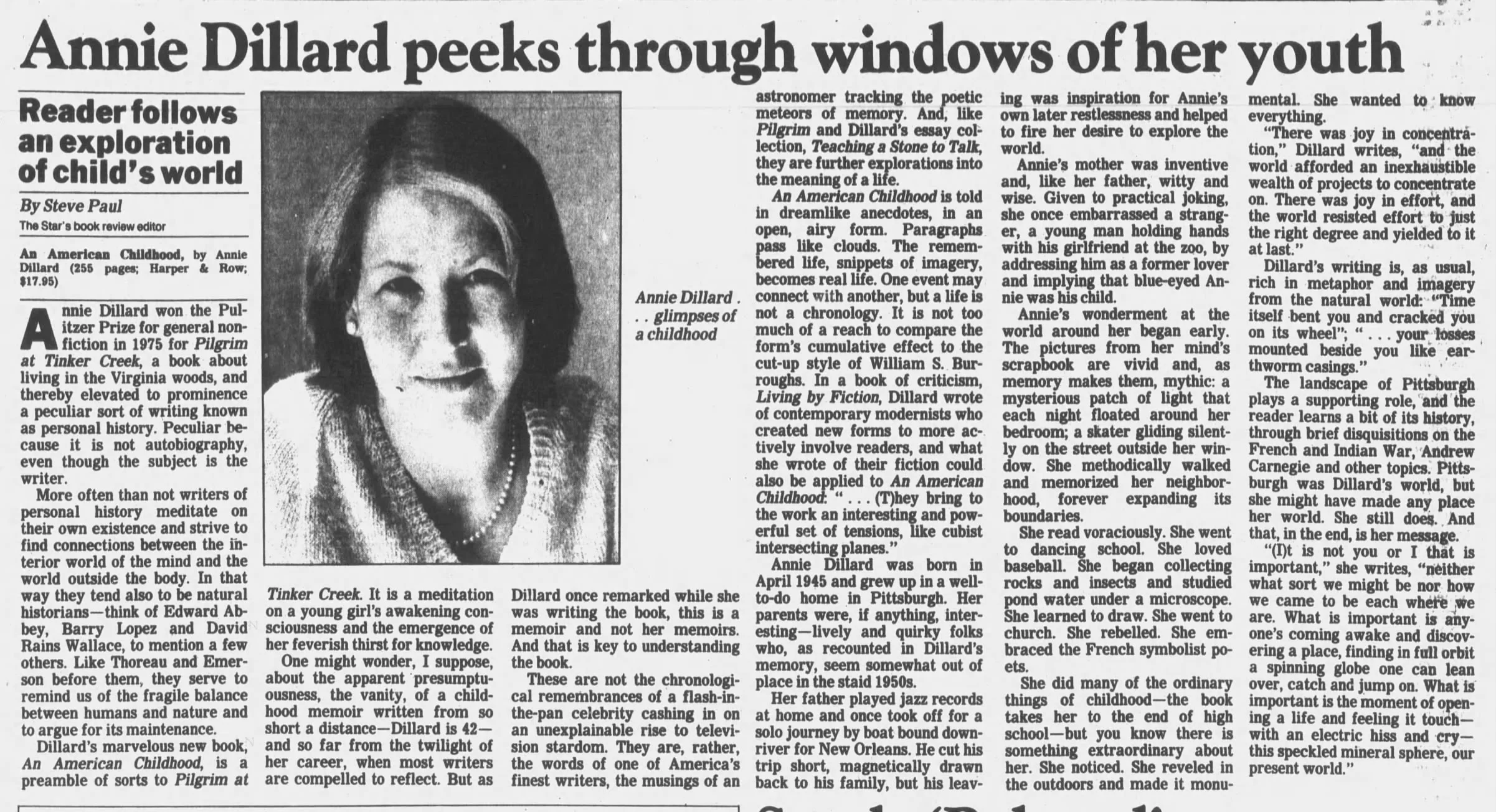
Annie Dillard’s death at 81 on September 15 had my brain cells spinning for a response. I gathered memories of recent encounters and the long record of her writing career, even a poem of mine in which she appears, and posted them in a Substack piece. Here is a review I wrote of Dillard’s mid-life memoir, An American Childhood, which ran in the Kansas City Star on September 20, 1987 (almost exactly 39 years ago). Apologies for the lame headline here, but I think the review holds up rather nicely.
steve paul
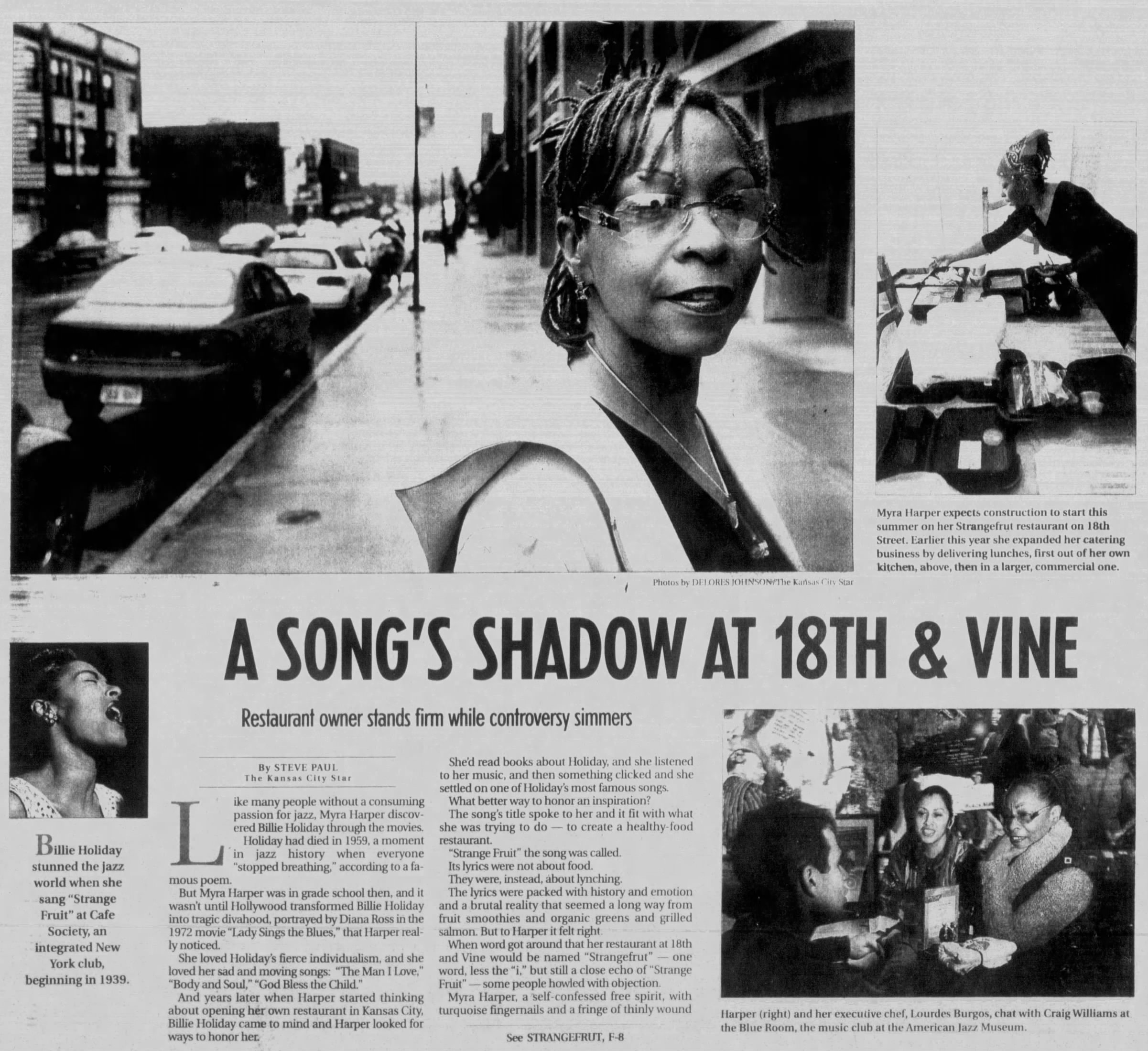
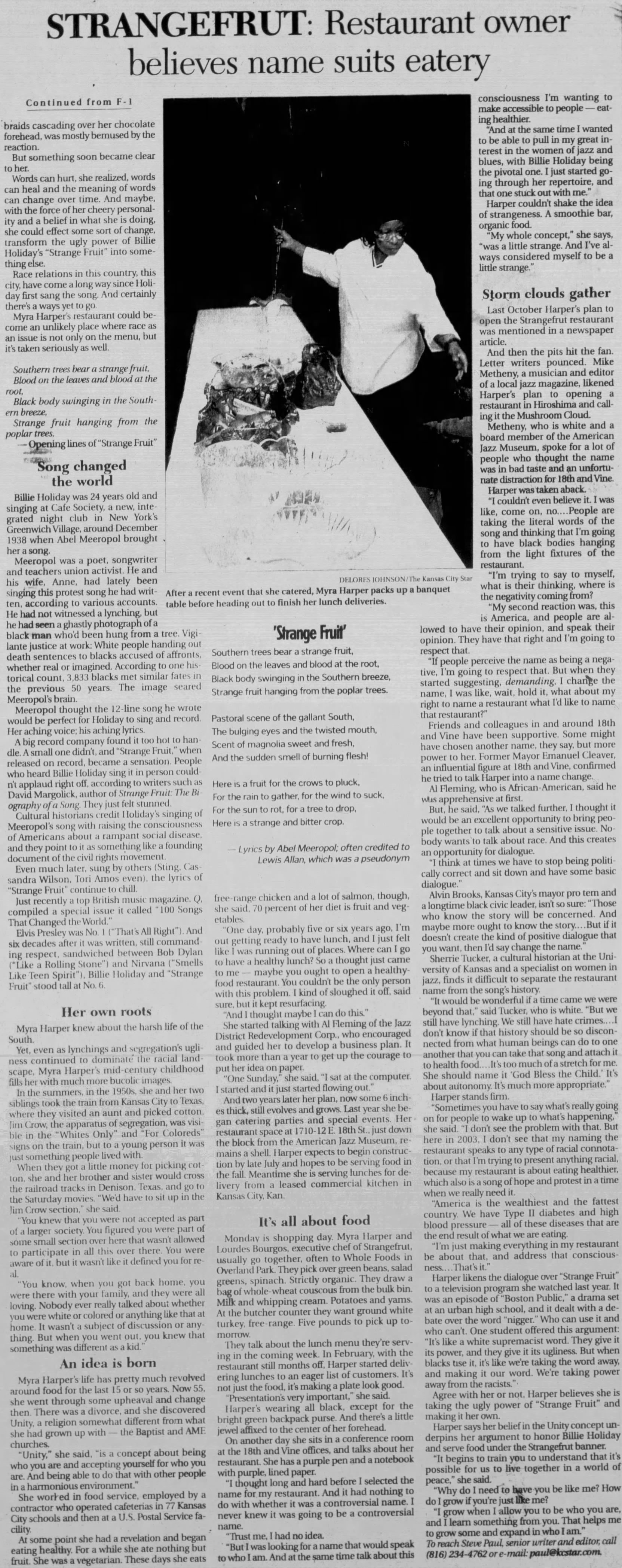
From the Archives: How Language, Race and History Collide in KC's Culinary History
Local news reports have noted, without much detail, that the plan to open a lounge in the burgeoning riverfront district of Kansas City has gone awry because of its intended name, Sundown Hi-Fi. The name was deemed too controversial for the district’s developers because of the word’s association with the ugly segregationist history of the American south. I thought it might be useful to note that a similar thing occurred in Kansas City more than two decades ago. Of course, my long profile piece about the matter, from 2003, doesn’t exist in The Kansas City Star’s often pitiful online archive, so I’ve retrieved it from newspapers.com.
From the Archives: Remembering Tracy Kidder, a Master of Non-Fiction Narrative
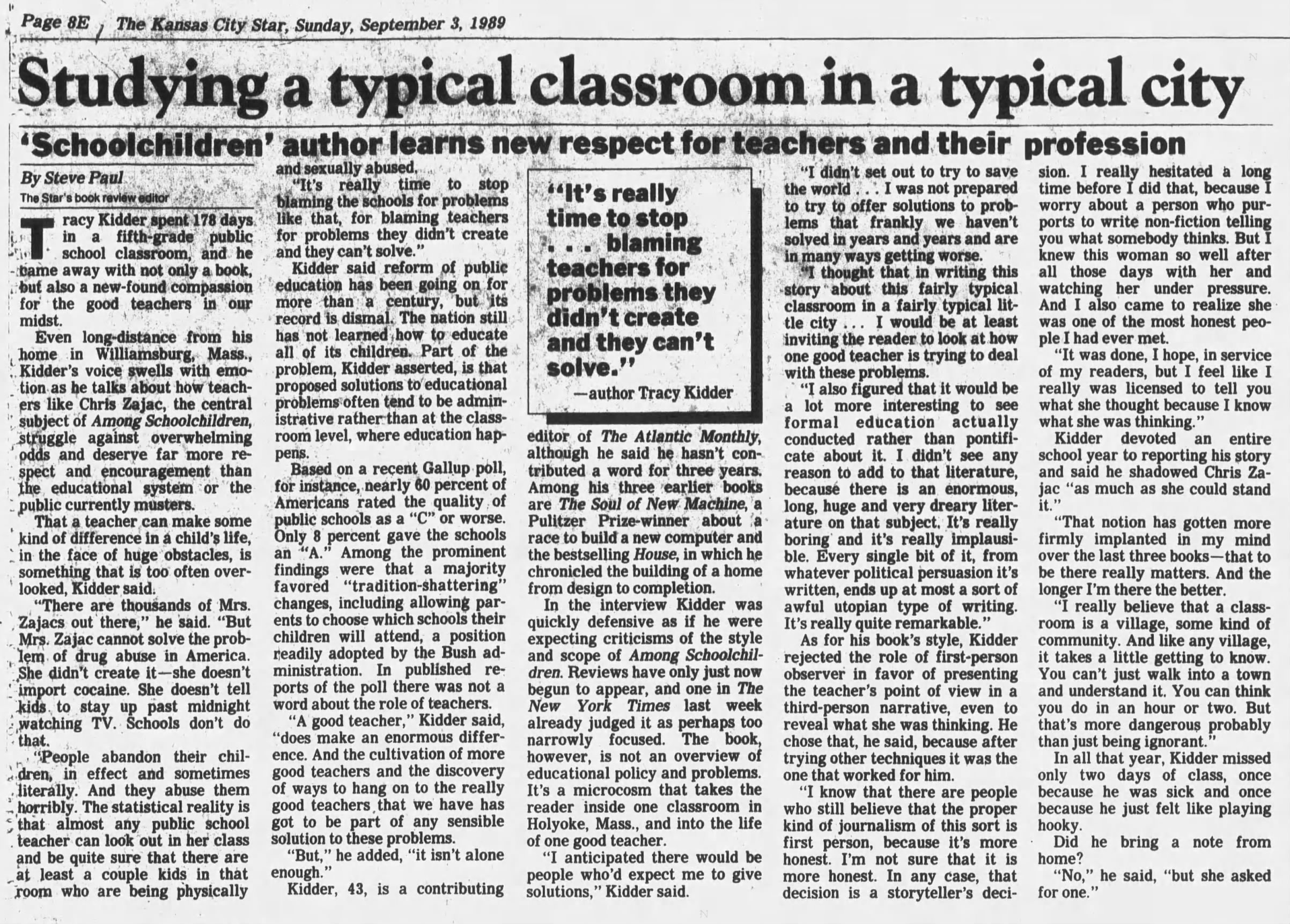
I was saddened to hear today about the death of Tracy Kidder, who succumbed to lung cancer at 80. My entry to his work was the unexpectedly thrilling The Soul of a New Machine(1981), which captured the frenzy of the early days of computer technology, a frenzy that has only accelerated exponentially ever since. Journalists of the day found Kidder’s immersive narratives to be the gold standard of long-form nonfiction, perhaps second only to the likes of John McPhee. I was fairly certain I’d written about him during my days as a book review editor, and, indeed, I found my raw notes file from a phone interview I did with him in 1989. The interview piece ran a few days later alongside my review of Among Schoolchldren from The Kansas City Star, September 3, 1989.


From the Archives: On Pat Metheny's Work as a Musician Telling Stories
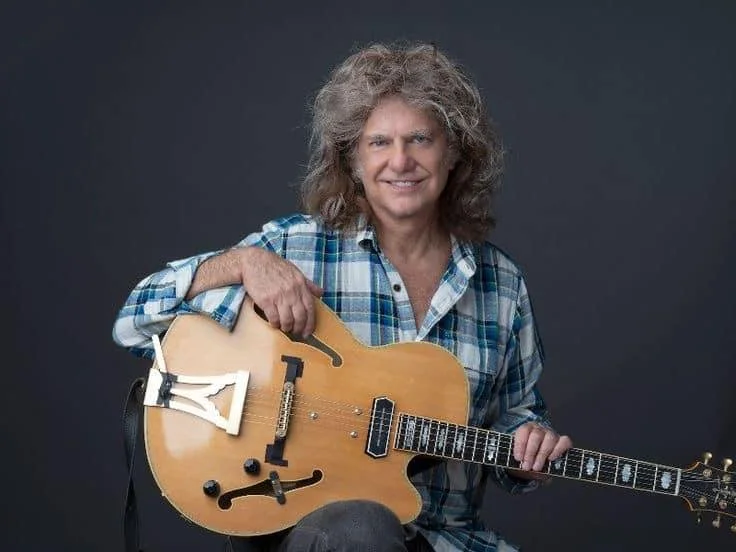
Two things collided in recent days — I’ve started listening to Pat Metheny’s new record, “Side-Eye III,” in advance of his concert in Kansas City on April 4 (at the Kauffman Center). Then the formidable jazz critic Nate Chinen posted on Substack a new interview with Pat and comments on the new record and tour that aligned quite well with my ears. He also posted links to earlier Metheny pieces, which caused me to go back to a major feature I produced about Pat’s Orchestrion project in 2010. It was December 2009 when I traveled to New York to spend a day watching Pat getting the hang of this incredible machine that he had brought into being for a new album and tour. My story ran on Page 1 of the Kansas City Star. Of course, since the Star’s website has been so awful over the years, I managed to find the story still existing on the website of the Ventura County newspaper, which picked it up from the McClatchy wire. Having just read it again after all these years, I thought, hey, this was fun to write and somehow it still reads pretty well as a long-view account of Metheny’s career. Not sure why it came out formatted this way, but I’m not intending to mess with it too much.
Just FYI, I touted the April concert in a blip accompanying my March-April See Hear column for KC Studio Magazine.
By Steve Paul
Mcclatchy Newspapers
NEW YORK — For Pat Metheny, music is nothing without a story. It's a lesson he picked up 40 years ago playing with Kansas City drummer Tommy Ruskin, when the 15-year-old guitarist was beginning his passionate drive to make music a way of a life.
Everything's a story. And everything in Metheny's world seems to be connected.
There's the interconnected path that leads from a childhood memory to the long electric arc of his musical career to the launch last week of the most astounding jazz band he has ever assembled.
Then there's the story of the friend of a friend who got him a deal to spend a few months rehearsing in this vacant Byzantine Catholic church in Brooklyn.
Metheny, with guitar strapped on, stands on his carpeted practice stage strewn with wires and surrounded by drum kits, cymbals, marimba, vibraphone, little percussion pieces, piano, a half-dozen other guitars, and two mysterious wooden cabinets lined with bottles.
And there's not another musician in sight.
Yet, Metheny launches into a new tune and the familiar liquid ring of his Ibanez guitar fills the sanctuary air. Then, as his fingers move up and down the neck, the drumsticks start riding the cymbals and drumheads, which are arrayed on tall racks behind him.
Soon the vibes are playing, the marimba, a bass guitar, a gang of vertical stringed machines called a robot guitar, all controlled by Metheny, all responding to electric signals he's sending out from his Ibanez.
Yes, Metheny, the fluffy-haired musician who has proven that a near-high school dropout can become one of the most creative performers and composers of his time, has now blazed another trail.
He has invented what has to be, at least for the moment, the ultimate one-man band.
Sure, any lounge lizard worth his paycheck can push a few buttons on a keyboard and get the sound of a rhythm section and strings swaying to a languid bossa nova.
But there's never been anything quite like this, and Metheny has never done anything as complicated and as outrageously fun.
With a new record just out and a tour starting in France, you might think that Metheny, the veteran, has already done it all.
"Every single person," he says during a rehearsal break, "including my wife, thought I'd lost my mind. This one takes the cake."
The story of Pat Metheny's "Orchestrion" record and tour begins with a childhood summer memory. Pat, about 8, and his older brother Mike, both trumpeters like their father, discover the wonders of a player piano in their grandfather's basement in Wisconsin. Load in a roll of paper and the mechanical piano plays a tune.
Fast forward a few years and Metheny's playing in the marching band in high school at Lee's Summit, Mo., and in the evenings, when he should be doing homework, he's taking his newfound interest in the guitar to another level. At 14, 15, 16, Metheny talks and plays his way onto bandstands around Kansas City, getting a jazz education from Herman Walder, from Tommy Ruskin, from trumpeter Gary Sivils, from pianist Paul Smith, who hires him for a regular gig at a pizza parlor.
The first time Ruskin hears him, about 1970, Metheny seems a pretty well-formed guitarist, far more mature and accomplished than you'd expect from a 15-year-old.
Ruskin didn't really sit him down and say, "Hey, kid you've got to tell a story," but even then Metheny was musician enough to understand that there was something deep about the way Ruskin played the drums.
"He liked my solos," Ruskin says. "He calls them, 'telling a story.' I try to tell a story rhythmically when I play rather just playing for speed or technique. I'm still working at that."
Yet, Ruskin adds, "If he learned something from me, it was by osmosis."
Metheny, a self-described "mercy graduate" of Lee's Summit High School, soon catches the ear of a music school dean who recruits him to attend the University of Miami. One week into the program, Metheny befriends another young and brilliant musician, the bassist Jaco Pastorius. Metheny also comes to the embarrassing conclusion that he doesn't belong in college.
He goes to the dean, says he feels inadequate and certainly not up to the intellectual demands. The dean, as Metheny's story goes, notes how students had swarmed to the school's new electric-guitar major and asks him if, instead of staying on as a student, he'd like to teach. "Can I keep my dorm room?" Metheny asks.
From there, vibraphonist Gary Burton, whom Metheny impressed at the Wichita Jazz Festival in 1973, gets 19-year-old Metheny onto the faculty of the Berklee School of Music in Boston, the real launch pad for Metheny's rocketing career.
He teaches three terms in 1974-75 and by 1976, Metheny makes his recording debut as a leader for the ECM label, releasing the first of dozens of LPs and discs. (His most recent big project, "The Way Up," was a nonstop 68-minute orchestral-type composition that, in concert, he played straight through, leading a seven-piece version of the Pat Metheny Group.)
As a musician, he's not an acoustic purist. His records blast with electronic anthems as much as they explore avant-garde corners and soothing melodic tune-making. As early as 1978, he makes a solo record, "New Chautauqua," by sandwiching tracks of himself playing different guitars in the studio, and by the next year he's dabbling with electronic instruments including a digital synthesizer connected to his guitars called a Synclavier (SIN-clah-veer).
"Technology has been part and parcel of what I do every day," he says.
But those things are just tools, he'd say, as he did in a 1985 interview with Downbeat magazine: "I always try to emphasize that if you don't have anything to say musically, it doesn't matter if you've got a state-of-the-art Synclavier or a crummy old spinet piano. You still have to come up with the goods."
The memory of his grandfather's player piano rolled around in Metheny's mind over the years, and his own research led him to the Orchestrion, a generation of mechanical players on steroids that dates to the late 19th and early 20th century.
"With Orchestrion, the player piano expands out to other instruments," Metheny says.
In short, it was an entertainment machine that allowed a performer to emulate a band, though, with today's ear, a band that would sound rather crudely simplistic and oompah-heavy.
Because those instruments operated on foot-pumping pneumatics, the possibilities of nuance and dynamic range were limited.
As Metheny's idea takes hold, he seeks the advice and partnership of instrument makers and experimentalists across the nation. A few years ago, someone gave him the breakthrough idea of using solenoids, or electrical switches, to control a variety of instruments.
"I wanted to play a guitar with my feet," he says, "and that opened the door for me — solenoids."
By 2008, Metheny thinks he had learned enough to proceed. The instrument makers began building an array of devices for him, eventually deploying a total of 400 solenoids to transfer Metheny's directions to the mallets, drumsticks and picks that play along.
And those ranks of bottles in elegant wooden cabinets? They are tuned, much like a pipe organ, and respond to puffs of air, also on his command.
Concert listeners used to DJ-spun sound environments and computer controlled music will note here that Metheny uses no sampling, no looping, no-prerecorded sounds, not even a computer keyboard on stage. All of the music on the new album, and in the concerts to come, are real time and made essentially by acoustical instruments.
"It's something that's hard to explain. It's not samples. It's a big living, breathing thing."
Some of the instruments, scheduled to arrive a year ago, show up two months late. That gives him barely six months to learn to play them. "I had to do a week of math just to get it all to groove," he says. In the meantime he's writing music for a September recording session, and he's still in search of the story of the music, really trying to focus on what he's trying to do and say.
In the end, the story becomes a kind of autobiography of a musician. The whole thing the robo-guitars, the bells, the lightly brushed cymbals adds up to a portrait of the musical mind of Pat Metheny.
"Every sound there is made by me," he says, "and is fundamental to the way I hear things."
By December, the day of this demonstration, the recording is done and now the task is memorizing the music to play in concert and continuing to master the instruments, to understand their capabilities and what they can and can't do as he stands on stage alone and plays his guitar.
"Honestly, I didn't know what was going to happen," he says. "It took me to new and different places."
The record, "Orchestrion," is fully composed and controlled, with textures and tempos in five compositions that sound like no one but Metheny.
In concert, his challenge is that of a jazz musician: to create improvisations on those pieces on the spot.
And something else he has never done before:
"This," he says, "is the first time I've ever toured solo."
Metheny did not set out to find an alternative to paying a band. After this, he'll continue with his group projects and trio recordings and every other aspect of his musical journey.
A little before 7 p.m., Metheny's phone lights up. It's his wife, Latifa. He'll be home soon, he says, to visit with the kids — the couple had their third child in May — and, he tells her, he'll get takeout dinner on the way.
His routine: drop the older kids at school, arrive in the Brooklyn church at 9, home for dinner, then back working with his production crew and rehearsing till late.
Making new music, balancing family life: That's material for a whole other story.
Reposting from FB:
At The Kansas City Symphony on Friday night I had the distinct pleasure of hearing Leila Josefowicz play the extraordinary Violin Concerto No. 2 by the Polish composer Karol Szymanowski. She and it rank right up there as one of the most ferocious instrumental performances I've ever witnessed. Given the composer's Polish identity, I am only wondering if the piece, from 1933, can be heard as a response not only to personal ill health (Szymanowski died four years later and this was his last major work) but to the ugliness then rising in Europe. (Just a thought; more study needed.)
This morning, I'm watching Josefowicz, via YouTube, play a John Adams violin concerto, which rivals Szymanowski's ferocity. In any case, you have two more opportunities to see her with the very fine KC band, and its pinpoint leader Matthias Pintscher— tonight (Saturday) and Sunday afternoon (she'll certainly ignite some pre-Super Bowl fireworks).
Earlier this season, Josefowicz played the Szymanowski concerto with the NY Philharmonic. Maybe a recording will eventually make its way to the YT screen. I can't say I've followed Josefowicz's career from apparent child prodigy to MacArthur "genius grant" and beyond, but I will certainly pay more attention now. Also on the KC Symphony program is Ravel's lovely "Mother Goose" suite and the epic Symphony No. 5 by Prokofiev.
Astoundingly, when I mentioned to a restaurant manager that we were heading to the Symphony last night, he knew that the Prokofiev was on the program and said he'd read the composer's autobiography when he was young. After 300 pages, he told me, Prokofiev was still only 17. Go figure. What's not to like about a night on the town?
Here’s on of those YT vids, with Leila J in John Adams’ concerto:
From the Archives: Remembering the Literary Mastery of Daniel Woodrell (1953-2025)
By Steve Paul
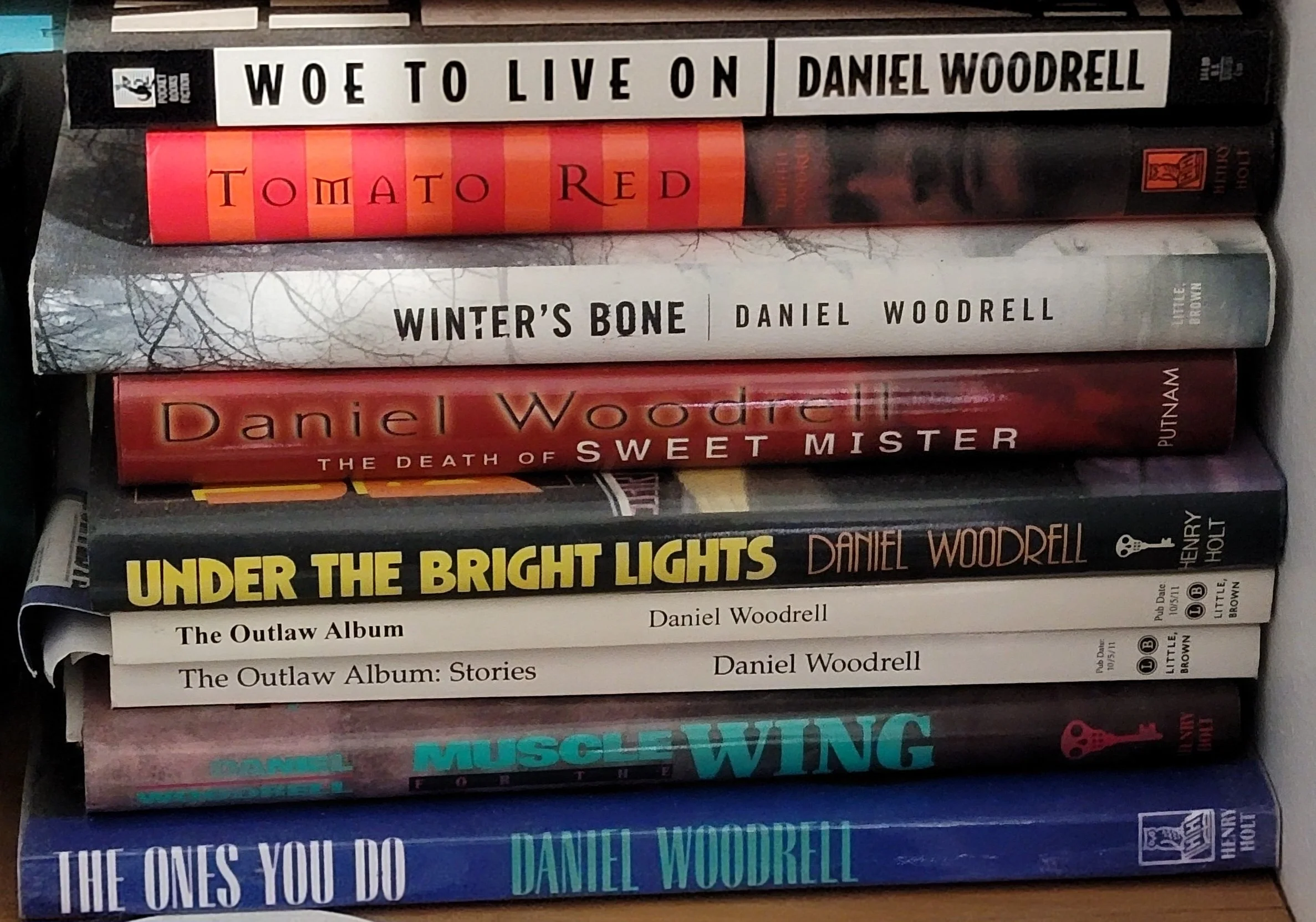
This week we received the devastating news that Daniel Woodrell, the Missouri-based author of a superb series of novels produced over the last forty years, had died of pancreatic cancer. He was a mere 72. I regret even more that last March, when we were traveling to a conference in Alabama I failed to make an advance connection with him and I missed an opportunity to get together while passing through West Plains, MO. His reply to me at the time, included this: “I finally started reading Connell seriously and geez he's got it all.” I know we had crossed paths when I was working on my biography of Evan S. Connell, and I’m glad he got the urge to read more of Connell’s work.
I knew I’d written about Connell a few times over the years, and I was heartened to unearth some of those pieces. He would have come on my radar circa 1987 when, as book review editor at the KC Star, I assigned his civil war novel to another fine writer with a western bent, the late Lenore Carroll. My first interview with him occurred about five years later, in 1992.
I was pretty sure I’d reviewed the fabulous Winter’s Bone but I’d forgot that I paired that with Cormac McCarthy’s The Road. So that one turned out to be an interesting read and memory jolt. I’m not prone to quoting myself, but 20 years later I felt somewhat good about this piece: “Woodrell lives in the hills and absorbs their currents. He captures the acts and language of the disenfranchised, the downtordden, the mischievous. his characters tend to be aggressively anti-social or behavioral screw-ups, ‘scornful of town law and town ways, clinging to their own.’”
Two years after the novel came out, I used Winter’s Bone in a class I was teaching at Knox College, and I was surprised when the students turned out to be less enthusiastic about it than I was. Probably a combination of their rich-kid privilege and my lousy teaching. No big deal. But I also loved the movie version, wowed by its faithfulness to Woodrell’s story and the absolutely stunning presence of Jennifer Lawrence in the starring role as Ree Dolly.
I was also happy to be reminded that I heaped praise on Daniel’s later novel, The Maid’s Version, a remarkable example of his ability to mine and transform real, historic events from his native state’s hidden corners.
When I was putting together the short-story collection Kansas City Noir something like 14 years ago, i was eager to include Daniel. My recollection is his entry came very late in the process, but he was such a meticulous writer and his story, Come Murder Me Next, Babe, was so eerily fine (based on another true-crime tale), I didn’t care. If you’re looking for an entry point into Daniel’s work, you could start there and quickly move on to Winter’s Bone.
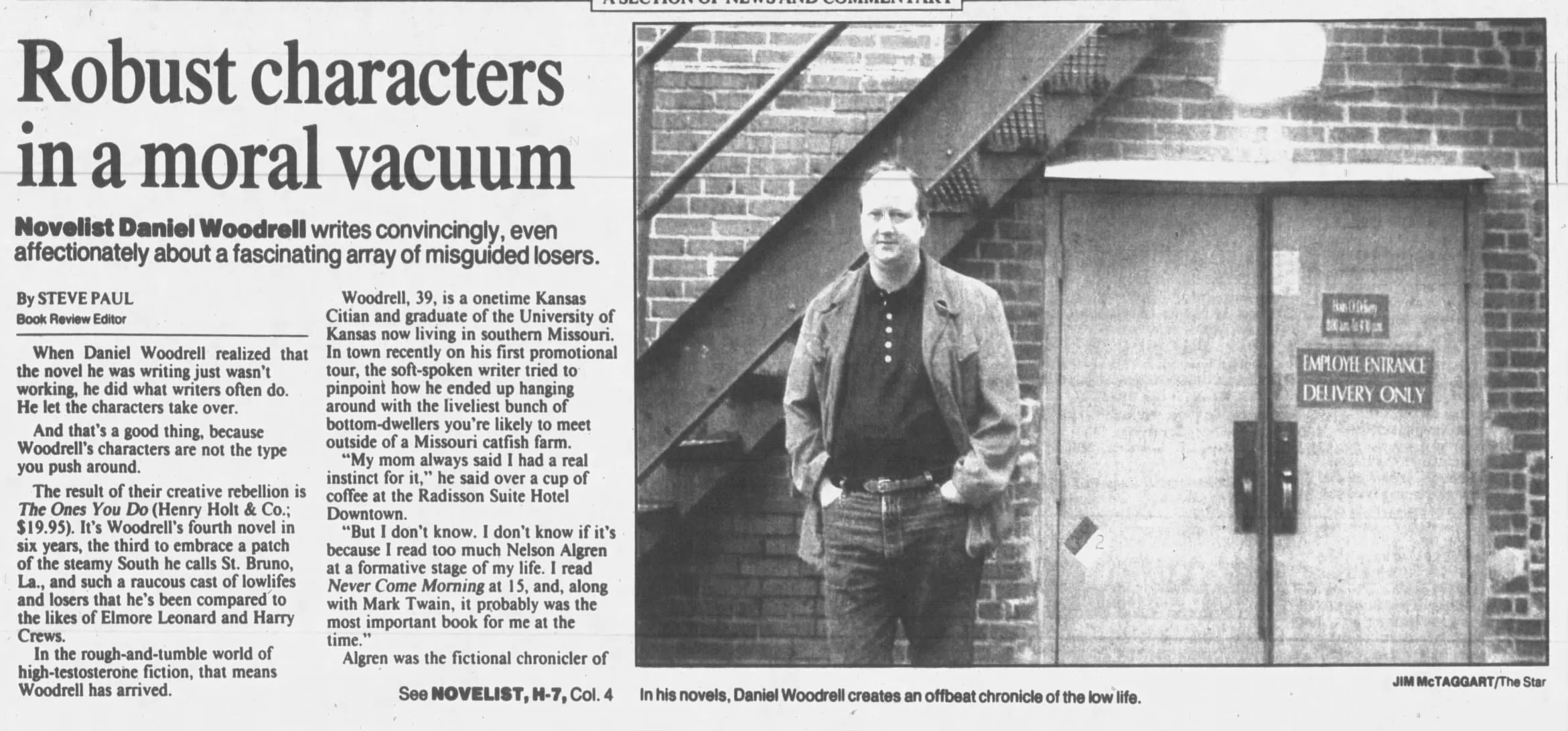
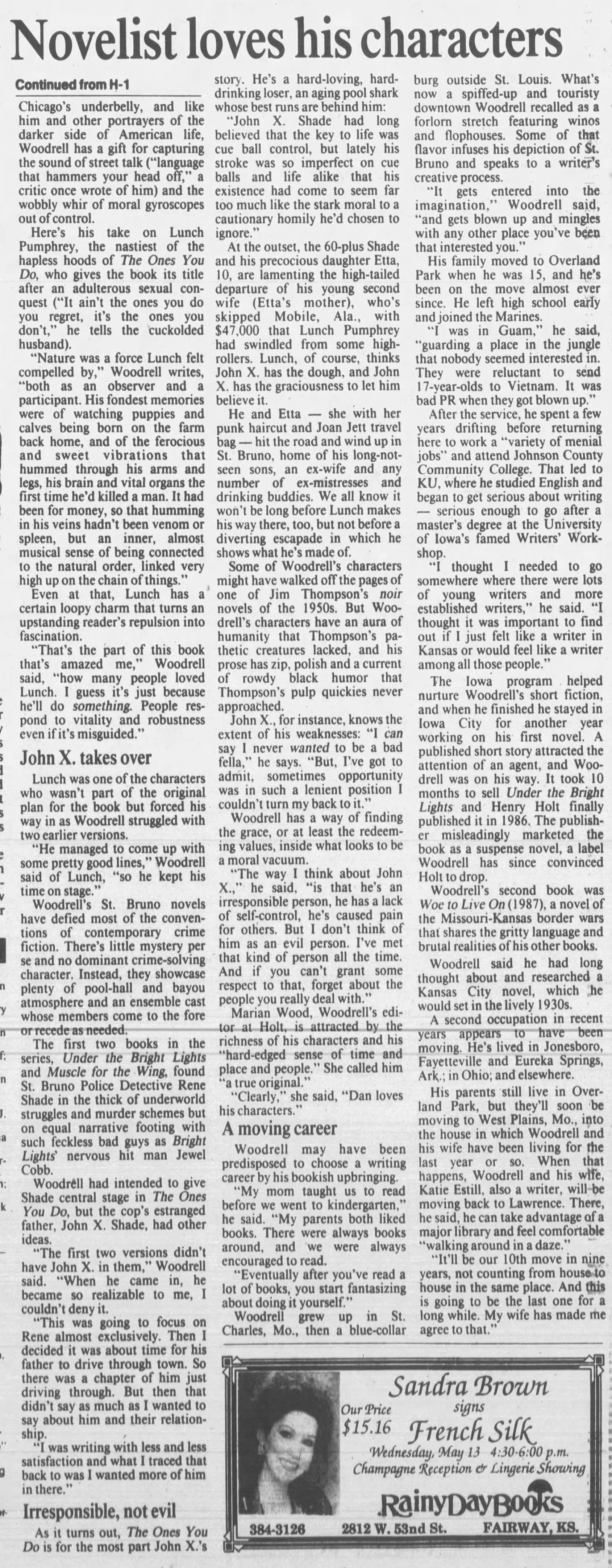
Each of the reproductions below come from the pages of The Kansas City Star — from 1987, 1992, 2006, 2013.



Recent Wanderings: Columns, Articles, Reviews
Sometimes I lose track, but my inner editor tells me I ought to do a better job of compiling some of my recent writings. So here I’ll post links to works published in various place—my KC Studio columns, Substack eruptions, etc.
Art and History at UMKC: A couple of days last summer, I dropped in to view the work of two Spanish art conservators who were touching up and preserving a major, but little-known art work on the walls of a UMKC building. I’ve written about these murals before; they’re the work of a Spanish artist with connections to both Ernest Hemingway and to the current director of the Nelson-Atkins Museum of Art. Like so:
https://kcstudio.org/a-rare-and-powerful-artwork-puts-on-a-new-face-at-umkc/
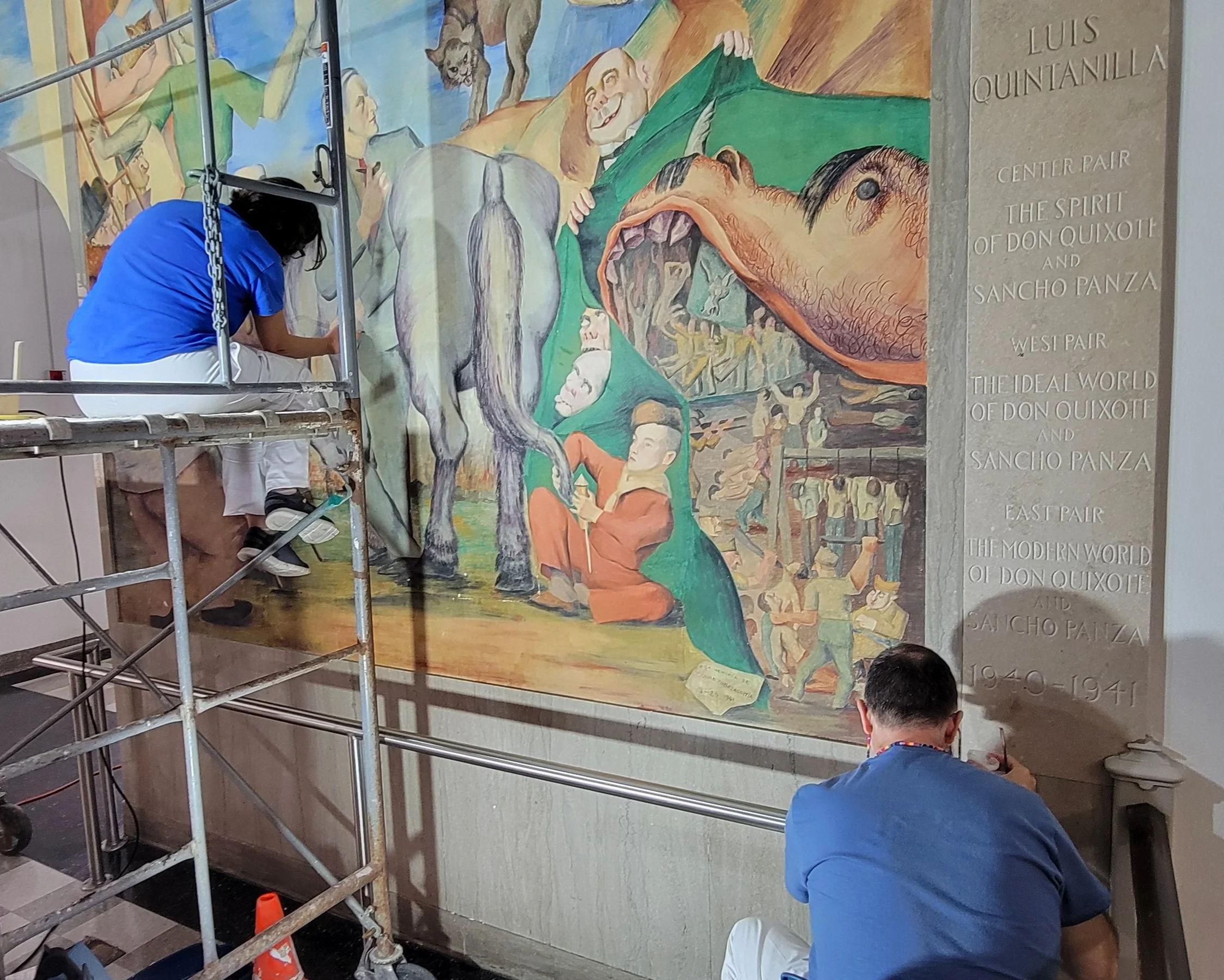
Conservators at work on “Don Quixote in the Modern World”
Two Dudes and Bob Dylan: After a summer encounter with Robyn Hitchcock, I read his recent memoir about the year 1967, which we happened to share as a notable period in our respective teen-aged musical awakenings. My review (of sorts), originally posted on substack: https://substack.com/home/post/p-177798282
From the Archives: A Pynchon Double-Header Prompts a Review Revisit
I’ll concede that I am usually slow on the uptake. We’re on the verge of having a new Thomas Pynchon novel, Shadow Ticket, hitting the market any day now. I haven’t yet read it, and hope to get to it soon. And I haven’t yet seen the new movie, “One Battle After Another,” directed by Paul Thomas Anderson, which you might now is an adaptation of Pynchon’s Vineland, which was published in 1990. Hey, 1990, that rang a bell, and sure enough, while I was still book review editor of The Kansas City Star, I reviewed Vineland, and, damn, if the review doesn’t still feel a bit fresh and not to embarrasingly out of date.


A Jazz Discovery: Miles Davis's French-Film Soundtrack, and More
Cross-posted and slightly expanded from my teeny Substack.
In all the years (nearly six decades) of listening to, DJing, and accumulating jazz records, I’m fairly certain I’ve never encountered this unusual Miles item until I snared it a few weeks ago at an antique store in Maine.
The LP made it home safely, halfway across the continent, and I’m now listening. First side is a wholly improvised soundtrack to a French film, a noirish thriller, made with French sidemen in a Paris studio. The second side is a session recorded in New York a few months later featuring the familiar Miles Davis sextet—with Coltrane, Cannonball Adderley, Bill Evans, Paul Chambers and Jimmy Cobb, . Given its release in late 1959, the record is both a precursor and a follow-up to “Kind of Blue.” Awesome; it’s blowing my mind.
In poking around a bit, it seems this particular mono LP from Columbia is a fairly rare find; some of the tracks can be found on much later compilations. But this one sounds great as it is, with minimal surface issues.
RIP Lenny Zeskind, Author and Investigator, and Revisiting My 2009 Profile
The Kansas City Star’s Judy Thomas wrote this week about the death of Leonard Zeskind, a Kansas Citian committed to researching and uncovering the many tendrils of white nationalism in the U.S. His landmark book on the project was one of hundreds recently purged from the library at the U.S. Naval Academy by the reckless administration, Judy reported. In 2009, I wrote about the book upon its release, and reading about it again, in this fraught moment of authoritarian and right-wing fervor, speaks to its utter timeliness and timelessness. In visits with Zeskind at his office at the time, a labyrinthine lair lined with file cabinets, he displayed both a sly sense of humor and utter seriousness about his work. In one moment, he beseeched me to aim a bottle of lubricant into his eyes. That was a first in my newspaper career. The story below first appeared on page 1 of The Kansas City Star on May 18, 2009.


The Year in Books: Recapping Some Reading from 2024
in books


By STEVE PAUL
(c) 2024
Belatedly posting some notes about memorable books from year now past. Somewhere around Thanksgiving I returned to KCUR’s “Up-to-Date” with Steve Kraske to discuss some of my favorite reads of the year. I’m posting a few of my notes here, followed by lists of other books I spent quality time with.
Here are the highlights from the radio show:
Percival Everett: James (Doubleday). Winner of the National Book Award and other honors this year, Everett’s novel retells the story of Mark Twain’s Huckleberry Finn through the consciousness of that classic’s Black character, known as Jim. Everett’s James is smart, literate, philosophical, courageous, cagey, and his story of escape, survival, adventure, danger, and the complicated bonds with Huck is unforgettable. I listened to the audio version of the novel and was riveted from beginning to end.
Donna Seaman: River of Books: A Life in Reading (Ode Books/Seminary Co-op). Not just because Donna Seaman is a friend, her memoir of a lifetime devotion to the essential act of reading is a delightful and winning procession of connected essays. A longtime staffer at the American Library Association’s advance-review journal, Booklist, she has recently ascended to editor-in-chief. Her story of a rebellious, smart childhood in rough-edged Poughkeepsie, New York, being the loving daughter of loving and reading parents, includes a year or so in Kansas City in the 1970s when she attended the Kansas City Art Institute. The book is infused with literary tributes, artistic and creative impulses, and despite episodes of personal loss, a spirit of generosity, love of the natural world, and human fellowship. Anyone who loves books and identifies as a chronic reader will recognize a kindred spirit and compare influences and reading lists with those that Seaman shares.
Alexis Pauline Gumbs: Survival Is a Promise: The Eternal Life of Audre Lorde (Farrar Straus Giroux). This deeply imagined and unconventionally constructed biography tells a compelling life story, tracing Audre Lorde’s journey from tough and emotionally challenging childhood to her status as beloved poet, lesbian activist, and spiritual thinker. Gumbs brings a poetic eye and empathetic sensibility, especially toward Lorde’s themes exploring science, nature and the physical and metaphorical universe.
The Harlem Renaissance and Transatlantic Modernism, edited by Denise Murrell (Metropolitan Museum of Art/Yale University Press). In the category of art and “coffee-table” books, this is the huge and handsome catalogue of a major retrospective exhibit that I saw earlier this year at the Met in New York. The sheer variety of style, craft, imagery, and narrative content of these works proves how far from monolithic the creative movement we call the Harlem Renaissance really was. There’s intimate portraiture, vibrant street scenes, abstract collage, and stunning representations of the range of humanity that made up the African American experience in the 1930s and beyond. One particular revelation, for me, were the lovely portraits and lively, boozy social canvases by Archibald Motley. Another involved dwelling on a familiar mural by Aaron Douglas and realizing how it resonated with the kind of political engagement to be found in Picasso’s “Guernica.” This book is filled with insightful scholarly essays that provide broad context and detailed focus on many of the individual art works.
Wright Thompson: The Barn: The Secret History of a Murder in Mississippi (Penguin Press). Extraordinary and riveting narrative that recounts all the threads of American history that led to the torture and killing of Emmett Till, a 14-year-old Black boy, by white men in 1955. This essentially is the biography of a place, a small patch of the Mississippi Delta, which also happens to contain the family home of the author. Thompson, an award winning writer who once wrote sports stories at the Kansas City Star, performed an enormous amount of research as he interweaves his own story and his quest through deep history and the murky legacies of the civil rights-era tragedy that still resonates today.
Samantha Harvey: Orbital (Atlantic Monthly Press). Recent winner of the Booker Prize, this short novel becomes a meditation on human existence, prompted by the narrative’s setting inside the minds and lives of six International Space Station occupants as they speed around the planet. It’s a lyrical and evocative read, though one that some readers might find to be periodically precious. This was another book that I absorbed by listening, an audible experience that was uplifting, cosmic and often hypnotic.
Rachel Kushner: Creation Lake (Scribner). There’s an unusual setup as a mysterious central character, an American woman who may or may not be named Sadie Smith, wangles her way into a collective of French environmentalist rebels. A cult leader’s lectures on human history and the legacy of Neanderthal life in the workings of the modern world give the novel some intellectual heft. The main character’s relationships, sexual drive, and subterfuges provide loads of tension and propulsion as the novel unfolds.
Much of my reading these days involves biography, given my involvement in Biographers International Org. Early in 2024 I caught up with the five finalists for the 2024 Plutarch Award, honoring the best of the prevous year: Each of these five books took a different approach to biography, illustrating, for me, the great range that the craft of biography (as distinguished from autobiography and memoir) spans today.
Jonathan Eig, King: A Life (Farrar, Straus and Giroux)
Howard Fishman, To Anyone Who Ever Asks: The Life, Music, and Mystery of Connie Converse (Dutton)
Lisa M. Hamilton, The Hungry Season: A Journey of War, Love, and Survival (Little, Brown and Company)
Prudence Peiffer, The Slip: The New York City Street That Changed American Art Forever (Harper)
And the Plutarch winner: Yepoka Yeebo, Anansi’s Gold: The Man Who Looted the West, Outfoxed Washington, and Swindled the World (Bloomsbury)
More recent reading and biography titles to come.
From the Archives: That Time Gillian Flynn Tried to Kill Me
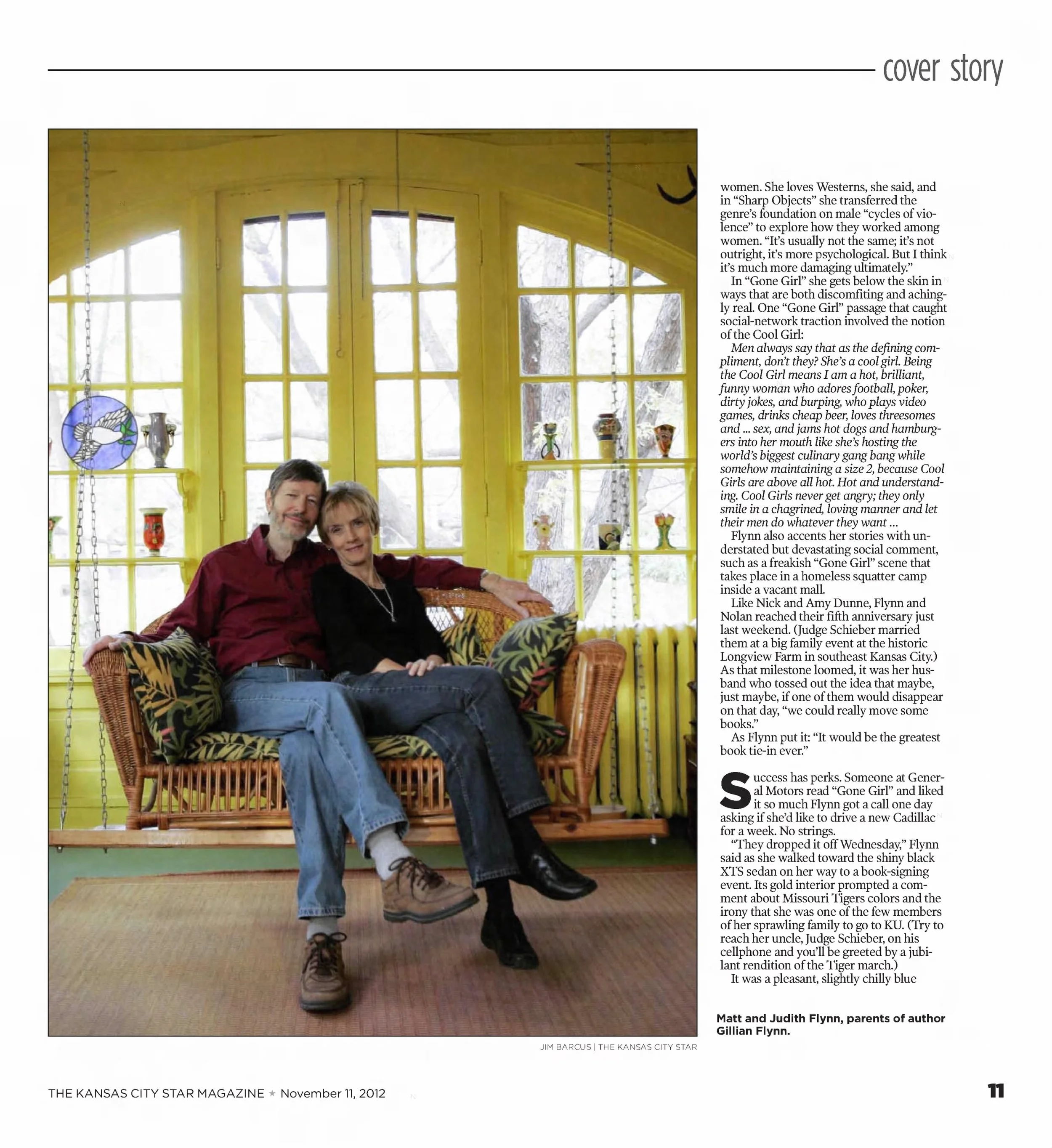
With Gillian Flynn, the Gone Girl goddess, coming back to her hometown soon, why not flash back to the feature profile I put together in 2012. At the time, Flynn’s writing career and personal life had begun to soar. She graciously allowed me to visit with her in her Chicago home and to follow along as she appeared at a bookstore reading. That’s when it got really interesting—though I left this little detail out of my magazine piece. (Why oh why? It shoulda been the lede, maybe?) I was a passenger in Flynn’s car as we returned to her place from the suburban bookstore. At one busy intersection, she made a left turn…INTO THE WRONG, ONCOMING LANE, if I recall correctly. It didn’t take long to correct the driving error, but still. We joked about how maybe she was having the impulse to bump off this nosy writer. Whatever. Maybe she tells the story differently. Maybe she doesn’t even remember it. Although we shared a stage once in an event for the Mid-Continent Library, we’ve had little to no contact ever since. It certainly has been fun to follow her projects over the years, and nice to hear that she’s struggling to work on another novel. In any case, I’m sharing here the magazine pages of that story, published just about a dozen years ago, Nov. 12, 2012, in The Kansas City Star Magazine (remember when?). Some of the photographs are mine; I was happy to line us up with my friend Emily Railsback, who had recently resettled in Chicago, to shoot the cover portrait.



Travel Journal: Turkey (Türkiye), an 'Ever-Evolving Mirage'
After a long week’s journey to Istanbul and the Cappadocia region, I’ve been sorting photographs and diving into my notebooks to pull together some mostly coherent impressions. What I’m posting here still seems raw and incomplete, but I hope it captures some of the essence. I’ll also be posting selected pictures at this site’s photography page, Available Light and Shadow.
All content is (c) Steve Paul, 2024.
6 October 2024, Istanbul
We spent an extended week in Turkey, bookended by a long day of travel to get there and two long days of travel coming home.
I hadn’t really focused on how enormous a city Istanbul had become. Current estimates of 20 million people are common, though we heard numbers even higher. The population may have swelled in the aftermath of two earthquakes that ravaged several central cities of the country in 2023. The subsequent migration and infrastructure damage has led to a painful economic crisis marked by rampaging inflation, though it was hard to see how that was playing out in daily life of the city from our limited, tourist perspectives. What we saw was a bustling, crowded place, with pockets of modest or impoverished dwellings punctuated with new construction, renovation, and what felt like tourism-driven abundance.

Blue Mosque
Our hotel, the Ottoman-inspired Armada, was in the Sultanahmet district, just a 10-minute walk from some of the most historic and popular sites, including the Hagia Sofia, the Blue Mosque, and the Basilica Cistern. It was another 10 minutes on foot to the Grand Bazaar. Because we arrived in the late afternoon, our opening itinerary included a rooftop reception and dinner. After some intermittent raindrops, the evening unfolded nicely, and we dined on a typically fabulous spread of small plates (meze) and sweets. Overlooking the terrace was the Blue Mosque, which was bathed in white and violet lights.
Because we were a group of musicians and music aficionados, we were treated to a mini-concert by a quartet of Turkish musicians, which helped set an important tone and thread of our visit.

Our welcoming band.
7 October, Istanbul
I know it’s impossible for a traveler to parachute into a country and even try to get a handle on its character. Perhaps because our friends who arranged the journey had much experience and many connections, our days here were filled with congeniality, not too many travel hassles, and many pleasant surprises. And perfect weather, too.
One guiding thought I had in mind wherever we went in Turkey was the writer Orhan Pamuk’s description of his country and his native Istanbul as an “ever-evolving mirage.”
A few random street scenes here:


***

View from the Bosphorus.
Getting to know Istanbul almost has to begin with the Bosphorus. It’s the physical and metaphorical axis that defines this vast city’s place in the world. It separates East from West, Europe from Asia. It’s part of the nexus of commerce and trade that has connected (and divided) so many cultures over the centuries. Our group had a choice opportunity to experience the Bosphorus on a private boat tour, complete with food and wine and glorious late afternoon breezes. We had views of historic palaces, of the famed Galata Bridge, of so much of the vibrant waterfront even despite the presence of rather monstrous-scale cruise ships—two more in addition to the Queen Victoria.
Cruising on the water as the sun was setting and the moon rising was a visual and visceral high point of our journey.
8 October, Istanbul
Our travel priorities always include what we can find in the visual arts, and we were quite taken with Istanbul’s relatively new Museum of Modern Art. The privately funded non-profit institution is a decade old, but it reopened just last year (2023) in a crisp and bright new building by the architect Renzo Piano.
A featured exhibit while we were there was by Olafur Eliasson, whose work I’ve long admired. He’s a sculptor of light and color, of metal and wood, of glass and optical illusions. I’d like to go in-depth about the exhibit, but will save some of that for later. Eliasson’s major concerns over environmental decay and climate change result in works that are both in your face and subtly melancholic.

Olafur Eliasson
Elsewhere in the museum we walked through the permanent exhibit of artists we were wholly unfamiliar with. But we were struck by the presence of significant forays into abstract expressionism, particularly by one or more female artists.
I’ve got very mixed feelings about AI developments in the cultural and creative world. But it’s hard to deny the entertaining visual appeal of the work being made by Rafik Anadol, a Turkish-American artist with a global practice. Like many people, I first encountered his super-sized, liquid-like wall extravaganza at the Museum of Modern Art, which transformed meta-data of the museum’s entire collection into a mesmerizing psychedelic experience. We happened to catch another Anadol production this summer, a special room-sized immersion at the Antoni Gaudí Casa Battlö in Barcelona. Now comes his pulsating immersion room at the Istanbul Modern, a piece that reflects and honors the Bosphorus. Blue and white tones cascade through the room like hyper-inflated waves. Mirrored floor and ceiling surfaces expand the effect all round you.
Walking out of one gallery and into a hallway I couldn’t help but notice a strange sight outside a wall of windows. It was a section of the Queen Victoria cruise ship, docked right there on the Bosphorus, within spitting distance of the museum. The geometric array of the giant craft’s cabins and rails made for an instant snapshot, a grand artistic gesture as if the slice of reality were hanging hugely on the museum walls (below).

***

Ezgi Karakus joins the musical enthusiasm at our group dinner.
An evening of fun, frivolity and fabulous food unfolded at the Hos Seda Balik Restaurant. After mounds of meze, a whole fish, and tastes of red Turkish wine, the long table erupted in music. And some spontaneous dancing.


9 October 2024, Istanbul
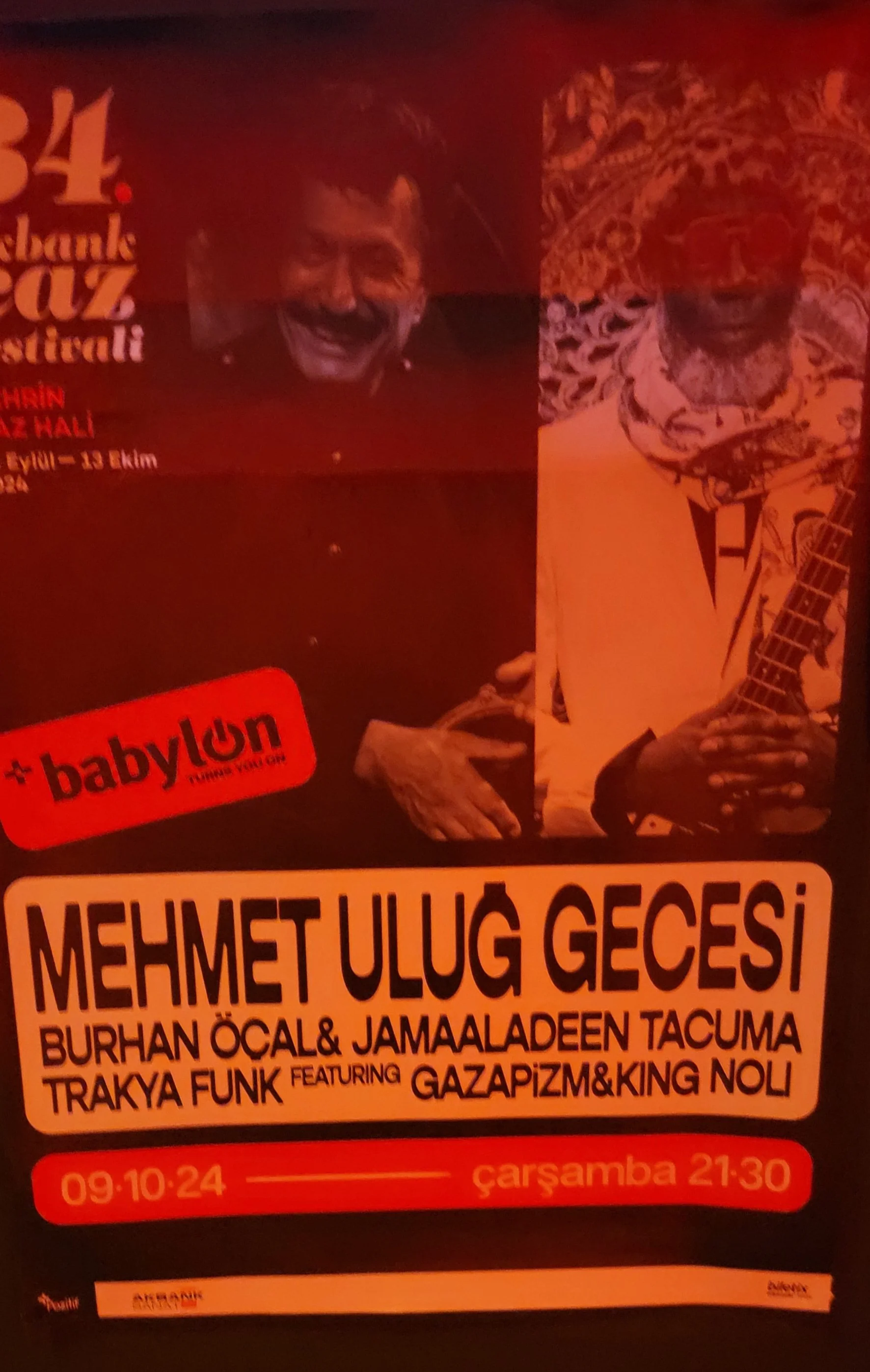
In preparation for the Turkey journey I poked around online to scout jazz clubs in Istanbul in hopes of finding a destination for one of our group’s unscheduled nights. Lo and behold, Istanbul’s Akbank Jazz Festival would be well under way offering numerous opportunities coinciding with our days there. Among the options was a concert featuring the American bassist Jamaaladeen Tacuma, whose funk-infused music I hadn’t heard for some years (decades). I was intrigued by the possibility of hearing him in the context of Turkish fusion, as he was appearing with a band led by the percussionst Burhan Öçal. I didn’t know of Öçal, but I came away bowled over and eager to hear more from him.
Turns out this concert was something of a reunion of sorts, given that Tacuma had recorded an album with Öçal a quarter-century ago (“Groove alla Turka,” 1998). The show even began with a big-screen projection of some documentary footage of that recording session. And it also was presented as a memorial tribute to another Turkish jazz hero, Mehmet Ulug, who died in 2013 and is remembered at this festival every year.

Guest rapper Gazapizm
The scene: Babylon, a large, standing-only concert space within what seems like an extremely vibrant arts center and cultural complex. In planning for the evening out, I couldn’t figure out from Google Maps where our group of eight jazzers could eat nearby beforehand, so we opted for a fine spot (details on this elsewhere) near our hotel and then cabbed over to find Babylon. When we got there, we discovered that an open-air plaza outside the joint was filled with festive restaurants and people, so that was a lesson learned. (Next time in Istanbul!)
The upshot was a high-energy concert, with eight or more players on stage, including horns, keyboards, violin, various percussion. The opening tune was “Nihavend Longa,” which dates back to “Groove Alla Turka.” (I found it on Tidal, though it’s likely available on other streaming services.) As an opener it highlighted an attractive blend of eastern and western jazz sounds. My experience might be somewhat limited, but this and other tunes on the set-list connected me with a memory of discovering the Lebanese-Parisian jazz fusion of Toufic Farroukh on a trip to Europe in 2002 (see Farroukh’s terrific album “Drab-Zeen”).
Tacuma introduced one tune with a plea for peace, kindness, and love, which was met with great applause. Called “Rahima,” it’s a gentle ballad named for Tacuma’s wife.
Toward the end of the set, the band was joined by a highly popular rapper named Gazapizm, who added an unexpected layer of vocalism to the proceedings. Another singer, whose name escaped me, joined to whip up more emotional vibes, helped close the concert.
We were deep in the crowd (not conducive to decent photos or video), and I was struck by the overwhelming youth of the audience. Not sure that we’d see quite so many young folks at a similar jazz concert in the U.S. Carol, my partner, not exactly a jazz fan, said she really enjoyed the show.
While back-filling for details, I found this link to an NPR show from not long ago featuring Tacuma, which is worth a listen (see link below photo).

Burhan Öçal, Jamaaladeen Tacuma, and a guest singer whose name I didn’t catch. At Babylon.
A Food Interlude
To discover the joys of Turkish cuisine is to recognize its close relationship to Greek and Middle Eastern foods. We enjoyed ubiquitous variations on hummus, baba ghanoush and tzatziki. Red pepper concoctions appeared on almost every buffet and table. At our luxurious hotel, I was turned onto the attraction of salad for breakfast, encouraged by our Turkish travel mate, Ezgi Karakus, to try the rocket lettuce, or mild, large-leaf arugula, sprinkled with lemon juice and oil. I experimented with using the leaves to wrap various cheeses.

Lamb shank at Mozaik, Görome, Cappadocia.
Best meal—so good we had it twice—was a lamb shank at Mozaik, a restaurant in Görome, Cappadocia. Moist, tender, falling off the bone; we learned from an insider that a chef’s secret was putting dates in the oven as the shank roasted, which added a subtle sweetness. Another high point was the series of delicious small plates, along with bottomless wines, that accompanied our private boat tour along the Bosphorus channel. The wooden boat belongs to the Armada Hotel, where we stayed just a stone’s throw from the water. I knew virtually nothing about Turkish wines, but sampled several throughout our stay and learned that wine production somewhere in or around Cappadocia could be as ancient as that in the Republic of Georgia and Shiraz, Iran. Another liquid attraction in Turkey is the ever present Raki, which is essentially a version of what we know from France as pastis, or Ricard—the delicious (if you like such flavors) anise aperitif.
Not long ago, the New York Times helpfully ran a feature story about the rise of female restaurateurs and chefs in Istanbul, which I happened to carry with me on the journey. Turns out that one of those restaurants, Giritli, was just around the corner from our hotel. Its outdoor patio was attractive and comfortable, and prix fixe menu was absolutely first rate. Our jazz-going crew started out there one night. The meze assortment was a filling starter plate, but I couldn’t resist the grilled fish as a main dish (sea bass, I think it was). And once again, the wine, a Bordeaux-style blend, was perfectly fine. I didn’t get around to peeking in the kitchen or trying to greet the chef; but our table service was super friendly and first-rate.





October 10-11, Görome and Uçhisar, Cappadocia

Cameras blazing at the post-ceremony tourist show at Saruhan
After a short flight from Istanbul to the Kayseri airport, one of our first experiences in the Cappadocia region involved a journey into history and mysticism. Pretty sure I can honestly say I’d never witnessed a Whirling Dervish ceremony, but here it was, twirling before our eyes inside a 13th-century caravanserai. I’m not exactly sure what links the spiritual event to the place, an ancient stop called Saruhan on the so-called Silk Road. But it’s now a tourist attraction. Visitors are invited into an interior arena and cameras are prohibited as initial silence turns into music and a quartet of men doff their black robes, step onto the stage and begin moving, clad in white tunic and skirt, in symbolic steps and spins. I was struck by a brochure’s note that the tall fez atop their heads represented the “ego’s tomb,” a point emphasized when you understand that the ceremony leads the participants into “an ascent through love, in which the dervish deserts his ego, finds the truth and arrives at ‘The Perfect.’” (I borrowed the idea for what might well become a line in a future poem: The extended fez is known as ego’s tomb,/ which, after all, is what a successful poem could be.) At the end, the dervish ceremony succumbs to the demands of tourism by tacking on a brief coda suitable for camera phones and offering a gift shop with dervish and local souvenirs.
***

It’s somewhat fascinating how the Cappadocia region has developed only in the last 40 years or so, as I understand it, into a compelling and mega-popular tourist region. Its geological marvels and rockadelic landscape are a big part of it, of course. In 1985, the Görome National Park and surrounding area received protection as a UNESCO World Heritage Site for its historical cave dwellings, religious refuges, and nearly incomparable depth of the human experience. Then, as a tourist economy began to develop—not easily within a culture known for sharing rather than profiteering— someone had the brilliant idea to sell the landscape experience via hot-air balloons. As one local insider put it to me one night, most people anymore come to Cappadocia for the balloons and don’t even know about the ancient churches or the history. The balloons—as many as 150 at a time, each carrying four to a dozen or more passenger—float above the spires and valleys each morning at dawn. Travelers are lured to view the penile towers and “fairy chimneys” in Love Valley and similarly marketed sites.


Today, tour buses navigate the narrow roads in the hills and towns. If you take a sunset Jeep tour of the valleys you will soon be in the midst of a bizarre conglomeration of tourists on horseback and tourists on ATVs all jockeying for selfies among the rocks.
I had a feeling that we could pass on the balloon ride, especially after learning that we could avoid the early-morning call and relax with coffee on a hotel terrace with fabulous views of the balloons. Coffee wasn’t available yet, but my camera phone was fully charged.


***
Don’t get me wrong. I know I was a willing participant in a tourist parade through Turkey, a place I had never encountered. But over the years I’ve developed an abiding sense of tourist guilt that glides to the surface from time to time as crowds amass around me. (We were in Barcelona this summer just days after anti-tourist protests erupted along La Rambla, within steps of where we’d soon be staying. Tourism is striking a difficult balance with local politics and economic and environmental priorities in many places. And don’t let’s get started on what local havoc Airbnb has caused.)

A Melmuk design.
What we witnessed and took part in on this trip was a rather conventional skim of prominent attractions, accented with beautifully curated events and gatherings that spoke to the musical and cultural-exchange roots of this journey. In addition, our planners’ special connections in Turkey led us to special experiences, even when we were engaged in what I recognized was a heightened form of performance retailing. By that, of course, I mean we had insider-tours, complete with demonstrations and personal attention, of a famed ceramics studio, a high-end jewelry studio, and a highly regarded carpet shop. (See my video below of the famed ceramicist and entrepreneur Galip Körükçü making a pot at Chez Galip.) Yes, we spent money in all of them.
12 October, Görome
Many thanks go to our inspiring tour organizers and guides from Ensemble Iberica. We were ably led by Erin McGrane, Jeff Freling, Beau Bledsoe, and Ezgi Karakus. A culminating experience was a concert by Beau and Ezgi (with a cameo by Jeff) in one of those historic caves, a onetime proto-Christian or Byzantine church now in its modern guise as an event space. The candle-lighted setting was gorgeous, exceeded only by the music, which washed over our group like a prayer. Despite the lighting, I captured some video, including this one of a composition by Ezgi inspired by her hometown of Izmir. Of course, another fine feast followed at our new favorite restaurant, Mozaik in Görome.
13 October, Uçhisar

© Steve Paul, 2024
I awoke before dawn today and found a perch on a terrace of our cave hotel. It felt like the first opportunity to sit and write anything of substance based on our days of hectic travel. I also felt a strong pull toward the morning view of Mount Erciyes, the dominant inactive volcano of the region. Sunrise was approaching. Clouds and the dark shapes of land created a planar canvas of subtle colors. It felt like I was living inside a work of art in the moment and over the next 45 minutes or so I captured the slow evolution of images. Again, I could think of Orhan Pamuk’s “ever-evolving mirage.” Later I offered an online post, “Ten Sunrise Views of Mount Erciyes.” Instagram, of course, reduced the images to its standard square format. Here are four of the originals in their horizontal glory. I want to live with these for a while and think about whether they’re worth exhibiting.

© Copyright Steve Paul, 2024

© Copyright Steve Paul, 2024

© Copyright Steve Paul, 2024
14 October, Istanbul
Istanbul—This was an unplanned overnight back in the big city, caused by a delayed flight from the Nevsehir airport in Cappadocia. We missed our connecting flight to Chicago. My travel savviness failed and real information was hard to come by if we had any hope of booking alternative flights out of Istanbul. What the hell; all we could do was go with flow. That included taking a free hotel night with dinner from Turkish Air. I reported on this to FB:

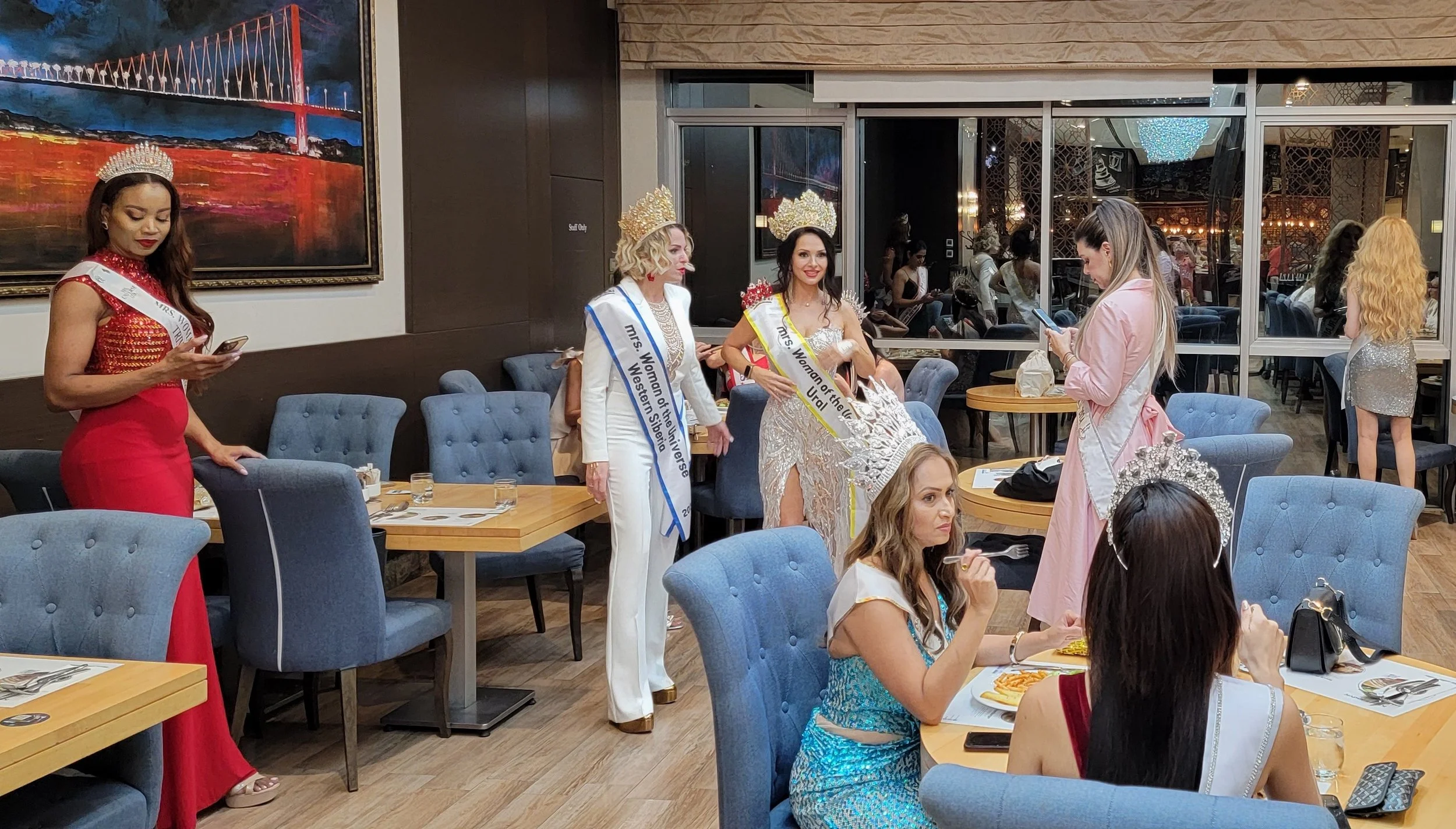
It's a wide weird world. Early today (Monday) our flight out of Cappadocia, Turkey, was delayed two hours, causing us (and others in our group) to miss our connecting flight from Istanbul to Chicago. After Turkish Air rebooked us for a flight early Tuesday, and after more than a few minutes of waiting, we got shuttled all the way into the city for a comp hotel, where checkout will be 3 a.m. (it's now about 9 p.m.) to get shuttled back to the airport for a 6:30 a.m. flight. Dinner buffet at the hotel wasn't bad at all, and then we caught sight of the bedecked and beglittered contestants of the Mrs. Woman of the Universe competition. The Universe! They were happy to be photographed as they strolled to the buffet and back. I did no reporting whatsoever, so can't say which Mrs. Woman won. (Later I learned the honor went to Mrs. Belarus.) Still, for every setback in life, and all the lost hours that we'll never get back, there seems to be an upside.


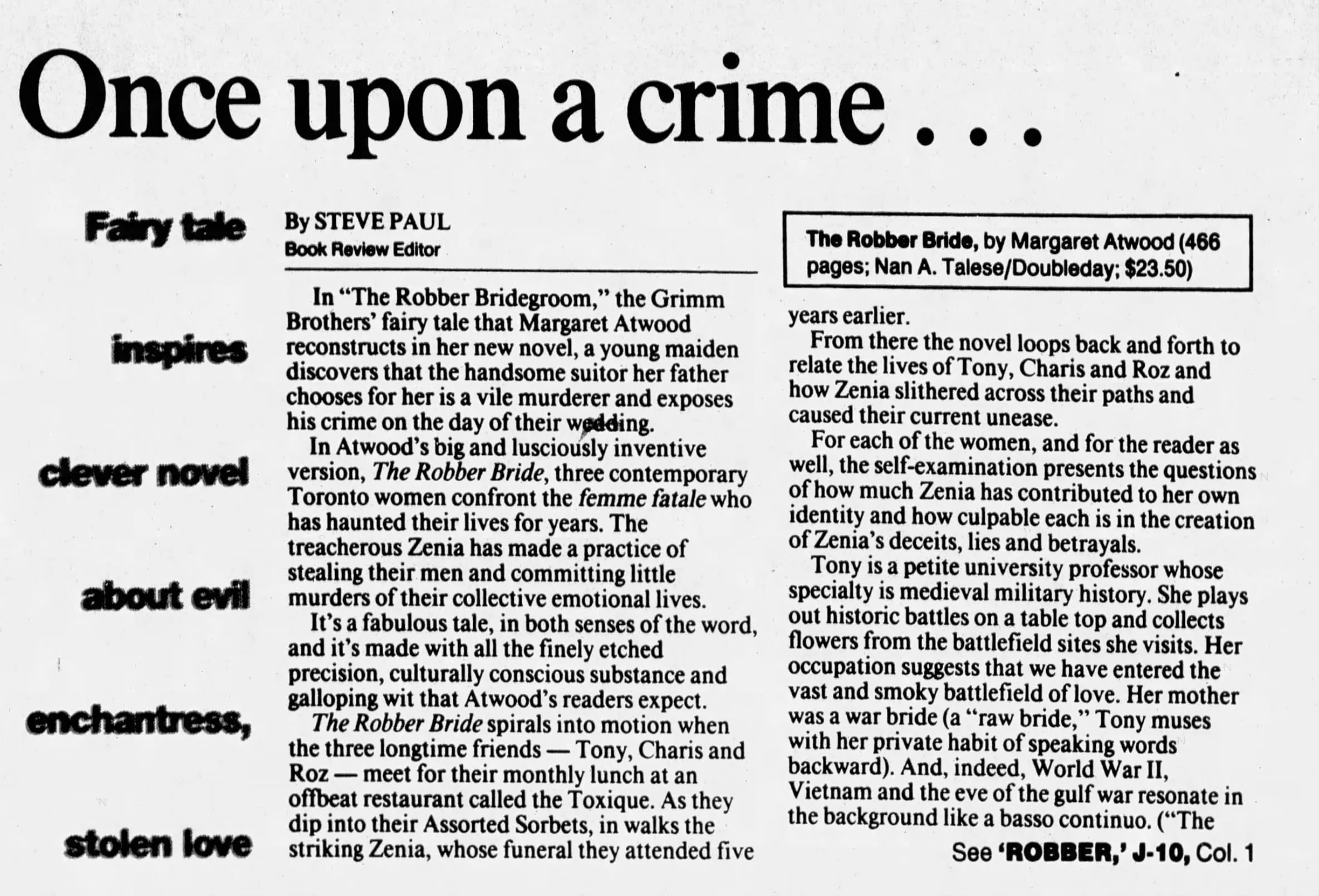
From the Archives: Reading and Interviewing Margaret Atwood, 1993-2022
By STEVE PAUL

With Margaret Atwood coming to Kansas City soon for a library talk (Sept. 24), I thought I’d dredge up a couple of related old pieces. I had the opportunity to meet and interview Atwood in 1993 at the annual American Booksellers Association confab (now Book Expo) in Miami. Her novel The Robber Bride was coming out that fall and her publisher had sent me an early copy of the book—so-called advance review copies were not yet ready, so they sent me a dupe of the typed manuscript. I’ll concede that my reading of Atwood was rather conventional if not underwhelming from today’s perspective. Then again, the interview with her remains enlightening.
In talking about the essential status of mythology in contemporary story-telling, one of the driving forces of her writing, she illustrated:
“One of the founding stories of U.S. culture is the biblical quotation ‘by their fruits they shall know them.’ It was originally intended spiritually—you know good people by how they behave. But it was interpreted by the Puritans to mean you can tell good people by how rich they are, which is with us today. It underlies so much literature in this culture—the idea of sin and redemption.”
Find reproductions of the two pieces, published Nov. 14, 1993 in the Kansas City Star, in three images below.
In more recent years, I had the pleasure of encountering Atwood at the Key West Literary Seminar. She spoke again about myth and fable. In my memory she talked about the movie “Aquaman” as a product of myth. The movie had just recently come out and she suggested that she watched it so we wouldn’t have to. (I still haven’t gotten around to it.) One morning in Key West, we ended up at a Duval Street CVS at the same time, where I met her husband, the writer Graeme Gibson. He would die just months later, as I recall.
Atwood happens to make a cameo appearance in my biography-in-progress of William Stafford. This goes back a ways to Atwood’s years as an emerging poet and fiction writer (her first novel was published in 1969). Shortly after being named Poetry Consultant to the Library of Congress for 1970-71, what we now call the U.S. Poet Laureate, Stafford put Atwood’s name on a short list of writers he would like to host during his tenure. He wanted to make sure women were represented on what was very much a male-dominated field. Sure enough, one of the first reading programs Stafford hosted in the fall of 1970 brought together Atwood and Galway Kinnell.
In 2022 I wrote to Atwood to see what she might recall of the event and/or Stafford. She kindly replied, hand-writing her response on my original letter and sending it back to me:
“I was 30! A very minor figure! …I love Wm Stafford’s poetry in book form—but he was a big cheese and I was a very small cheeselet.”
And here’s a blog bonus: An audio recording of the reading can be found at the Library of Congress website. Find it here and enjoy:


Baseball and KC's Crossroads? Can't We Devise a Better Plan?
A belated posting from earlier this year on the eve of the crucial vote that put a stop to the building of a baseball stadium in Kansas City’s arts district. For now. I think the ideas still hold. We’re still waiting for Plan B. The piece first appeared online at kcstudio.org
In the gallery above, scens both inside and outside the footprint of the proposed Royals stadium in the Crossroads Arts District.
By STEVE PAUL
(c) 2024, Steve Paul
Is it possible to be both a baseball fan and against the Kansas City Royals’ proposal to build a downtown park in the Crossroads Arts District? Well, why yes it is.
I went to the season-opening game on Thursday, not necessarily out of loyalty to the Royals but because a friend was in from out of town and wanted to go. As we sat there in the sunny upper deck, amid a sold-out crowd, the team largely displayed its all-too-frequent, uninspiring ways. (There’s hope for the team’s new starting pitchers and anxiety over a continued lack of offense and ineffective bullpen.)
But what I also thought about the enormous waste—economic and ecological—that would occur if Kauffman Stadium were imploded and scraped away, largely for the benefit of the football team that has shared the Truman Sports Complex for half a century.
Other than that, I’m not really opposed to further invigorating downtown with a baseball park. Nevertheless, like most of the people I know who have made the Crossroads synonymous with creative culture in Kansas City, I am opposed to the proposed location. Scraping and replacing the Kansas City Star’s modern printing plant (vintage 2006) seems like another waste, though one might empathize with the owners of the white (green) elephant who must’ve known they were taking a risk when they bought it and haven’t yet thought of anything else to occupy what could yet be a landmark building downtown.
I certainly understand some of the economic synergies that might occur. Foremost are the potentially lugubrious connections that this ballpark would make with the existing Power & Light “entertainment district” and the T-Mobile Center by way of the South Loop Park, which is envisioned to cap the highway in between it all. Perhaps this would alleviate some of the extra pressure that undoubtedly would occur in the neighboring blocks and businesses in and outside the ballpark’s proposed footprint. I’m hearing that one of the main beneficiaries of this vision would be the Cordish Cos., developer of Power & Light and the adjacent luxury high-rises, all of which are subsidized by an approximate $14 million annual contribution by the city (hello, taxpayers). But Cordish and their city protectors should not be calling the shots here.
Well, it should be no surprise to anyone who knows me—and this is not about me—that I am in solidarity with most of my artist and hospitality and Crossroads friends in standing against this big idea. A Crossroads baseball stadium wouldn’t necessarily destroy the neighborhood, but it would change it irrevocably. Which is why—this took a while to get here in real time—I’ll be voting no on extending the sports-sustaining three-eighths cents sales tax on Tuesday.
I’m not a sentimentalist, and I’m not opposed to change. I spent something like 45 years in the historic Kansas City Star building, which would still stand across 17th Street to the south of the stadium site, assuming its long-overdue redevelopment gets back on track and succeeds. My last office in the building directly overlooked the Brick across McGee Street, the quirky and lovely bar, grill and edgy music venue that will surely suffer during construction and after the neighborhood aura transforms to something that will probably be incompatible. OK, this is maybe sentimental: The Brick still serves burgers in the style of menu staples of its predecessor, The Pub, in the 1970s.
But why disrupt the clearly successful and organic growth of the creative-oriented Crossroads with a gargantuan, big-footed intruder from the world of sports. Next we’ll see an influx of betting parlors, right?
In the run-up to this late-breaking and ham-handed reveal of the Crossroads plan, the Royals led us to believe that they were seriously considering two other locations. One was in a largely industrial stretch of North Kansas City, and, frankly, people, I didn’t think this was as far-fetched of an option as it appeared. I mean, the site would have been in view of downtown and just across the Missouri River, and maybe we’d get water taxis or another bridge to go along with it.
The other site, the East Village, would’ve filled in a rather barren area northeast of City Hall and adjacent to the headquarters of J.E. Dunn, the contracting firm that, lo and behold, would probably build the stadium wherever it might go. Small town!
It’s clear that the Royals ownership was convinced—cajoled? hoodwinked?—into thinking that the East Village option would be more expensive than the Crossroads option, because with the latter they wouldn’t have to follow through with their promise to wrap in a new entertainment district surrounding a new stadium.
Granted, the East Village would be several more blocks away from Power & Light, and a new “entertainment district” might cannibalize the existing, tax-supported playground.
But I tend to operate in a mode of wishful-thinking idealism, and I can’t help but suggest that urban planning and architectural visionaries might be able to devise solutions that would help everyone, including the community of regular people and business owners who would most be affected by having a major league ball park in their front yards. Could there be mass-transit solutions connecting East Village with Power & Light? Of course. Could a lively street-level connection be developed to enhance the pedestrian experience from one location to the other? Surely.
For that matter, I still wonder whether it would make even more sense to build a new baseball stadium farther east in the Crossroads. This would create a logical synergy, efficiently connecting the Crossroads with the 18th and Vine District, perhaps even spurring a new east-west streetcar line. The Royals already have planted the Urban Youth Baseball Academy to the north of 18th and Vine. And the Negro Leagues Baseball Museum is on the verge of raising money to build a new, expanded facility in the district. Hello, does opportunity knock? Some sentimentalists might also recall when the old Municipal Stadium at 21st and Brooklyn, just a few blocks east of 18th and Vine, operated under clouds of Arthur Bryant’s barbecue smoke.
If the April 2 tax proposal goes up in smoke, as it were, here is what I’m hoping: The Royals (not so much the football team) will get the message that they have to do better (not just as a baseball team). Team officials did a lousy job, or no job at all, connecting with potential neighbors and stakeholders south of Truman Road. They did a lousy job of understanding the history and potential future of the Crossroads. They tossed a horrendously wild pitch.
The Royals’ principal owner, John Sherman, is a decent fellow with a proven record as a supporter of the Kansas City community. I know it’s fashionable to denounce him as a billionaire, but so effin’ what if his heart is in the right place. I’m hoping he hears through the noise of hyperbole and, if the no-vote prevails, comes to a better solution.
If the tax passes on Tuesday, I hope Sherman will do a better job of listening. And I also hope there will be time and inclination to mitigate the impact a stadium construction project would have on the Crossroads. I had a waking dream one recent night that stadium architects could somehow peel back the northeast corner of the bowl in order to preserve, protect, and even enhance the occupants of the east side of Oak Street, from Green Dirt at 16th to the Chartreuse Saloon at 17th. (Ha, more wishful thinking.) We’ll just have to see what if any effect would come, presuming this goes forward, under the late-announced plan to keep Oak Street open.
I’m pretty much in the camp that neither the Royals nor their Truman Sports Complex neighbors will be going anywhere else anytime soon. Will the Kansas side try to lure them? Will more lies be told to keep taxpayers in line? Sure and sure.
Let’s just hope that good sense wins out, and, after the teams and Jackson County lick their wounds, they’ll come up with a more palatable Plan B. That’s B, for baseball.
From the Archives: Stanley Crawford's 'Mayordomo'
I was saddened to learn of the recent deaths of two important New Mexico writers, N. Scott Momaday and Stanley Crawford. I never had the chance to meet Momaday though I certainly knew of his legacy as a voice of Native American culture. I did intersect with Crawford years ago and wrote about one of his New Mexico books. I’d only recently begun traveling to the Southwest and getting a handle on the interwoven cultures of the “Land of Enchantment.” Crawford’s Mayordomo was an enlightening guide to the complications of village life. This first appeared in the Kansas City Star in 1988.

From the Archives: Calvin Trillin Three Ways
One of Kansas City’s favorite literary native sons is coming back to town on a book tour soon. He’s touting a new collection of some of his classic magazine journalism, including landmark reporting on the Civil Rights movement of the early 1960s. It was some years later when Trillin’s “American Journal” reports began catching my eye in The New Yorker, and then a decade or so more when I began writing about Trillin during my days as Book Review Editor of The Kansas City Star.
I’ve dug deep into the files to unearth one of those book related stories, which included an interview in Trillin’s Greenwich Village pad.
Twice in the 2000s I managed to accompany Trillin on food tours of his beloved lower Manhattan, which turned me on to some of the more interesting corners of the village and Chinatown.
For now, I’m posting jpeg clippings. Hope that works for all.


Now, a food tour, 2005. My syndicated piece published in the Honolulu newspaper.


Seven years later, 2012, mostly new places, but some old favorites.


TABULA RASA, Volume 1, by John McPhee (Farrar, Straus and Giroux.
Me and Johnny McPhee: A Book Review, etc.
in books
By STEVE PAUL
(c) 2023
Something like almost 50 years ago, I was in Boston (actually, Newton) and staying in the third-floor guest room in a friend’s family’s Victorian house. I had some time to myself, and found on a table next to an easy chair a book I knew nothing about. It was called Oranges. The author was John McPhee, whom I had not yet had the pleasure of reading. I opened it. It was about oranges! And, strangely, seductively, on the very first page, McPhee performs a sequence of citric facts in a narrative dance that became instantly mesmerizing. I read the whole damn thing that weekend and became something of a McPhee disciple.
Years later, in the occasional class or workshop I led on non-fiction writing, I used the first chapter of Oranges as an example of the literature of fact. Some younger students didn’t get it, but maybe the problem was they didn’t get me or my class either.

A few years after reading Oranges, while early in my career as a daily journalist, I thought I ought to polish my resumé and, rather foolishly, enrolled in graduate school. In economics. The university department emphasized a discipline of social thought rather than mere numbers, and I’d enjoyed those studies as an undergrad. Bad move. When I pitched a paper proposal on an environmental issue relating to Alaska’s Tongass National Forest, the professor wanted to know what my sources were going to be. Well, there’s this great book about Alaska and the environment, Coming into the Country, by John McPhee (1976). Well, no, I was told; that’s just journalism and not good enough for graduate school. I made a feeble effort to gather some proper economic data. Then, essentially, I gave up and never finished the paper. Or graduate school.
As a journalist, my admiration for McPhee extended to a magazine project I organized—as an editor, not a writer—which borrowed from McPhee’s Encounters with the Archdruid (1971). One part of his story involved a rafting trip down the Colorado River alongside a federal land agency official and an outspoken environmentalist. The framing of McPhee’s three-part book made it a quasi-biography of David Brower, who would go on to prominently [found?] lead the Sierra Club. In our version of the story, we sent a reporter and photographer down the Missouri River for three days along with an environmentalist and an official of the Army Corps of Engineers. The two sides often clashed over river and channel management and the preservation of wild lands and natural eco-systems, and we hoped to capture conversations about some of those issues while boating down the Big Muddy. One of my principal roles on this journey was to transport the river travelers by van in between stretches on the river. All of us camped on a mid-river sandbar one night, and I recall waking early and watching the enveloping morning fog slowly dissipate.
In recent decades, while still working in daily journalism, I’ve referred to my extra-curricular activities in Hemingway studies as my own private graduate school. My self-directed program suits me just fine. If I suffer the consequences of not having the proper credentials or training in the research and writing I do, then so be it. I’ve raised the private grad school bar even higher following my newspaper career by completing two literary biographies and recklessly rolling into a third. And, as a longtime book critic and a lifelong reader, I continue to spend each and every day among books and at a keyboard.
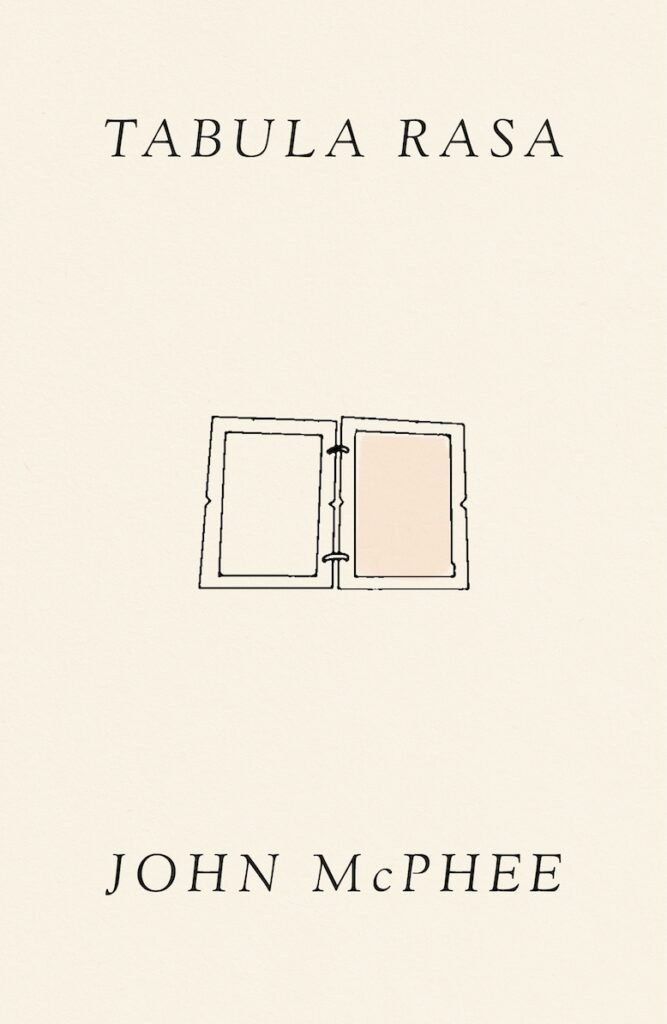
I know that’s a long ramble toward mentioning my delight as I was reading John McPhee’s new book, Tabula Rasa. It’s a memoir of sorts and a book about writing and not writing. It offers a collection of brief, miscellaneous pieces reflecting dives into McPhee’s old files to recount how and why a particular story idea didn’t pan out. Or did. Deep into the short book, he writes about the origins of Oranges. He’d noticed an orange-squeezing machine at Penn Station, and one question led to another. Then he dropped into the office of William Shawn, the editor of The New Yorker, where McPhee at the time was still pitching ideas on contract while teaching and hoping to become a staff writer. One idea or another failed to spark Shawn’s interest. Sometimes, McPhee realized, Shawn might have been protecting the turf of another New Yorker scribe. Then McPhee offered one word. “Oranges.” And he got Shawn’s classic green light: “Yes. Oh, my, yes.”
McPhee’s Tabula Rasa is engaging, charming at times, surprising, humorous, typically masterful and typically dense with detail—the annals of Princeton, New Jersey, for example—that might not appeal to every reader. Still, he manages to turn some of the raw driftwood into intriguing sculpture. He recalls, for instance, how he once thought about exploring one or more of the dozens of towns named Princeton across the nation. Ultimately he dropped the idea as the equivalent of the uninspired journalism practice of anniversary stories, or “of wilderness camping by Jeep Cherokee, of psychoanalyzing the Mummers Parade.”
We learn about the Leaning Tower of Pisa, the monkish pharmalinguists at drug companies who invent unintelligible names for generics, a Hemingway aficionado who happened to be a mediocre journalist he once spied around the bull run at Pamplona, and how certain travels and failed projects may have influenced McPhee’s two younger daughters, both of whom became writers.
The book made me want to go back to some early McPhee pieces—especially one about Kentucky bourbon—that eluded my attention or a place on my book shelves. And it reminded me to marvel again at the depth of McPhee’s reportorial memory and achievements in science and history; at the curiosity that takes readers into the lives of interesting people we might not otherwise meet; and at his ebullient mastery of language and the craft of story.

A Suite of Jazz Poems
in poetry
Over the last few years i’ve found a place for some of my jazz poems at JerryJazzMusician.com, a hand-built enterprise that offers a wide array of music-inspired study, commentary, history, and creative production. See the editor Joe Maita’s recent interview with Glenn Mott, who edited a collection of Stanley Crouch’s previously uncollected essays and critical pieces, Victory is Assured. (I wrote about Crouch’s book for KC Studio last September-October.) All well and good, but I thought it might be a decent idea to round up some of my poems that Joe has published. Given that my poetry practice remains mostly a private affair, I’m grateful for the outlet.
Piano
“In the creative state a man … lets down as it were a bucket into his subconscious…”
—E.M. Forster
.
Taking Forster’s bucket
into the unknown
like Keith Jarrett
in Bremen sailing
into pianissimo
pedals and digits and the dust
of oblivion all summoned
to transform silence
into a path where
bees sting where
hearts bleed where
buckets slosh and spill
torqued with bop and bounce,
they teeter back toward
stillness.
……………………..first published in New Letters
The Night I Heard Mose Allison Sing
Was in 1984, not yet 20 years after
I’d first heard that Southern drawl, soft
as cotton or Mississippi silt,
and those plaintive and wacky blues
lyrics that floated out of my little radio
in the night air.
But now, in the heart of the country,
Mose was looking academic, his gray hair
and beard neatly trimmed. He wore
a seersucker jacket.
At the piano, with a local bass player
and drummer I knew,
Mose first launched into a boogie-woogie
rhythm, with slightly skewed riffs, just
off balance. There was a maelstrom of
notes in double time, and I wondered,
as those sounds reached my ears, if I could characterize
it all as Looney-tunes meets Fats Waller meets Chopin.
Or maybe just Waller and Chopin, piano stars
of equal stature, I’d say.
Fifteen minutes into the piece, he shifted
to a darker place, then back to this
orchestral craziness. (Do you remember
this, Bob Bowman, deep in your string bass
aural archive? Would your fingers ever
recognize that jazz abandon again?)
Then we applauded Mose’s ear for a great
song, Percy Mayfield’s “Lost Mind,” and
I can still hear Mose sing, “If you would be so
kind as to help me find my mind…”*
After another offbeat tune,
Mose slowed down to sing
“Everybody’s Cryin’ Mercy,”
which speaks to us today
in the darkness: “people
running round in circles,
don’t know what they’re heading for.”*
I could name all of the songs he played,
because just now I found the notebook
where I wrote it all down, his tributes
to Duke Ellington, Willie Dixon
and the lesser-known Johnny Fuller,
a blues man who came out of Mississippi,
landed in Oakland and within 12 months
of this glorious Mose night
would be dead at an age we all hope to live past.
It looks like I must have written down
all the words, as Mose sang them, of “How
Much Truth,” not
knowing then one iota of what I know
30-plus years later about truth and whether
the world is “left without its daydream…
threatened by the works of man…Destined
for the frying pan.”*
Mose, dead now just one month
at the age of 89, took his piano
to the edge of chaos
more than once that night. That’s what
we live for, the truth and transformation
in music, crystalline moments that help us find
our lost minds and deliver meaning
in the love and the mist.
.
Quoted lyrics by Percy Mayfield (“Lost Mind”) and Mose Allison (“Everybody’s Cryin’ Mercy,” “How Much Truth”)
.
by Steve Paul
Body And Soul
The jazz man spoke
of his ancestors, the
lineage that brought
him to where he is.
Do not shine your
light on yourself, he
told the students
gathered around.
Honor the past,
honor the trials
of simple existence,
honor the pain and
blood that came
before you, and the
greatness that grew
despite all of that.
When he riffed
on “Body and Soul,”
the sounds coming
from all his circuits,
darting in and hinting
at the melody as we
knew it, reshaping,
and making the song his
own body in the moment,
his soul saxed message
was obvious, went
straight to the
heart and the blood.
.
by Steve Paul; in tribute to Logan Richardson
The Horn
The neighbor with
a trumpet stumbles
through “Watermelon
Man” on his porch,
an act to mitigate
loneliness perhaps
to reach beyond
the distance of
homeboundedness
“Lean on Me,” he
tries, knowing
we’ve lost the
songwriter who
made it an anthem
the notes skitter
around Withers’
melody like scouts
on a mission
securing the
perimeter,
protecting the
body and its
fragile
hymn.
.
by Steve Paul
Three Tiny Poems
Nutty
The twirler, the plinker-plunker
be minor, be diminished,
be neither of those things,
the waking, the daily glories,
the human scales
and ache-y arrows to heart, to ear,
I dream of Monkishness supreme
.
Ornithology
Bird call this morning is alto-sax heir of
that Bird, jabs and run-ons and then a melodic line
flits in again;
outside, the sun: dog on a leash,
finches galore stab at seeds,
everyone wonders
what else is there?
.
Havana Vibes
A conga player collides with “Pork-Pie
Hat,” the woman vibist fists two mallets,
follows bandmates into a driving, propulsive sound—
her stance languid, lanky, her long arms made moreso
as she stares into the music, now a Cuban bounce
thick like picadillo with piano and drums one on top of the other,
her mallets fly above like lightning bugs in the night.
Art in Balance: From Anadol's AI Ooze to Serra's Steel "Equal"
in art
First posted on FB, Feb. 16, 2023.
I had an hour or so to spend at the Museum of Modern Art yesterday, and it occurred to me later that in my random wanderings, mostly through recent and contemporary art, I'd experienced a kind of yin/yang revelation. On the one hand there was the astounding, rather psychedelic, machine-dream digital video creation of Refik Anadol, "Unsupervised." The pulsing, wall-sized, ever-evolving blob was a kind of macro abstraction in three-dimensional motion, which (and speaking of AI) had its origins in actual MoMa imagery transformed by the computer brain. It was mesmerizing, performatively electric and extremely captivating given the quantity of phone cameras and gawkers (self included) in its presence. On the other hand there was the room that held Richard Serra's "Equal," a suite of four stacked pairs of steel cubes. This, I realized, was Anadol's opposite, an experience in solidity and stasis. Mesmerizing in its own way, it asks us to slow down and look inward. MoMA The Museum of Modern Art


