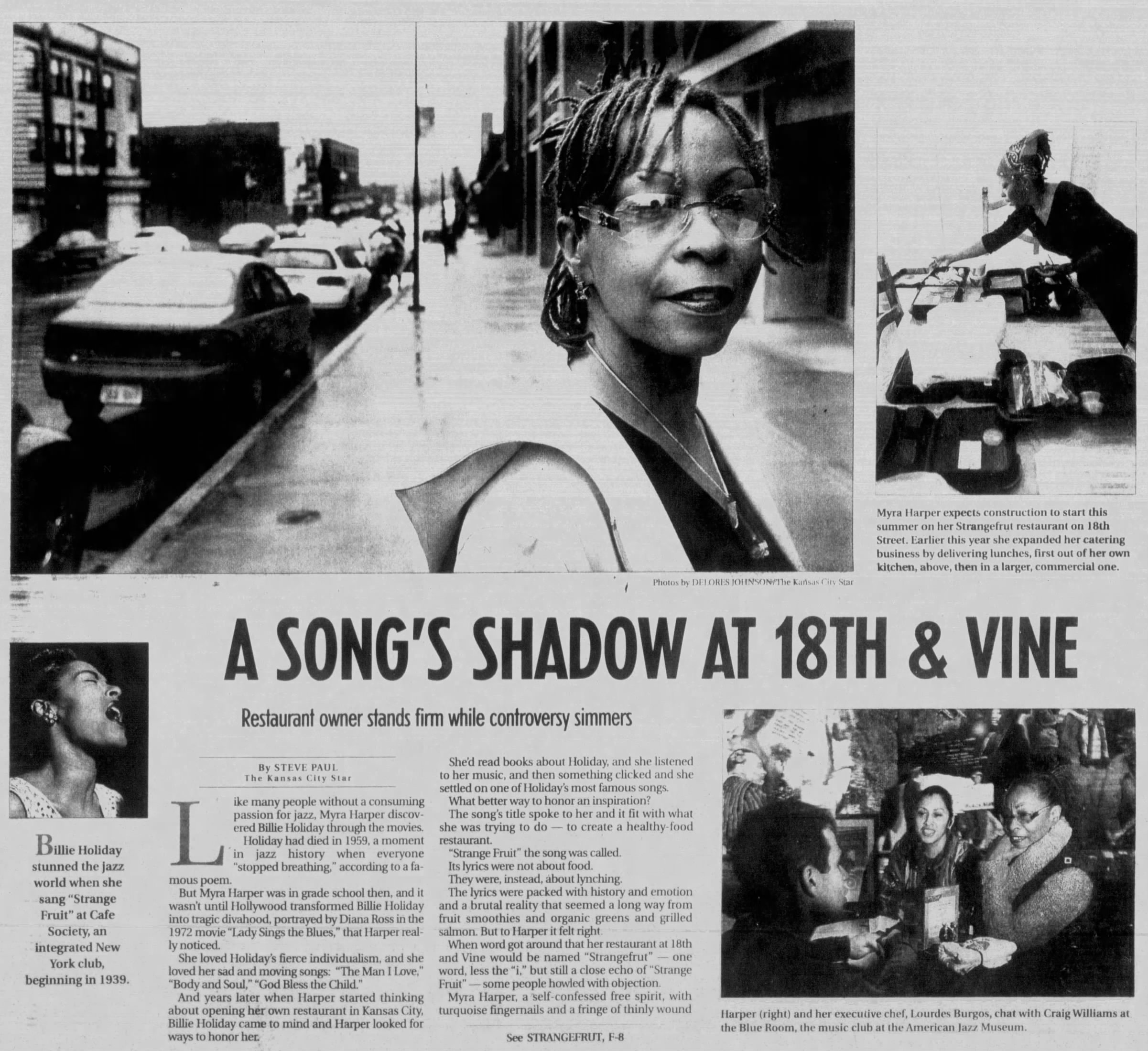
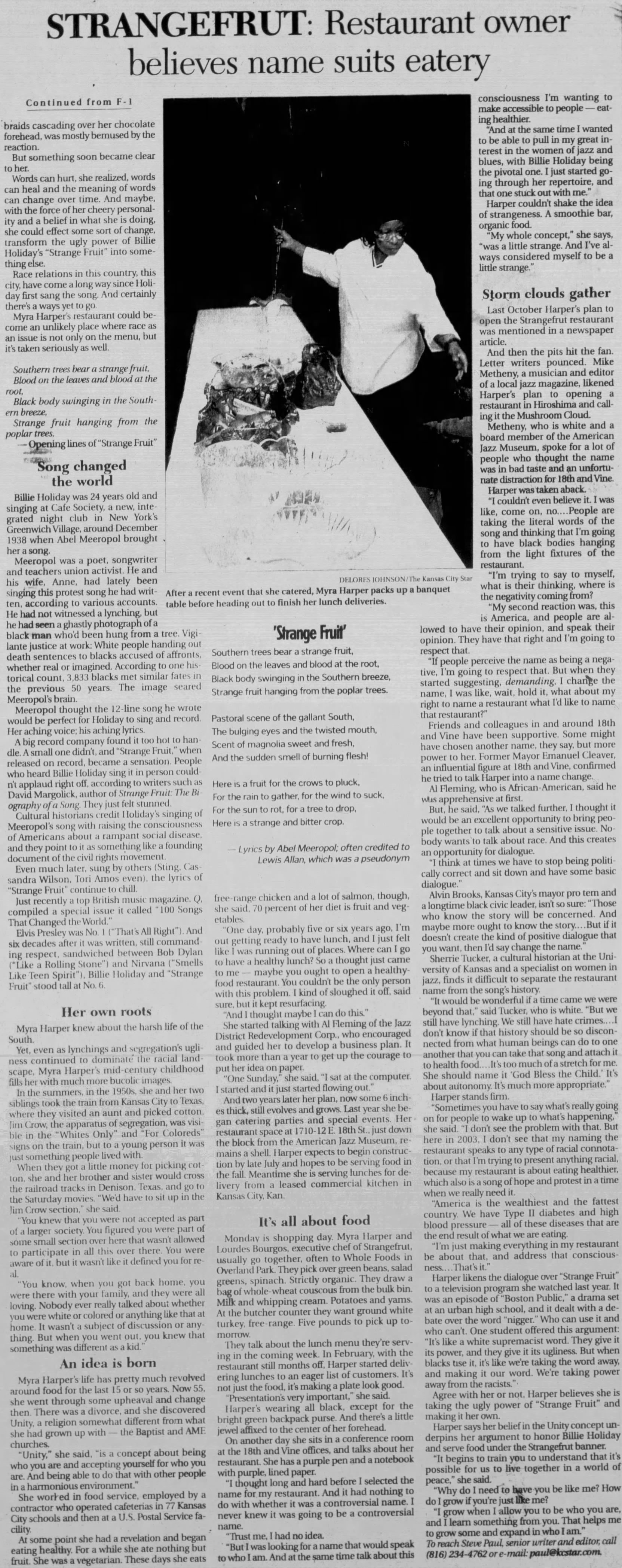
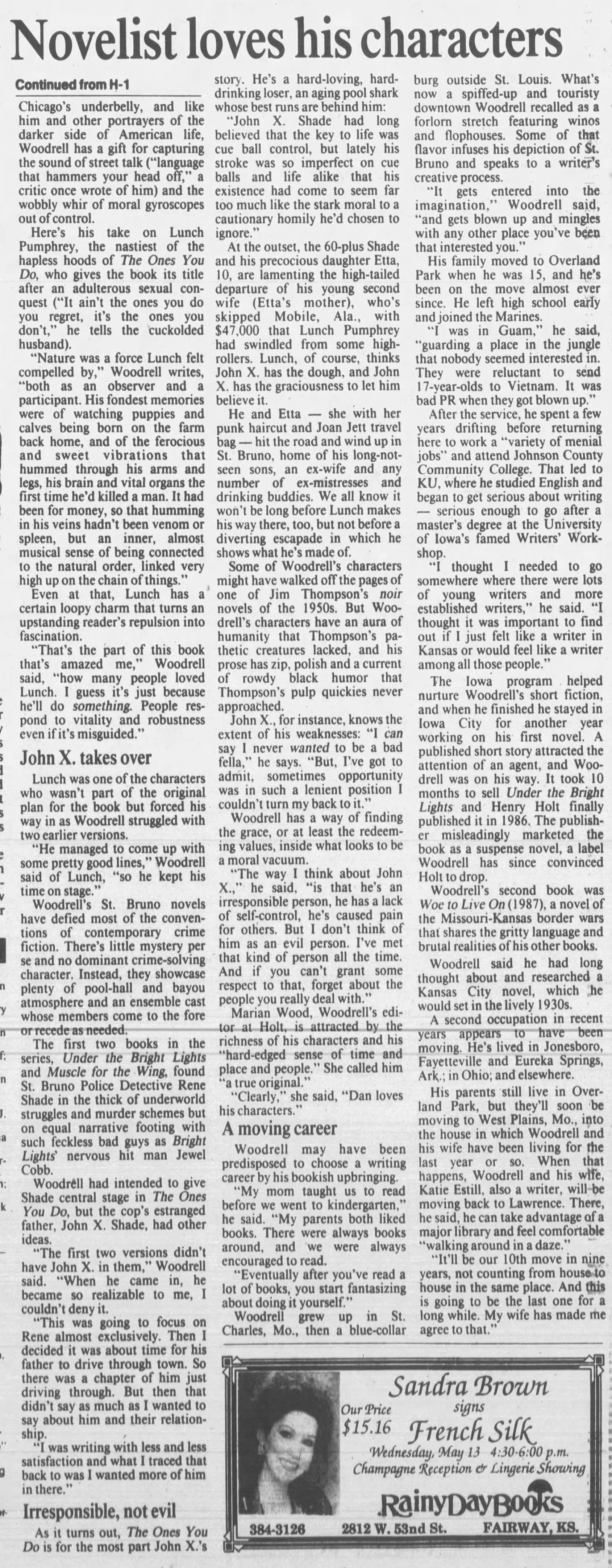
Local news reports have noted, without much detail, that the plan to open a lounge in the burgeoning riverfront district of Kansas City has gone awry because of its intended name, Sundown Hi-Fi. The name was deemed too controversial for the district’s developers because of the word’s association with the ugly segregationist history of the American south. I thought it might be useful to note that a similar thing occurred in Kansas City more than two decades ago. Of course, my long profile piece about the matter, from 2003, doesn’t exist in The Kansas City Star’s often pitiful online archive, so I’ve retrieved it from newspapers.com.
kansas city star
From the Archives: Remembering the Literary Mastery of Daniel Woodrell (1953-2025)
By Steve Paul
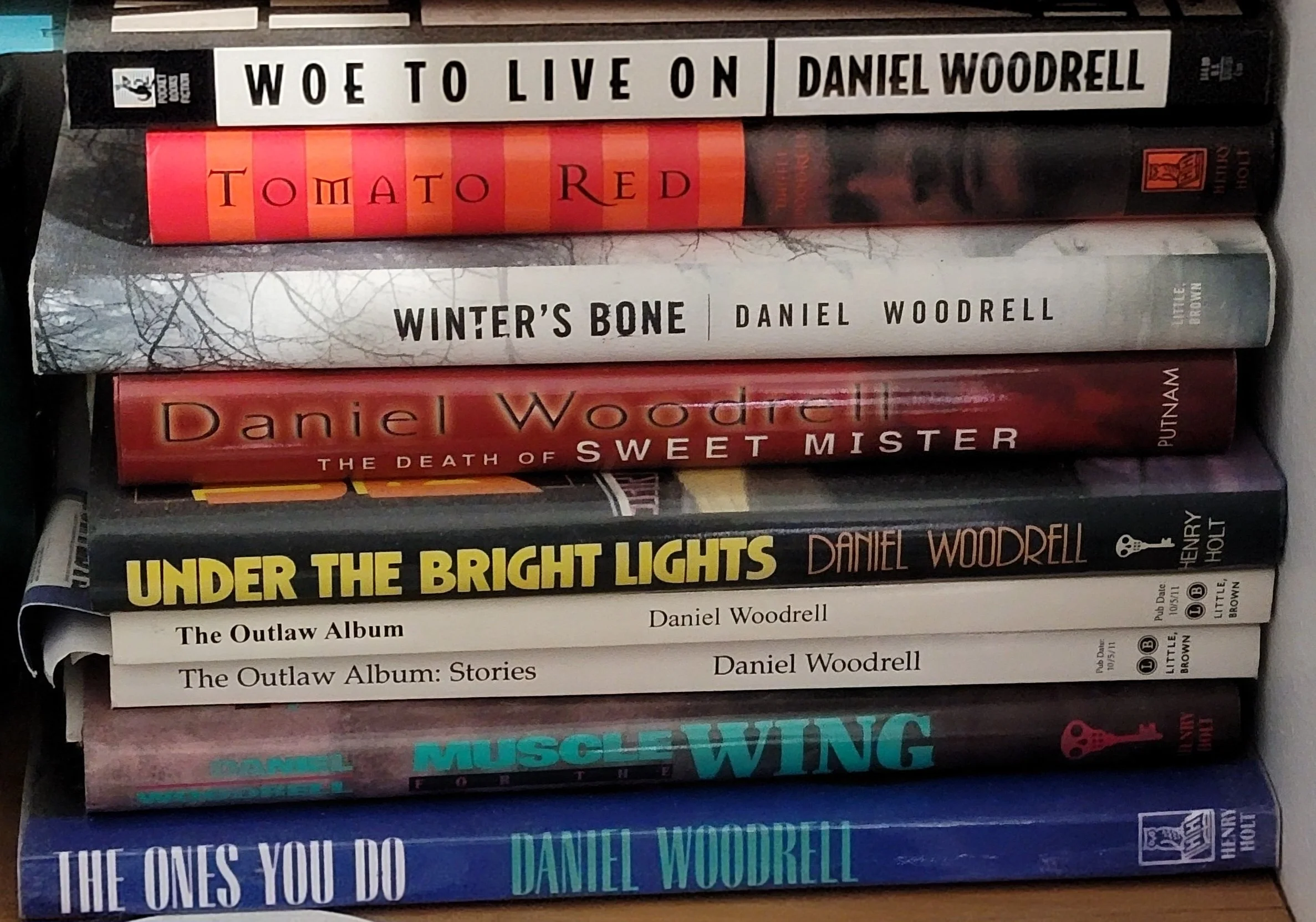
This week we received the devastating news that Daniel Woodrell, the Missouri-based author of a superb series of novels produced over the last forty years, had died of pancreatic cancer. He was a mere 72. I regret even more that last March, when we were traveling to a conference in Alabama I failed to make an advance connection with him and I missed an opportunity to get together while passing through West Plains, MO. His reply to me at the time, included this: “I finally started reading Connell seriously and geez he's got it all.” I know we had crossed paths when I was working on my biography of Evan S. Connell, and I’m glad he got the urge to read more of Connell’s work.
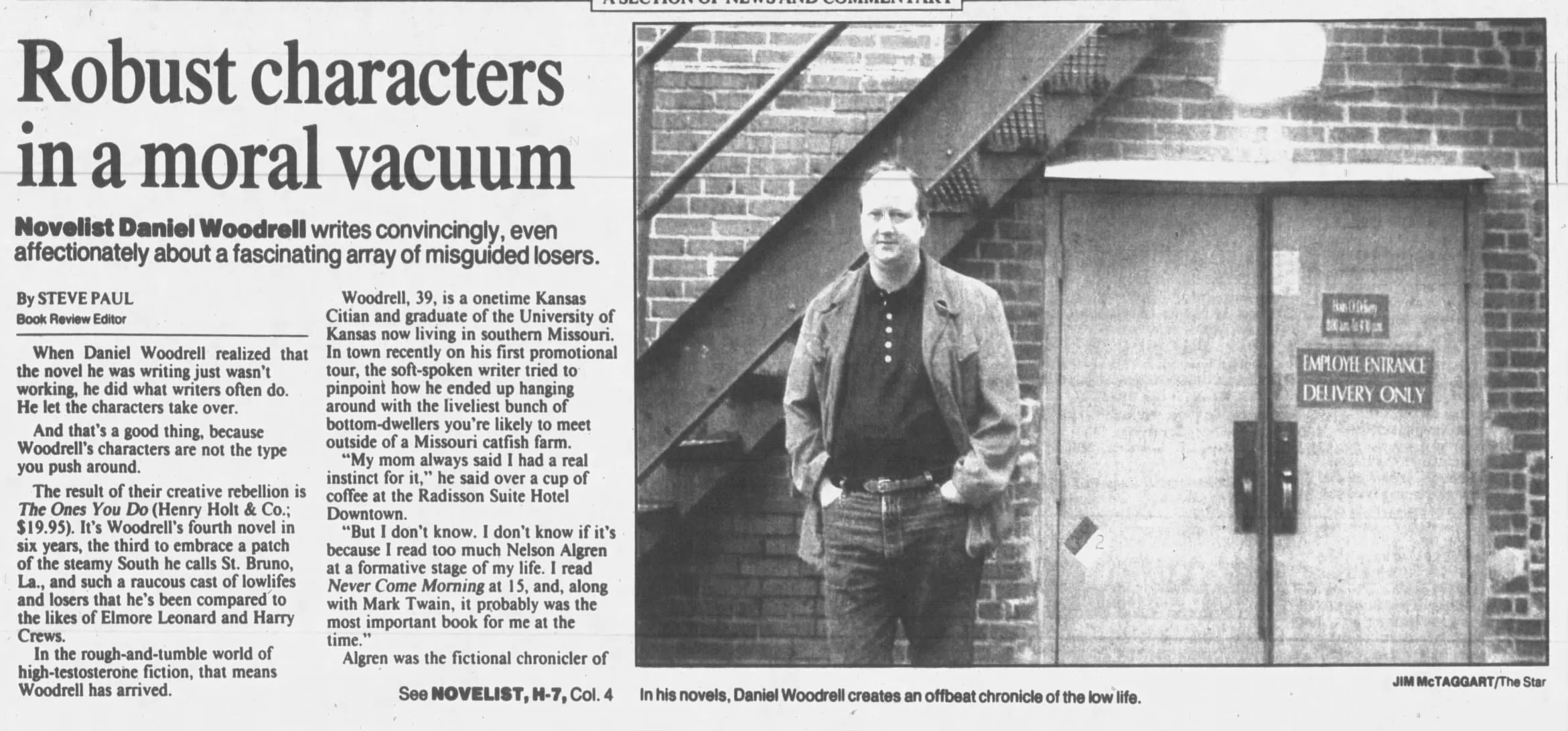
I knew I’d written about Connell a few times over the years, and I was heartened to unearth some of those pieces. He would have come on my radar circa 1987 when, as book review editor at the KC Star, I assigned his civil war novel to another fine writer with a western bent, the late Lenore Carroll. My first interview with him occurred about five years later, in 1992.
I was pretty sure I’d reviewed the fabulous Winter’s Bone but I’d forgot that I paired that with Cormac McCarthy’s The Road. So that one turned out to be an interesting read and memory jolt. I’m not prone to quoting myself, but 20 years later I felt somewhat good about this piece: “Woodrell lives in the hills and absorbs their currents. He captures the acts and language of the disenfranchised, the downtordden, the mischievous. his characters tend to be aggressively anti-social or behavioral screw-ups, ‘scornful of town law and town ways, clinging to their own.’”
Two years after the novel came out, I used Winter’s Bone in a class I was teaching at Knox College, and I was surprised when the students turned out to be less enthusiastic about it than I was. Probably a combination of their rich-kid privilege and my lousy teaching. No big deal. But I also loved the movie version, wowed by its faithfulness to Woodrell’s story and the absolutely stunning presence of Jennifer Lawrence in the starring role as Ree Dolly.
I was also happy to be reminded that I heaped praise on Daniel’s later novel, The Maid’s Version, a remarkable example of his ability to mine and transform real, historic events from his native state’s hidden corners.
When I was putting together the short-story collection Kansas City Noir something like 14 years ago, i was eager to include Daniel. My recollection is his entry came very late in the process, but he was such a meticulous writer and his story, Come Murder Me Next, Babe, was so eerily fine (based on another true-crime tale), I didn’t care. If you’re looking for an entry point into Daniel’s work, you could start there and quickly move on to Winter’s Bone.
Each of the reproductions below come from the pages of The Kansas City Star — from 1987, 1992, 2006, 2013.



Portrait in Love and Acid: On the Burns-Novick 'Hemingway'
My old newspaper, the Kansas City Star, which was Hemingway’s old newspaper, asked me to weigh in on the PBS biography, “Hemingway.” Why not? I spent a dozen hours watching the six-hour series twice and I caught eight of the nine pre-show panel discussions, which amounted to one of the most extraordinary promotional campaigns I’ve ever witnessed. I can’t say I’m one of Ken Burns’s biggest fans, but it’s hard not to be impressed by the sheer procession of material he and his colleagues manage to corral and by the compelling testimony they extract from their lineup of experts, several of whom I know. The documentary’s story line comes down to “he was complicated, more complicated than you ever thought.” Well, yes, but….Here’s a link to my essay-review:
https://www.kansascity.com/entertainment/tv/article250128694.html
Image above: Sketch by Luis Quintanilla.
The Kansas City Star Leaves its Historic Home
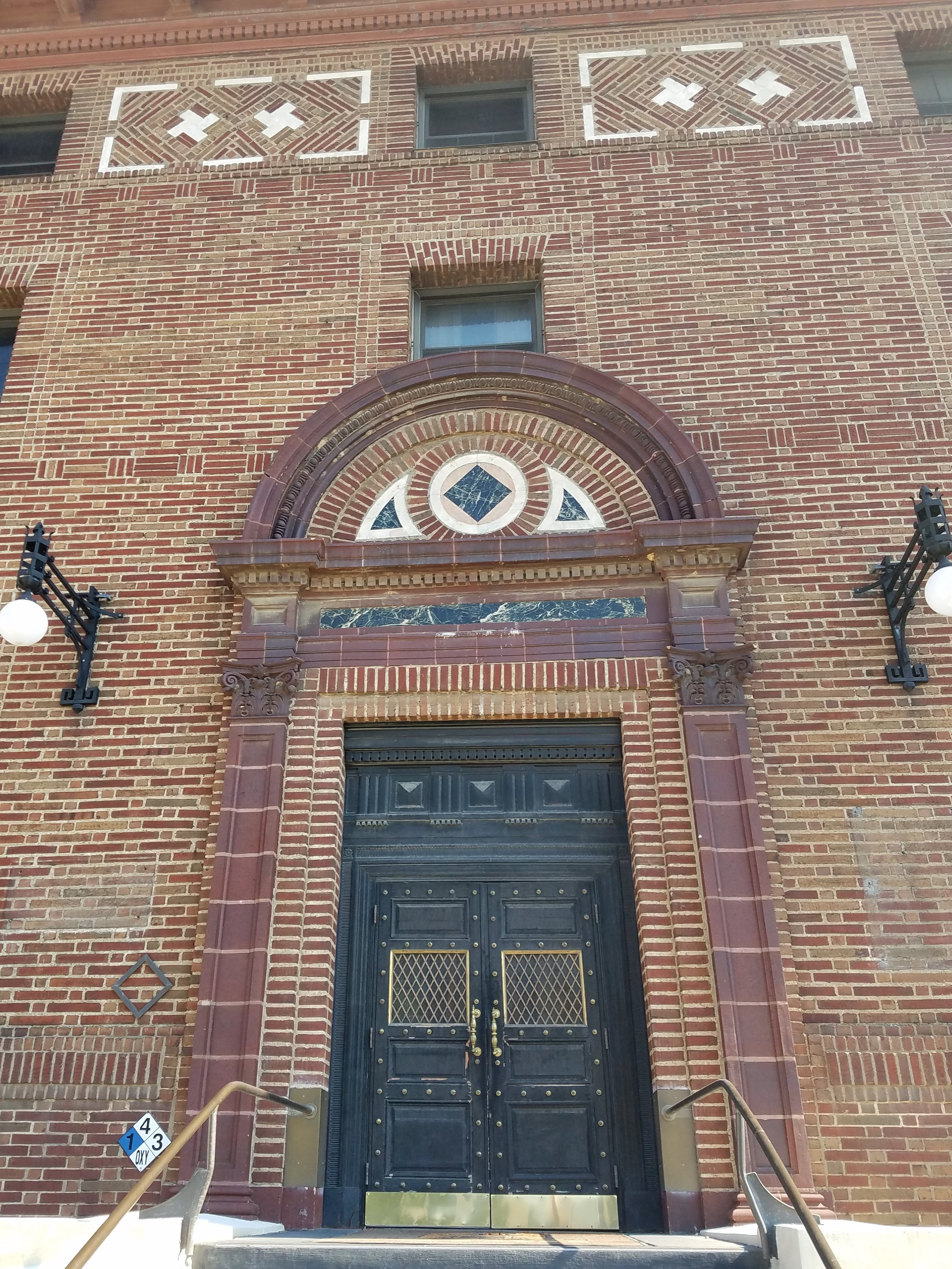
My friends and former colleagues at The Kansas City Star packed up their stuff the other day and moved from their historic building at 1729 Grand to new quarters in the printing plant across the street. The old brick building is bound for a new future. I wrote this piece for the Connecting blog, which maintains a network for the Associated Press. The AP's Kansas City bureau was housed at 1729 Grand for something like 60 years, so it shares in the building's history as well.
Here's the link (scroll to the second item on the page: http://campaign.r20.constantcontact.com/render?m=1116239949582&ca=fe15d003-e1fc-4e3e-b443-141c3f2edd47
Discovering Hemingway's Legacy at 1729 Grand
I wrote this piece originally for an Associated Press blog published daily by former Kansas City bureau chief Paul Stevens, he of the near mirror-image name.
In my earliest days at The Kansas City Star, the AP officed on the third floor in the temple of journalism that William Rockhill Nelson built, and Ernest Hemingway's ghost was hardly around.
Hemingway had been dead for a decade, and, to me, he was just someone whose work I'd read in school. I don't recall any substantial discussions about him in the building, nor was I impressed that his name appeared in bronze on a plaque that listed Star staffers who served in the first world war. It would be years before I began to appreciate not only his place in American literature but also his legacy as a cub reporter in the very newsroom where I spent more than 40 years as a writer and editor.

A WWI service plaque in the historic Kansas City Star building keeps the Hemingway link alive. I'll be curious to know where the plaque will go when a new owner takes over the building..
By 1999, the centennial year of Hemingway's birth, I had leapt into his world with abandon as I prepared a special-section tribute for The Star, "Hemingway at 100." I read deep into Hemingway's work, met many literary scholars at conferences, and began researching his life and work, especially his Kansas City period of 1917-18.
It seemed like such a folly, expecting to find morsels that hadn't already turned up in the many Hemingway biographies and scholarly works published even then. But I trudged on periodically, examining Hemingway's papers at the John F. Kennedy Library in Boston and elsewhere, inching through The Star on microfilm, and traveling to places that shaped the outsized talent, who possessed an indelible sense for the art of the word along with a knack for bombast and bad behavior.
When I chose to retire from the newspaper in March 2016, it was full-steam ahead on the biography that I'd been scratching at for too many years. A couple of months into the new round of work, an important insight emerged. For all those years I thought I'd been working on "Hemingway in Kansas City." But who would care about that? I finally realized. The morning that I reshaped my project as "Hemingway at Eighteen" turned out to be critical. Long story short, I refashioned a formal proposal that I'd been floating and within two weeks sold the book to an editor at the Chicago Review Press. The expanded time frame allowed me to take Hemingway from Kansas City to the ambulance service in Italy, where, two weeks before his 19th birthday, he suffered a near-death wounding on the war front along the Piave River.
Those two peak, teen-age experiences now form the bulk of my book.
At a conference last spring, I learned that slice-of-life biographies had taken the publishing world by storm. Sure, full-life biographies remain the ultimate standard for many authors and readers. But the kind of closely focused books expertly cast and popularized by my friend Candice Millard (on Teddy Roosevelt, President John Garfield and Winston Churchill) have blossomed. Ever since, I've been saying that of the dozen or more Hemingway books appearing in 2017 alone, mine, I'm sure, is the sliciest.
The book, subtitled The Pivotal Year That Launched an American Legend, begins with the recent high school graduate unsure of what to do with his life as he worked his family's vacation farm fields in Michigan and fished for trout. College was out of the question for a while, and Kansas City became the default when Hemingway ultimately determined the Chicago newspapers weren't hiring but an uncle could get him a job at The Star. Kansas City's lively, gritty and sometimes mean streets, along with the newspaper's colorfully intense daily grind, served as something like a college education for Hemingway. The book details some of his more notable pieces for the paper, presents some little-known background about The Star and the city, and delivers some previously unheard contemporary voices about Hemingway, the budding writer. For the world of journalism, it also raises new questions prompted by a surprising piece of history I was finally able to confirm after many years of trying - the time that Hemingway was called to testify before a federal grand jury.
Hemingway at Eighteen comes out in October, 100 years after Hemingway's arrival in Kansas City. And 100 years after the very beginning of his self-invented life as a writer.