Literature

In Search of Gale Zoe Garnett: A Literary Haunting

I first posted this piece on August 1, 2026, on my Substack site. It carried a subtitle: “How an Unexpected Project in Biography Might Begin.” I’ve made some investigatory progress since then, but I’m holding off on expanding the piece until more details emerge and as I experiment with aspects of the narrative that might result.

By Steve Paul

(c) 2026

Gale Zoe Garnett, a pop singer and actress who came to prominence in the 1960s, is something of a mystery woman who played a large role in the life of the chameleonlike writer Evan S. Connell, whose biography I spent more than four years researching and writing.
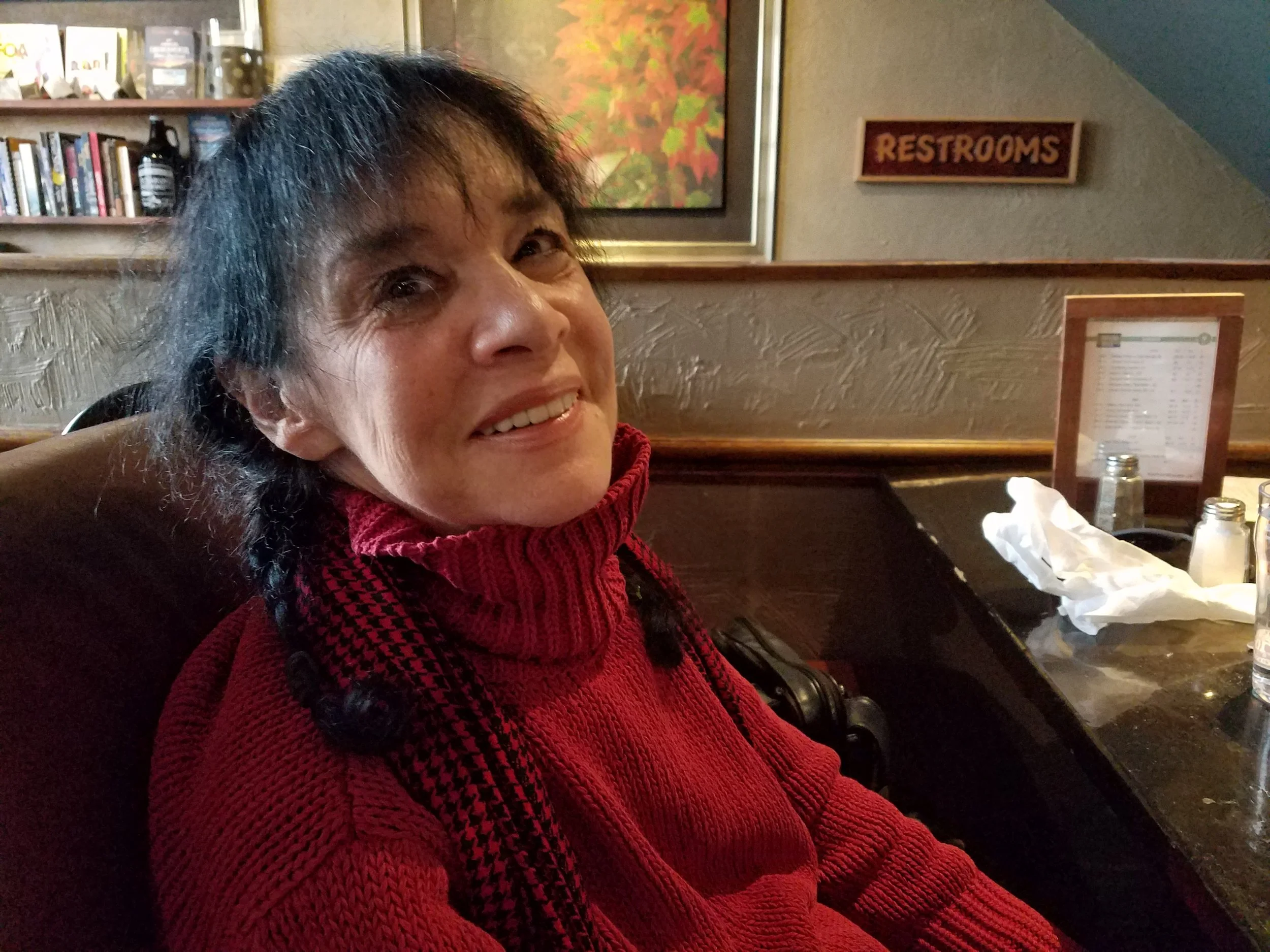
Gale Zoe Garnett, Toronto, 2017

In October 2017 I met up with Garnett in Toronto and took her out to lunch twice for interviews as I ratcheted up my project. Connell (1924-2013) was the author of a landmark twentieth-century novel, Mrs. Bridge, and a landmark work of biography and nineteenth-century history, Son of the Morning Star.

Garnett, now going by Zoe, was friendly, a bit opaque, and protective of her own life and of her memories of a man who had captivated her attention more than five decades when she was in her late teens and early twenties. In 1964 she caught the ears of millions with her pop-folk hit song about fanciful love—“We’ll Sing in the Sunshine.” She had a minor career in television and movies, and eventually she wrote at least three novels and a volume or two of poetry.

Transcribing the recordings of our conversations involved piecing together threads that started in one place then took seamless looping detours before returning (if they did) to the story lines I wanted to follow in the moment of her monologue. So what do you remember of that New Year’s Eve party at Pamela Mason’s in Hollywood?, I’d say in an effort to pull her back from elsewhere.

Just a few months after those interviews, in early 2018, my attempts to follow up with Zoe went unanswered. I began to worry about her. She had seemed frail, though bright-eyed, but I didn’t really have a clue about her existence. She’d dangled the possibility of meeting at her apartment, where, she said, there might be letters and other objects connected to Evan. She gave me directions to her place, but she put it off and it didn’t happen.
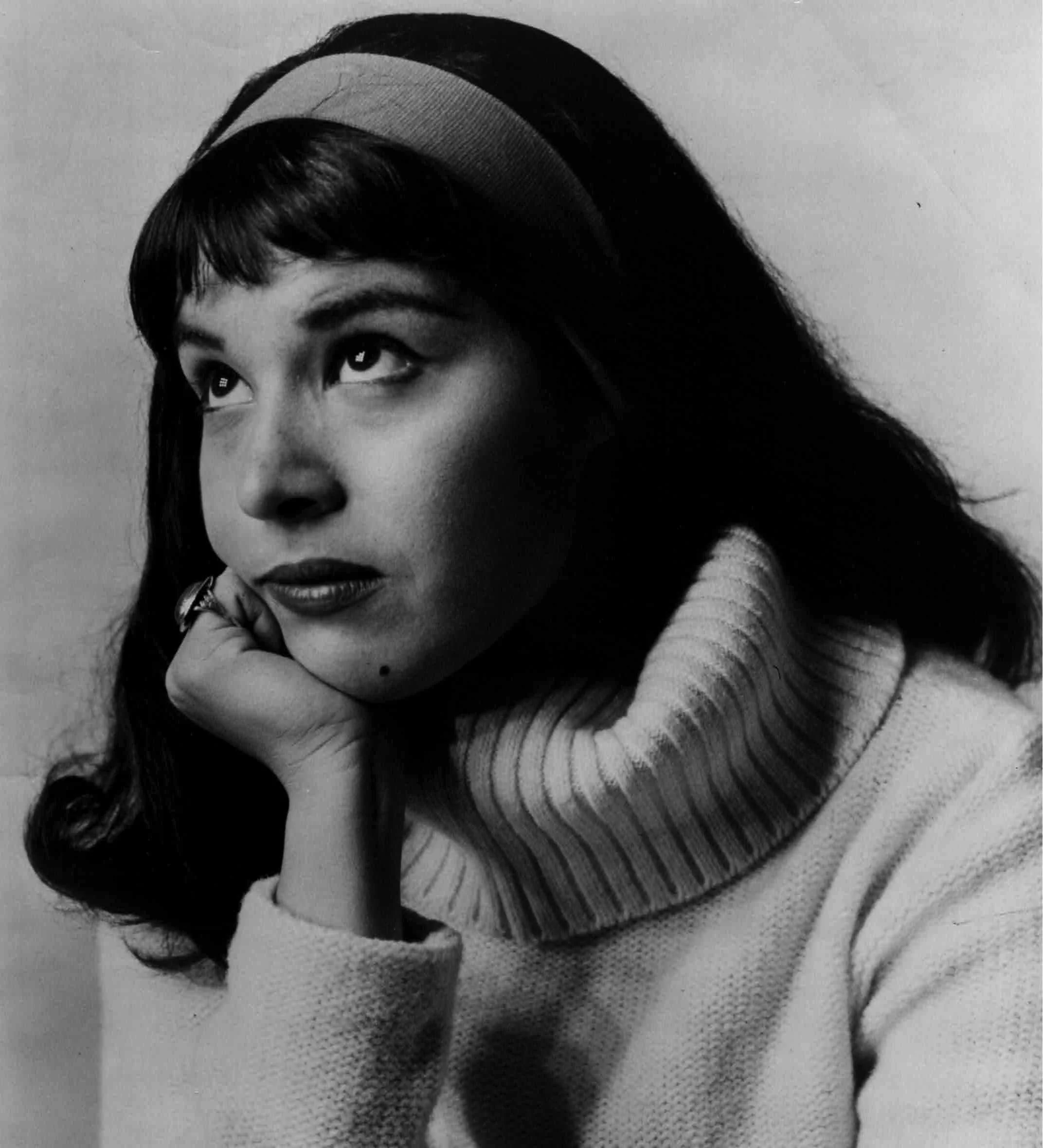
Gale Garnett, publicity photo, circa 1964.

She allowed me to take her photograph in one of the restaurants where we met (above) but was concerned that the result might not measure up to her reputation. She’d been a pop culture beauty with an exotic, dark-haired, olive-skinned look, leading Hollywood casting directors to put her in roles of various ethnic identities. Her sultry speaking style was distinctive enough that she stood in as the English-speaking voice of Italian actress Claudia Cardinale in The Pink Panther (1963) with David Niven and Peter Sellers.

Over the years I tried to find someone who knew of her and her fate—contacts in Toronto and elsewhere, the Canadian Writers Union, an organization in Visby, Sweden, where, Zoe told me, she had a living-writing studio. I got nowhere and ultimately concluded that her silence was not a personal rebuke to me but was owing to the fact that she had fallen off the grid and not voluntarily.

I\ suppose I could’ve tried harder over the years, but I’d moved on to other things. Such as finishing the Connell book and starting another. it was only recently, nearly nine years after seeing her in person, that an answer began to emerge.

Attending an international conference of the Ernest Hemingway Society in Toronto gave me an opportunity to try searching for Zoe again on her turf. Surely, I thought, some of the Toronto writers and scholars at this thing might have crossed her path. But no and no again.

One night, though, a featured speaker was Barry Callaghan, a Canadian writer, editor, and publisher. He was the son of Morley Callaghan, a journalist and writer who was a Hemingway contemporary. Callaghan père suffered the fate of being known less for his own books than for a famous boxing episode when he pummeled Hemingway’s nose in the presence of F. Scott Fitzgerald. His literary fate was partly sealed in the early 1960s, not long after Hemingway’s death, when his memoir, That Summer in Paris, was roundly and probably unfairly panned by Norman Mailer in the first issue of the New York Review of Books (“Punching Papa,” February 1, 1963).

After Callaghan’s talk, I managed to get in a few words as he greeted well-wishers and sold copies of his books and his father’s.

Yes, indeed, Callaghan knew Zoe. He and other friends used to see her frequently and would look after her. “She was destitute,” he told me, “and in bad shape.” Without pinning down details, he thought that she had been put somewhere but he’d lost track and had no idea where that might be.

I didn’t want to let that be the end of the road.

A few days later I called Gabriela Campos, Barry Callaghan’s daughter-in-law who with her husband runs his Exile publishing house. Campos had recalled seeing Gale at a book launch party for someone. But, again, how long ago was that?

Probably early 2018, she told me when I reached her by phone while waiting for a plane at the Toronto airport. Exile had published Garnett’s third novel, Savage Adoration, and she and the Callaghans maintained good relations. “We were close to her,” Campos said. “She was very fun and nice, but we lost contact with her.” Mailings of the Exile magazine began being returned as undeliverable. The publishers assumed that she was spending more time in Europe, but really didn’t know.

Campos referred me to another Toronto publisher who might know more. And indeed he did. Marc Côté, of Cormorant Books, responded quickly to my email inquiry. He’d known Zoe for more than 20 years. In 2018, he said, she underwent surgery for a brain tumor, which, of course, explains our lost connections. Two or three years later, she suffered a stroke. Her mental faculties were in obvious decline to the point that she became a ward of the province of Ontario.

In emails, Côté recounted his deep friendship with Zoe and we discussed her relationships with the likes of movie director John Huston and former Canadian prime minister Pierre Elliott Trudeau. We also bantered about the mystery of her age, which in the public and private records is all over the place.

She had explained her connection with Connell and others as well as the confusion of her birth year in our 2017 interview:

“I just always liked older men, because they knew stuff. I didn’t have a chance to go to university or even upper level, the collegiates, because I had to support myself. There was no choice. I was it and because my father had died when I was 12 and a half and my mother went off with a man called Nigel. So I had to hold it together, which meant a lot of lying about my age, a lot of bogus papers. To this day, I’ve got five ages on the internet. It was just, I had to.”

In 2000, shortly after Trudeau died, the byline of Gale Zoe Garnett appeared above a remembrance of Trudeau, with a revelatory aside, published in the Globe and Mail, one of Canada’s leading newspapers. She knew him for 20 years or so, and their relationship had been no secret. “He was a brilliant father,” she wrote, “the best I’ve ever seen (and I, for my own reasons, study fathers constantly).”

So, down this rabbit hole I’ve gone—retrieving my extensive notes from the Connell project and her many letters to Connell and Huston, revisiting her record albums I’d found along the way, reconsidering the wealth of material in the transcription of our interviews.

Connell was the strong and silent type. Handsome as all get out, he’d had a good run of girlfriends and never married. Garnett was the love of his life, his publisher, Jack Shoemaker, told me. Zoe once told Shoemaker that while visiting Evan near the end of his life, the epically laconic writer said, “You know, I love you.” “Why did you never tell me?” she replied. “I thought you knew.”
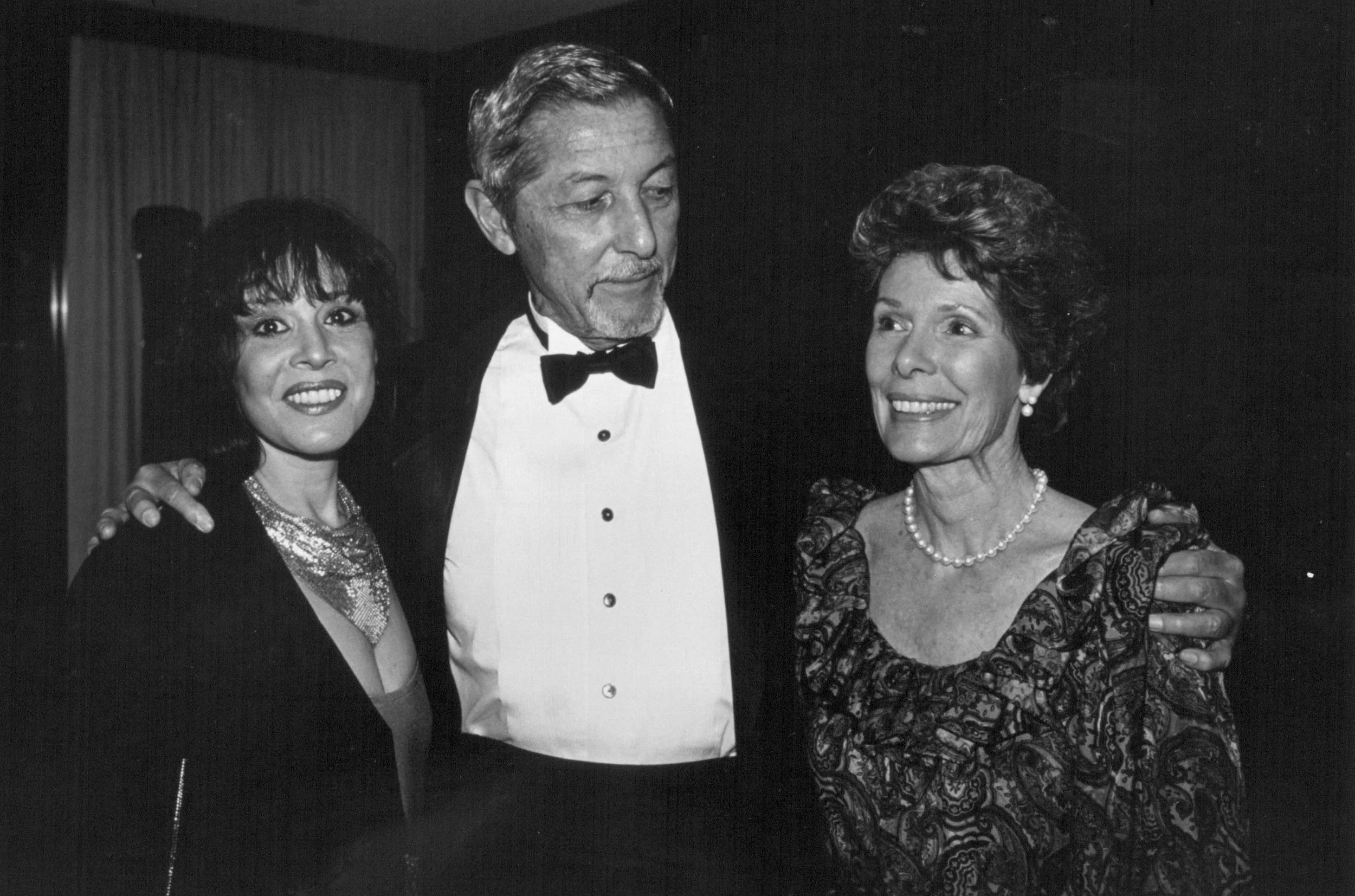
Garnett with Evan S. Connell and his sister, Barbara Zimmermann, before the Kansas City premiere of the movie Mr. and Mrs. Bridge, 1990. Photo courtesy of Janet Zimmermann.

In 1989, Zoe spent a couple of months in Kansas City, Connell’s original hometown. Connell had gotten her a role in the Merchant-Ivory movie Mr. and Mrs. Bridge, which was based on his two novels about a mid-twentieth century American family. In addition to the workings of the film production, I’d gathered some odd details that never made it into my book. For one thing, some locals took them to see the Rolling Stones at Arrowhead Stadium. I can’t imagine Connell enjoying it, but Zoe, the onetime rocker and Sausalito radio host, probably did.

Where is all this heading? Do I need another book-length project right now? Does Gale Zoe Garnett, a fascinating woman who lived the proverbial unfiltered life, deserve a full-fledged treatment?

I much regret the lost opportunities as well as Zoe’s sad and troubling fate. But the writing impulse has been unleashed, and I feel as if, now that the haunting gap has been at least partly filled, I might owe her story more of my time.

Steve Paul’s book Literary Alchemist: The Writing Life of Evan S. Connell was published by the University of Missouri Press in 2021. He is president of Biographers International Org.
How chess channeled the dark visions of Evan S. Connell

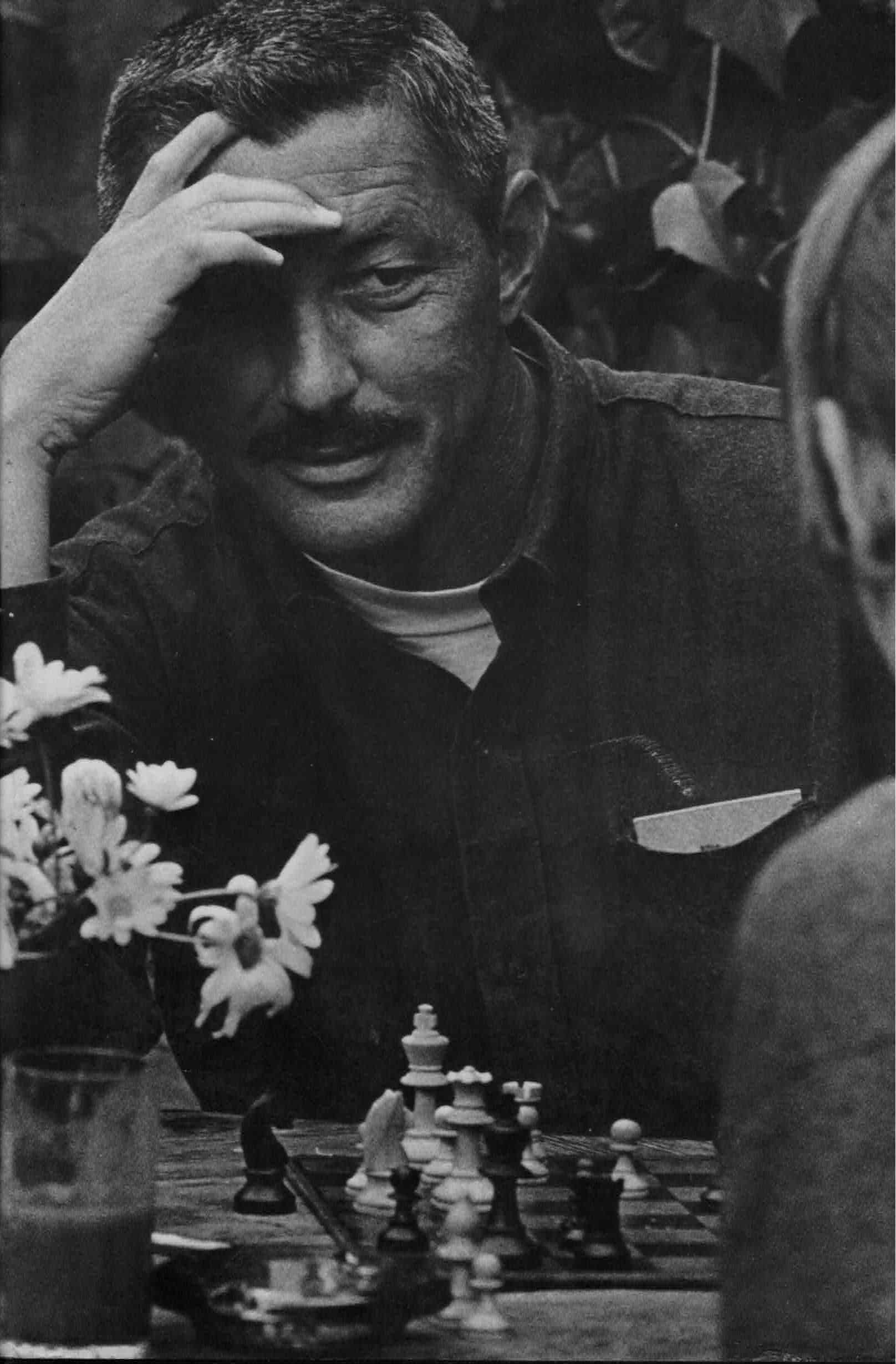
I wrote this standalone essay while finishing my book. It recently appeared online at New Letters (https://www.newletters.org/digital_features/steve-paul-spring-2022/). The photo here of Connell in the midst of a chess game is by Eve Crane and comes from the back jacket cover of Mr. Bridge, published by Knopf in 1969.

By Steve Paul

It wasn’t surprising to learn, early in my research about the underappreciated American author Evan S. Connell, that he harbored a habit for chess. Connell (1924-2013) was a notably introspective and private person, a writer given to long, self-directed intellectual pursuits. So focusing his attention onto a chessboard while hanging out in a bar came to him naturally.

            As a denizen of the so-called No Name Bar in Sausalito, Connell often could be found at a quiet, back-corner table nursing a beer or a martini and buried in a mano-a-mano round of chess.

            But Connell, whose best-known titles are the minimalist novel Mrs. Bridge (1959) and the maximalist work of Indian-war history Son of the Morning Star (1984), went even further with this obsession. In one of his more challenging yet astutely composed books, Connell employs a game of chess as a recurring device.

            At a time when a popular Netflix series, “The Queen’s Gambit,” has brought new attention to the brainy board game, Connell, something of an unacknowledged pacesetter of late twentieth-century literature, can offer a new and wholly unexpected point of entry.

             Points for a Compass Rose (1973) was the second volume of a fragmentary, genre-bending literary project that Connell began a decade earlier in Notes from a Bottle Found on the Beach at Carmel. Its form is epic poetry, though it mostly reads like meditative and argumentative prose. Its content is a guided tour of deep human history. Despite Connell’s protestations that he was no poet—and reviews that said much the same—the book was a finalist for the National Book Award in poetry in 1974. Annie Dillard once declared the two books to be masterpieces. “You could bend a lifetime of energy to their study,” she wrote, “and have lived well.”

            In Points for a Compass Rose, Connell’s nameless narrators evoke the follies of violence, vanity, and debacle from ancient times to the waging of the Vietnam War, which was still under way at the time he wrote. And embedded periodically from beginning to end are a series of chess moves.

            “The colors of a chessboard represent our two conditions,” Connell writes, “which are Life and Death.” He goes on to describe how the white and black chess pieces represent a diversity of men who “contend together and finally experience a mutual fate leveling all ranks.” There are ancient judgments we readers must contend with: “the Queen moves aslant because Woman is greedy and not to be trusted” and “the King…moves in all directions because he is law.”

            As he is about to launch into the action, Connell’s spokesman warns: “Play warily, my friend, your opponent is subtle. Take abundant thought of your moves, because the stake is your immortal soul.”

            So, in this fractured worldview, much depends on chess, a game imbued with symbol and philosophical meaning. For example, Connell notes in this kaleidoscopic work how a chess game involving a frustrated King Ferdinand of Spain contributed to Christopher Columbus’s mission to find the New World.

            Along with the chess moves, another recurring marker in Points for a Compass Rose becomes a litany of horror—the names of German death camps in World War II are followed, one by one, by the number of people who perished there. That sequence represents only a part of the book’s inventory of brutality. So, the stakes in this project are high.

            P-K4.

            P-K3.

            These are the game’s opening moves early on in the book. White King’s pawn steps forward two spaces to the fourth rank. Black King’s pawn responds warily from the other end of the board by moving one square.  

            The game winds through the book with pairs of moves appearing every 10 to 20 pages or so.

            Connell sets up the final move in the text like this (again, in a voice from his unidentified cast of narrators): “Look, I had two sons. One was killed in Asia,// the other’s lost his wits. I regard them as tokens// in a merciless game of incredible complexity// played for the most part by companies of footmen// snatched from the board by mounted knights, bishops// and other powerful opponents who are supervised// from far away by an immured and terrified king.// Tell me, did they have much chance?”

            Connell has no mercy for political leaders and warmongers who led us to disasters such as the Vietnam War.

            And then this sequence by symbolic “tokens”: P-B4, PxP.

            After 14 previous pairs of moves and countermoves, this exchange was the first direct assault, in which a black pawn captures a white one. Drawing from my rudimentary experience with chess, I can surmise that the board is now set up to witness an outright slaughter. Yet, we reach the end of the book with the game hanging in air.

            I don’t know how Connell saw it playing out. In “The Queen’s Gambit,” Beth Harmon has bedtime visions of chess challenges to come. Connell did not have the benefit of her phenobarbital habit, nor did he go in for her kind of reckless, drunken bingeing.

            Connell left us no specific commentary about his use of the chess game—in his writing or his life—except what can be found in the pages of Points for a Compass Rose. There, the battle on the board serves at least two missions. As a mirror and an omen.

Race is never far from the surface in Connell’s two Bridge novels

This essay, which I wrote before the publication of Literary Alchemist: The Writing Life of Evan S. Connell, appears as part of a package about me and Connell in an online feature of New Letters magazine: https://www.newletters.org/digital_features/steve-paul-spring-2022/

By STEVE PAUL

Evan S. Connell, the writer largely known for his portrayals of domestic uneasiness in mid-20th century America, never shied from the realities of whiteness and race.

            His two novels about a prosperous Kansas City family in the 1930s and ‘40s, Mrs. Bridge and Mr. Bridge, contain numerous incidents that peel back the scab of genteel indifference and overt scorn that white Americans brought to race relations.

             Connell wrote Mrs. Bridge in the 1950s, in the era when the civil rights movement and conflicts over the grip of Jim Crow segregation were both growing. Mr. Bridge followed 10 years later, in 1969, following the legislative successes of the 1960s as well as the assassinations of Martin Luther King Jr., John Kennedy and his brother Robert, and Malcolm X.

            But both novels looked back to an earlier period, one at least partly reflecting Connell’s own boyhood in Kansas City. He was born there in 1924, left for college and the Naval Air Corps in the early 1940s, and essentially left for good, via the G.I. Bill and a wandering spirit, a few years after the end of World War II.  

            While some readers might be aware of Kansas City’s status as a “wide-open” playground, a sin city that was fertile ground for the blossoming of the sound of jazz, the realities of systemic segregation and cultural racism were no less in force than anywhere else.

            In Connell’s novels, a reader’s sense of the state of race relations in Kansas City in that period often comes through the Bridge family’s interactions with their Black housemaid and cook, Harriet. (Emblematic of Harriet’s diminished stature is the fact that it’s not until late in the second novel, do we learn her last name, Rodgers.)  She had served them well for nine years and even loyally rebuffed another matron’s offer of $10 more to leave the Bridges and work for her.

            Another foil in Mrs. Bridge is Alice Jones, daughter of a neighbor’s “colored gardener,” whose developing friendship with one of the Bridge daughters is essentially snuffed out.

            We are meant to consider how India Bridge, the novel’s timid matriarch, welcomed daughter Carolyn’s attitude toward the Black girl, how she thought that Carolyn saw no difference between them.  

            Yet, Connell leaves the reader with the truer insight: "Soon, she knew, the girls would drift apart. Time would take care of the situation."

            In fact, “the situation” lingers in numerous ways throughout both books.

            Mrs. Bridge once had to instruct Carolyn not to refer to the maid as a “cleaning lady”: “You should say the cleaning ‘woman.’ A lady is someone like Mrs. Arlen or Mrs. Montgomery.” [22]

            And she was full of subtle discouragements and slights, intentional as well as unconscious, regarding Alice. The end came when Mrs. Bridge counseled her daughter against accepting an invitation to a party at Alice’s house. Alice lived at Thirteenth and Prospect, “a mixed neighborhood.” “Can I go?” Carolyn asked. “I wouldn’t if I were you.” [41] Connell gives the episode another look in Mr. Bridge. Later in the day, India Bridge mentions the party invitation to her husband and wonders whether she should say it would be OK to go. “I don’t want Carolyn to get in the habit of visiting that end of town,” Walter replies. “Carolyn doesn’t belong at Thirteenth and Prospect any more than you or I do. Those people resent us.” [MrB 78] It never occurs to either India or Walter Bridge where that resentment might come from.

            Late in the first novel, the Bridges hire a chauffeur, an “affable colored man” originally from New Orleans. The arrangement fizzled after a few weeks, when phone calls from the man’s creditors proved to be overly annoying. Subsequent experiences with two Asians and another Black man soured Mrs. Bridge and her husband on the idea of having a driver after all.

            Some years later, after Carolyn is married and living in a Kansas suburb, she visits her mother and mentions she and her husband were talking about buying a house, one with a decent yard and a dry basement. Carolyn now was very much conscious of “the situation.” She tells her mother of a concern about a neighborhood they’d looked at: “The niggers are moving in.” [235] Mrs. Bridge did not know how to respond. She reflected that “she herself would not care to live next door to a houseful of Negroes; on the other hand, there was no reason not to. She had always liked the colored people she had known.” Well, of course she had.

            Mrs. Bridge does tell Carolyn that surprisingly she had run into Alice one day in a downtown elevator.  It had been years. Alice now worked as a hotel maid, and Mrs. Bridge noticed how she looked darker—“so black”—than when the two girls played together. “It’s such a shame.”[236]

            In four simple words, Connell thus exposes not only the shame but the tragedy of white privilege and the enduring pain of the “all-American skin game,” as the late Stanley Crouch once put it, albeit in a somewhat different context. Carolyn suggests there’d be no reason for her to visit Alice. She wouldn’t know what to say.

            As Connell returned to the family portrait a decade later in Mr. Bridge, the subject of race becomes even sharper. American cities, including Kansas City, had been burning, and the toxic atmosphere couldn’t help but inform Connell’s vision as he reflected on a societal landscape of two or three decades earlier.

            It’s likely that Connell was also stirred by an increased understanding of the disturbing racial picture emanating from his old home town.

            By the early 1960s, Connell, while living in San Francisco, had attached himself to a literary magazine, Contact, published across the bay in Sausalito. Connell became a co-editor and some of his work had appeared in the journal in recent years, including segments from Mrs. Bridge several months before its arrival as a novel.

            In 1963, Connell produced an editorial comment—it was unsigned, but I’m certain of his authorship—about a Kansas City, Kansas, family who were snared in a web of injustice and tried to do something about it. The Shanks family refused to send their children to a segregated school, were not allowed to send them to a white school, and were fined when they chose to teach them at home. This was a decade after the U.S. Supreme Court’s decision in Brown vs. Board of Education, which called for the end of school segregation. That federal case, of course, had arisen from Topeka, just an hour west. The editorial not only lamented the situation and lauded the Shankses quiet heroism, but took the local media to task for their hypocrisy and, in the case of the Kansas City Star, shameful silence.

            As the portrait of Walter Bridge emerged from his consciousness, Connell was unsparing about the family patriarch’s hardly suppressed racist attitudes.

            One of the most quietly searing moments in Mr. Bridge occurs after India Bridge sees a photograph from a lynching in a news magazine. As we know from many such photos, the dangling Black victim was surrounded by a crowd of grinning, leering white men and boys. “What on earth makes people behave that way?” she wants to know. Her husband takes in the scene, feels the violence and the setting in a sensory, knowing way, and exclaims that most disappointing of equivocations: “There are many fine people in the South.” Then he blames the victim, figuring he must have been doing something “that he shouldn’t have been doing.” Hell, Walter Bridge says, he’d spent a few days in Atlanta once, “and I never met more courteous people.” [78-79]

            Scenes with Harriet Rodgers again present opportunities to reveal Mr. Bridge’s character. When some coins go missing from his dresser, he can’t help but wonder if she, rather any of the children, stole them, because there was no proof otherwise. When Carolyn and Harriet have a little spat, however, he blames his daughter and warns her to treat the maid with dignity and to remember Lincoln’s words: “It is no pleasure to me to triumph over anyone.” [102]

            When Harriet informs Mr. Bridge that her nephew in Cleveland had received a four-year college scholarship and wanted to go to Harvard, he takes it in skeptically. Later, to his wife, he fumes: “No good will come of it.”[178] When a boyfriend gets Harriet in trouble with the police, Walter drives downtown to pick her up and warns her that there’ll be no more of that.

            After the oldest Bridge daughter, Ruth, moves to New York, her father pays a visit on a business trip. He meets a Black friend of hers as they wander through the Metropolitan Museum. He wonders how often Ruth and the friend get together, and Connell channels his insecurity, which, of course, remains the insecurity of much of white America: “Perhaps this intermingling of the races was inevitable. In centuries to come it might be all right. But not now.” In my reckoning, the line can’t fail to prompt a response, coined by an ancient rabbi: “If not now, when?”

            Connell well knew that he was pulling back the curtain on uncomfortable matters. As Mr. Bridge was undergoing proofing and revisions, he added a couple of vignettes to heighten the racial undertones. In one, he wonders about a series of attacks on neighbors’ dogs in the form of ground beef laced with bits of glass. He suspects the perpetrator must be one of the Black laborers in the neighborhood.

            Connell’s own father, a noted eye surgeon in Kansas City, was known for his stern, businesslike, and distant demeanor. Connell conceded that his father at least in part inspired Walter Bridge and his attitudes—about Jews as well as Blacks.

            Depictions of everyday racism arise only sparingly elsewhere in Connell’s body of work. The scope of his vision, however, in nearly 20 distinct books spanned the clash of civilizations and the vast human record of folly, intolerance, suffering, and violence.  Rather than period pieces of a quaint and quiet America, his two Bridge novels retain, for better and worse, some timeless and contemporary power.

Reviews, Reader Reactions and More: A Roundup

Wall Street Journal, Jan. 8-9, 2022

Response to the book has been generally rewarding. Positive reviews have appeared in such wide-ranging places as the University of Kansas Alumni Magazine, the Wall Street Journal, American Scholar, the Star-Tribune of Minneapolis (Kathleen Rooney’s gracious review of Dec. 26, 2021, has also been picked up by numerous smaller papers around the country). Notable was an essay that sprawled over five pages in the January 2021 Harper’s. The author, Gemma Sieff, had interviewed Connell in 2011 and used the occasion of my book to revisit her experience with him and his works. I can’t argue with her highly positive words about Literary Alchemist.

I don’t usually put a lot of stock in reviews posted on Amazon. Though most are well-meaning, it’s rare to find a passionate and knowledgeable contributor (at least in my experience). An exception is Elizabeth Broun’s mini-review, which she posted in January. Elizabeth is former director of the Spencer Museum at the University of Kansas and the Smithsonian Museum of American Art. Here’s her take:

After first discovering "Mrs. Bridge" decades ago, I've eagerly anticipated each new Connell publication as a unique exciting experience, each book unlike any other. When Connell turned from fiction to historical reflections --- "Son of the Morning Star," "The Alchemist's Journal," a book on the crusades, and another on Goya --- the pattern of his work began to emerge. Connell captures the fatal forgetfulness of modern life --- the horrors of WWII and Vietnam, the atrocities of religious righteousness, the inhumanity between colonizers and indigenous people ---as told by contemporary witnesses to all this. His observations are offered without condescension and in prose that has an affecting musicality. There's no one who can write like Connell across such a spectrum of current and historical worlds, from a personal vantage point that resonates with readers. Yes, my own interests center on history and art, so I'm partial ... but Connell speaks to all of us about ourselves.

Steve Paul's biography---Connell's first comprehensive biography---is blessedly straightforward, full of specific facts, free of pontificating, and insightful in linking the myriad threads of Connell's complicated private life and art. He writes with clarity and plenty of detailed information, so I can make my own more informed understanding of this complex author, according to my personal reading of his works.

After just finishing Paul's book, I've ordered 8 of Connell's books, many of which I once owned but eventually gave away and want now to re-read, to add to the 6 remaining on my shelf. I know now how my 2022 will start!

Well, boy howdy, thank you. The best news I’ve had has come from numerous people who report that my book has sent them back to Connell’s work.

Some of the most startling receptions have come to me privately in letters from people who who knew Connell in one way or another at various stages of his life. I cherish a letter that came from Jane Vandenburgh, who was a close friend of Connell’s, having been girlfriend of then married to his longtime editor, Jack Shoemaker. Jane’s reaction to the book was visceral; she started rereading the Bridge novels; she got over an early resistance to Son of the Morning Star and now considers it “one of the best histories of anything I’ve ever read.” Ultimately, she told me, “It’s astonishing really how vital he becomes in your beautiful book, how he figures hapticly forth in his physical presence.”

Yes, I couldn’t help but to be moved.

I’m grateful for the opportunity to have chatted with veteran biographer Carl Rollyson for his weekly podcast, “A Life in Biography.” Carl is biographer of Marilyn Monroe, Sylvia Plath, William Faulkner and many others. In a teaser to my appearance, Carl called Literary Alchemist “an impeccable state-of-the-art biography.” You can find the hour-long program via your usual podcast portal or here: https://podcasts.apple.com/us/podcast/a-lively-talk-with-steve-paul-about-literary/id1508239647?i=1000549376164

Overall, I wish there’d been a few more reviews. Maybe others will come down the road. This is a tough time for author tours and events, but I’ll be doing a virtual conversation for the Santa Fe Public Library, much like the one we did at the KC library in early December. Santa Fe is scheduled for 5:30 p.m. (Central)/4:30 (Mountain) on March 24. I’ll also be on a panel at the Unbound Book Festival in Columbia, MO, the weekend of April 22-24; details to come. And other events are in the works.

If anyone actually finds and reads this post, and has read Literary Alchemist, I’d be glad to hear from you.

.

Literary Alchemist in the News

Freelance writer Jon Niccum interviewed me while I was traveling through west Texas. We talked on Zoom via a chancy connection outside a hotel in Marfa. But it worked out fine and Niccum’s piece has now been published in The Kansas City Star; online earlier this week and in print today:

https://www.kansascity.com/entertainment/books/article256134107.html

I was also pleasantly surprised to see this sharply observed mention in the University of Kansas Alumni Magazine:

https://kansasalumnimagazine.org/rock-chalk-review/the-writing-life/

The Early Word Is In....And Encouraging.

The Missouri Writer Phong Nguyen reviewed Literary Alchemist for KC Studio magazine and found much to like:

https://kcstudio.org/chronicling-the-great-and-necessary-contradictions-of-an-artist/

I’m also grateful for a brief but positive review, which appeared Nov. 1 in Booklist, the review journal of the American Library Association. The review struck me as nicely attuned to the details of the book, giving me the impression that the critic actually read it closely. The review sits behind a paywall, so I’ve copied the text here:

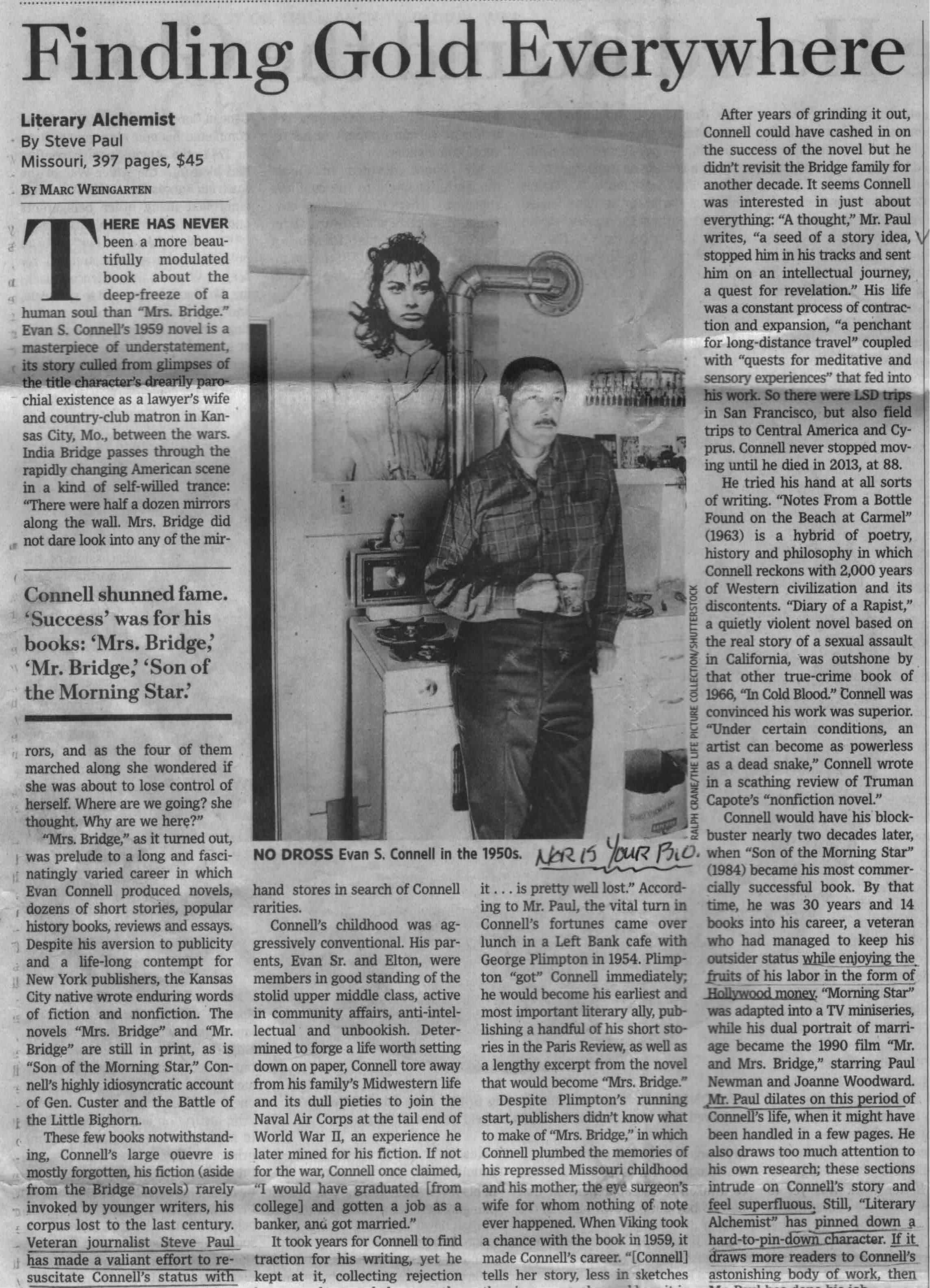
Literary stars rise and fall. Reputations are often burnished when an impassioned biographer finds the perfect subject, as exemplified by Steve Paul’s (Hemingway at Eighteen, 2017) absorbing and thorough life of Evan S. Connell. Connell was born into an affluent Kansas City family in 1924, the son of an eminent doctor and a society matron. He matriculated at Dartmouth before dropping out to become a navy pilot in WWII. Connell once claimed to have “the dullest life of any writer,” false modesty that Paul quickly dispels. Connell cut a debonair, mustachioed Clark Gable-like figure. Charismatic, he loved women but remained a lifelong bachelor. His one true love was his craft. He travelled the world, studied creative writing with Wallace Stegner, ran a literary journal, and later experimented with LSD. Best known for his novels Mrs. Bridge and Mr. Bridge, Connell also wrote prize-winning stories, essays, reviews, and best-selling biographies. Paul’s impressive research and close reading of Connell’s oeuvre illuminates the many autobiographical connections between the artist’s life and work. This should reestablish Connell in the pantheon of literary arts.

— Bill Kelly