biography

In Search of Gale Zoe Garnett: A Literary Haunting

I first posted this piece on August 1, 2026, on my Substack site. It carried a subtitle: “How an Unexpected Project in Biography Might Begin.” I’ve made some investigatory progress since then, but I’m holding off on expanding the piece until more details emerge and as I experiment with aspects of the narrative that might result.

By Steve Paul

(c) 2026

Gale Zoe Garnett, a pop singer and actress who came to prominence in the 1960s, is something of a mystery woman who played a large role in the life of the chameleonlike writer Evan S. Connell, whose biography I spent more than four years researching and writing.
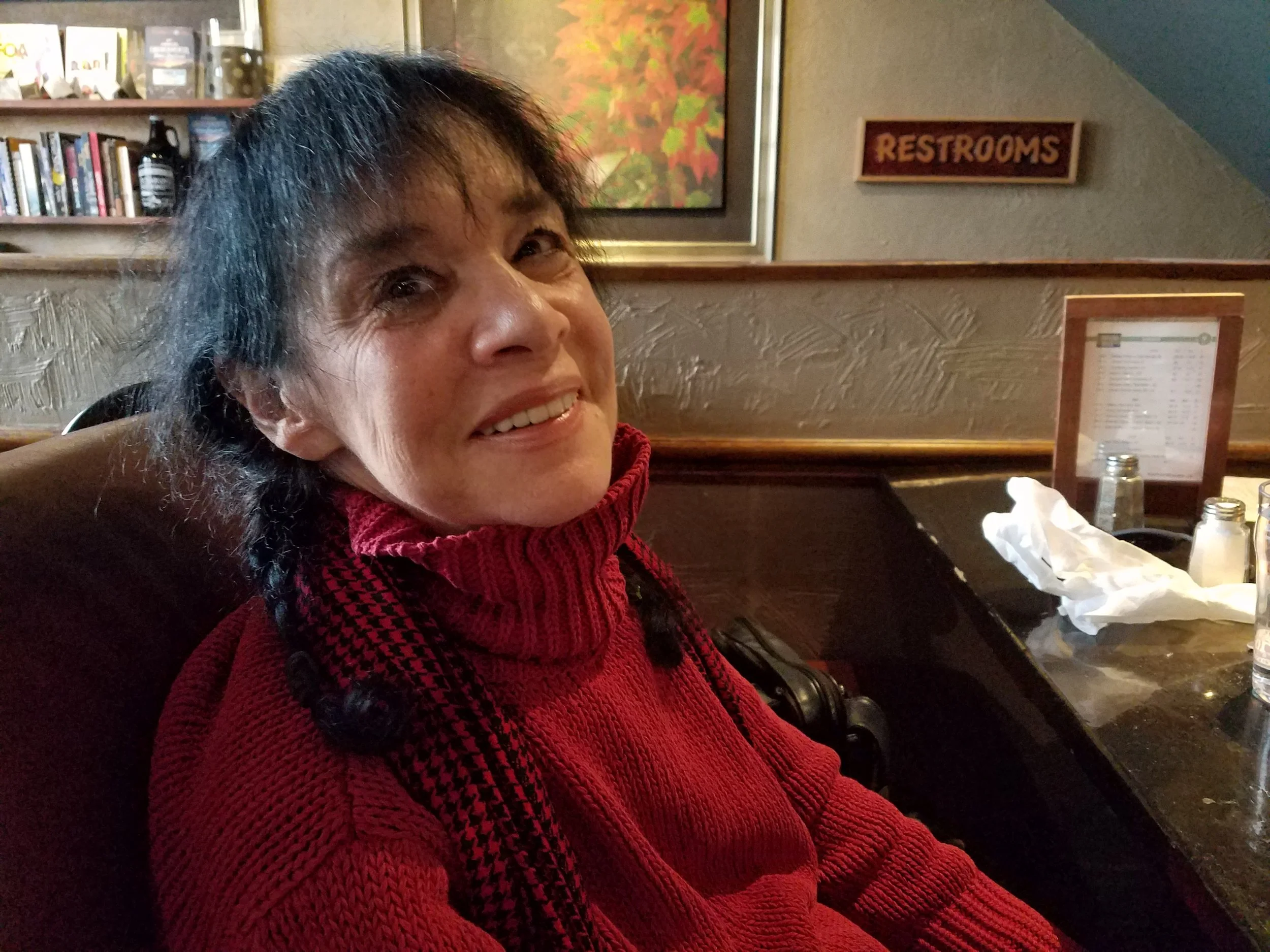
Gale Zoe Garnett, Toronto, 2017

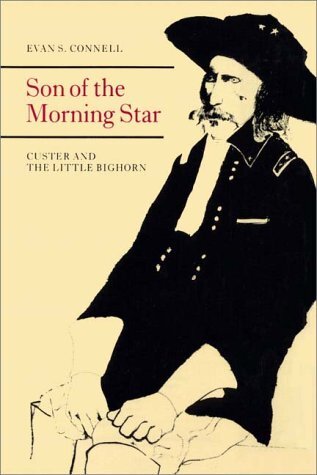
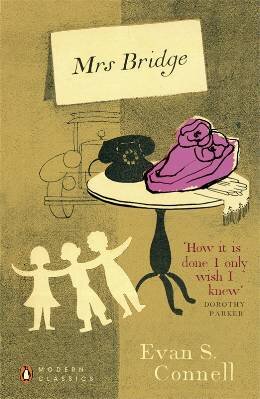
In October 2017 I met up with Garnett in Toronto and took her out to lunch twice for interviews as I ratcheted up my project. Connell (1924-2013) was the author of a landmark twentieth-century novel, Mrs. Bridge, and a landmark work of biography and nineteenth-century history, Son of the Morning Star.

Garnett, now going by Zoe, was friendly, a bit opaque, and protective of her own life and of her memories of a man who had captivated her attention more than five decades when she was in her late teens and early twenties. In 1964 she caught the ears of millions with her pop-folk hit song about fanciful love—“We’ll Sing in the Sunshine.” She had a minor career in television and movies, and eventually she wrote at least three novels and a volume or two of poetry.

Transcribing the recordings of our conversations involved piecing together threads that started in one place then took seamless looping detours before returning (if they did) to the story lines I wanted to follow in the moment of her monologue. So what do you remember of that New Year’s Eve party at Pamela Mason’s in Hollywood?, I’d say in an effort to pull her back from elsewhere.

Just a few months after those interviews, in early 2018, my attempts to follow up with Zoe went unanswered. I began to worry about her. She had seemed frail, though bright-eyed, but I didn’t really have a clue about her existence. She’d dangled the possibility of meeting at her apartment, where, she said, there might be letters and other objects connected to Evan. She gave me directions to her place, but she put it off and it didn’t happen.
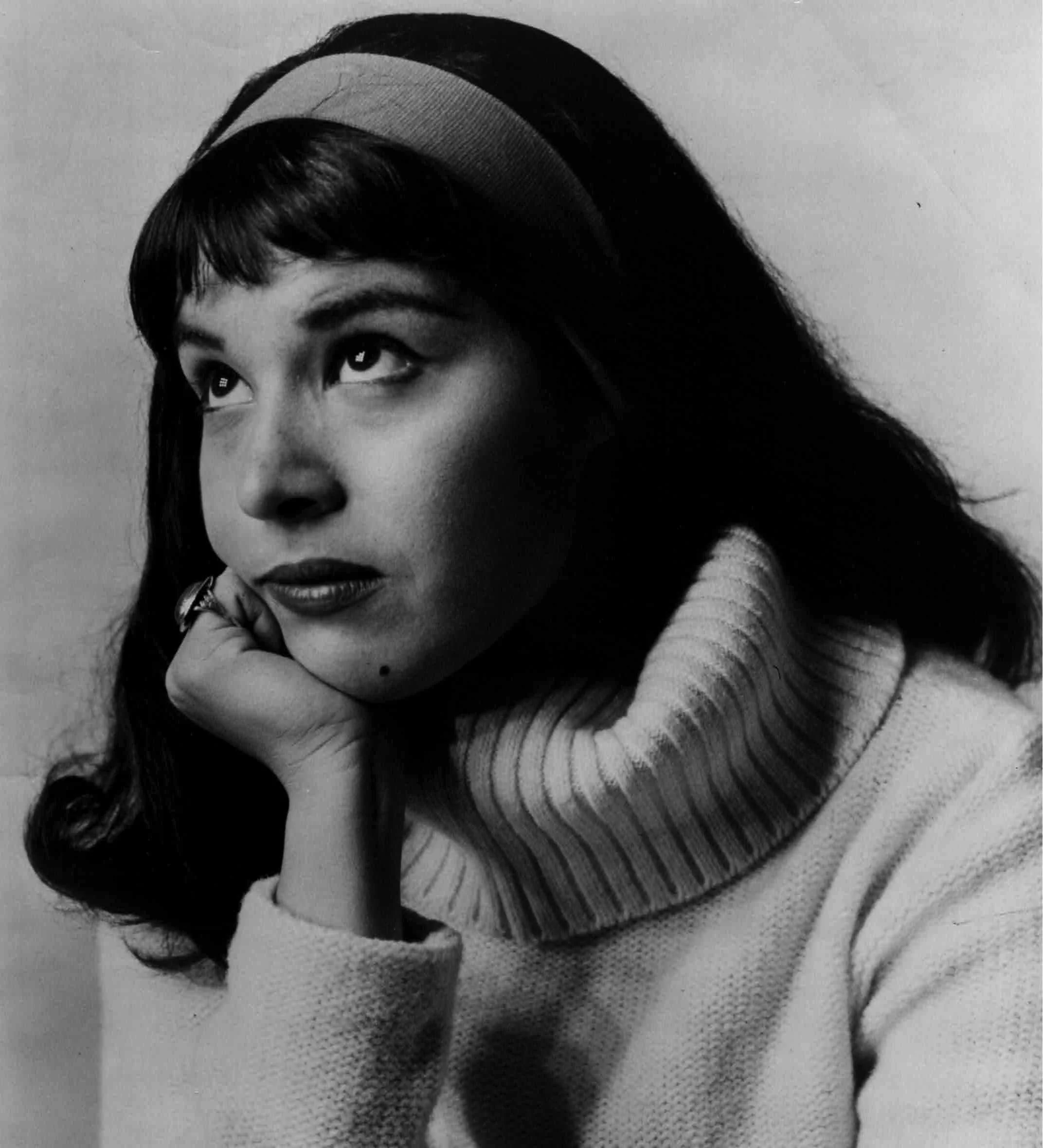
Gale Garnett, publicity photo, circa 1964.

She allowed me to take her photograph in one of the restaurants where we met (above) but was concerned that the result might not measure up to her reputation. She’d been a pop culture beauty with an exotic, dark-haired, olive-skinned look, leading Hollywood casting directors to put her in roles of various ethnic identities. Her sultry speaking style was distinctive enough that she stood in as the English-speaking voice of Italian actress Claudia Cardinale in The Pink Panther (1963) with David Niven and Peter Sellers.

Over the years I tried to find someone who knew of her and her fate—contacts in Toronto and elsewhere, the Canadian Writers Union, an organization in Visby, Sweden, where, Zoe told me, she had a living-writing studio. I got nowhere and ultimately concluded that her silence was not a personal rebuke to me but was owing to the fact that she had fallen off the grid and not voluntarily.

I\ suppose I could’ve tried harder over the years, but I’d moved on to other things. Such as finishing the Connell book and starting another. it was only recently, nearly nine years after seeing her in person, that an answer began to emerge.

Attending an international conference of the Ernest Hemingway Society in Toronto gave me an opportunity to try searching for Zoe again on her turf. Surely, I thought, some of the Toronto writers and scholars at this thing might have crossed her path. But no and no again.

One night, though, a featured speaker was Barry Callaghan, a Canadian writer, editor, and publisher. He was the son of Morley Callaghan, a journalist and writer who was a Hemingway contemporary. Callaghan père suffered the fate of being known less for his own books than for a famous boxing episode when he pummeled Hemingway’s nose in the presence of F. Scott Fitzgerald. His literary fate was partly sealed in the early 1960s, not long after Hemingway’s death, when his memoir, That Summer in Paris, was roundly and probably unfairly panned by Norman Mailer in the first issue of the New York Review of Books (“Punching Papa,” February 1, 1963).

After Callaghan’s talk, I managed to get in a few words as he greeted well-wishers and sold copies of his books and his father’s.

Yes, indeed, Callaghan knew Zoe. He and other friends used to see her frequently and would look after her. “She was destitute,” he told me, “and in bad shape.” Without pinning down details, he thought that she had been put somewhere but he’d lost track and had no idea where that might be.

I didn’t want to let that be the end of the road.

A few days later I called Gabriela Campos, Barry Callaghan’s daughter-in-law who with her husband runs his Exile publishing house. Campos had recalled seeing Gale at a book launch party for someone. But, again, how long ago was that?

Probably early 2018, she told me when I reached her by phone while waiting for a plane at the Toronto airport. Exile had published Garnett’s third novel, Savage Adoration, and she and the Callaghans maintained good relations. “We were close to her,” Campos said. “She was very fun and nice, but we lost contact with her.” Mailings of the Exile magazine began being returned as undeliverable. The publishers assumed that she was spending more time in Europe, but really didn’t know.

Campos referred me to another Toronto publisher who might know more. And indeed he did. Marc Côté, of Cormorant Books, responded quickly to my email inquiry. He’d known Zoe for more than 20 years. In 2018, he said, she underwent surgery for a brain tumor, which, of course, explains our lost connections. Two or three years later, she suffered a stroke. Her mental faculties were in obvious decline to the point that she became a ward of the province of Ontario.

In emails, Côté recounted his deep friendship with Zoe and we discussed her relationships with the likes of movie director John Huston and former Canadian prime minister Pierre Elliott Trudeau. We also bantered about the mystery of her age, which in the public and private records is all over the place.

She had explained her connection with Connell and others as well as the confusion of her birth year in our 2017 interview:

“I just always liked older men, because they knew stuff. I didn’t have a chance to go to university or even upper level, the collegiates, because I had to support myself. There was no choice. I was it and because my father had died when I was 12 and a half and my mother went off with a man called Nigel. So I had to hold it together, which meant a lot of lying about my age, a lot of bogus papers. To this day, I’ve got five ages on the internet. It was just, I had to.”

In 2000, shortly after Trudeau died, the byline of Gale Zoe Garnett appeared above a remembrance of Trudeau, with a revelatory aside, published in the Globe and Mail, one of Canada’s leading newspapers. She knew him for 20 years or so, and their relationship had been no secret. “He was a brilliant father,” she wrote, “the best I’ve ever seen (and I, for my own reasons, study fathers constantly).”

So, down this rabbit hole I’ve gone—retrieving my extensive notes from the Connell project and her many letters to Connell and Huston, revisiting her record albums I’d found along the way, reconsidering the wealth of material in the transcription of our interviews.

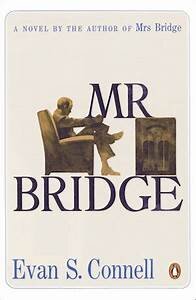
Connell was the strong and silent type. Handsome as all get out, he’d had a good run of girlfriends and never married. Garnett was the love of his life, his publisher, Jack Shoemaker, told me. Zoe once told Shoemaker that while visiting Evan near the end of his life, the epically laconic writer said, “You know, I love you.” “Why did you never tell me?” she replied. “I thought you knew.”
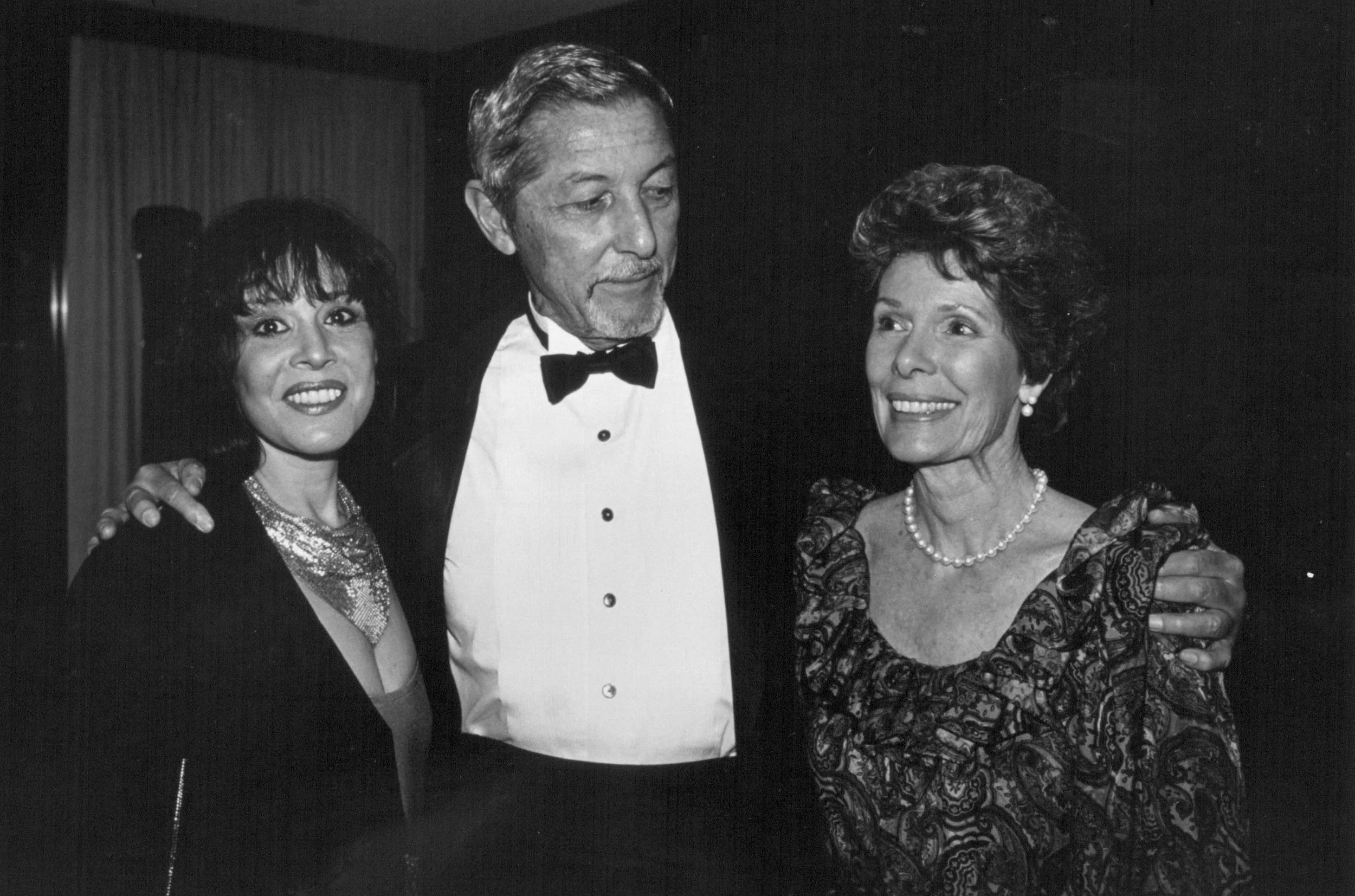
Garnett with Evan S. Connell and his sister, Barbara Zimmermann, before the Kansas City premiere of the movie Mr. and Mrs. Bridge, 1990. Photo courtesy of Janet Zimmermann.

In 1989, Zoe spent a couple of months in Kansas City, Connell’s original hometown. Connell had gotten her a role in the Merchant-Ivory movie Mr. and Mrs. Bridge, which was based on his two novels about a mid-twentieth century American family. In addition to the workings of the film production, I’d gathered some odd details that never made it into my book. For one thing, some locals took them to see the Rolling Stones at Arrowhead Stadium. I can’t imagine Connell enjoying it, but Zoe, the onetime rocker and Sausalito radio host, probably did.

Where is all this heading? Do I need another book-length project right now? Does Gale Zoe Garnett, a fascinating woman who lived the proverbial unfiltered life, deserve a full-fledged treatment?

I much regret the lost opportunities as well as Zoe’s sad and troubling fate. But the writing impulse has been unleashed, and I feel as if, now that the haunting gap has been at least partly filled, I might owe her story more of my time.

Steve Paul’s book Literary Alchemist: The Writing Life of Evan S. Connell was published by the University of Missouri Press in 2021. He is president of Biographers International Org.
Reviews, Reader Reactions and More: A Roundup

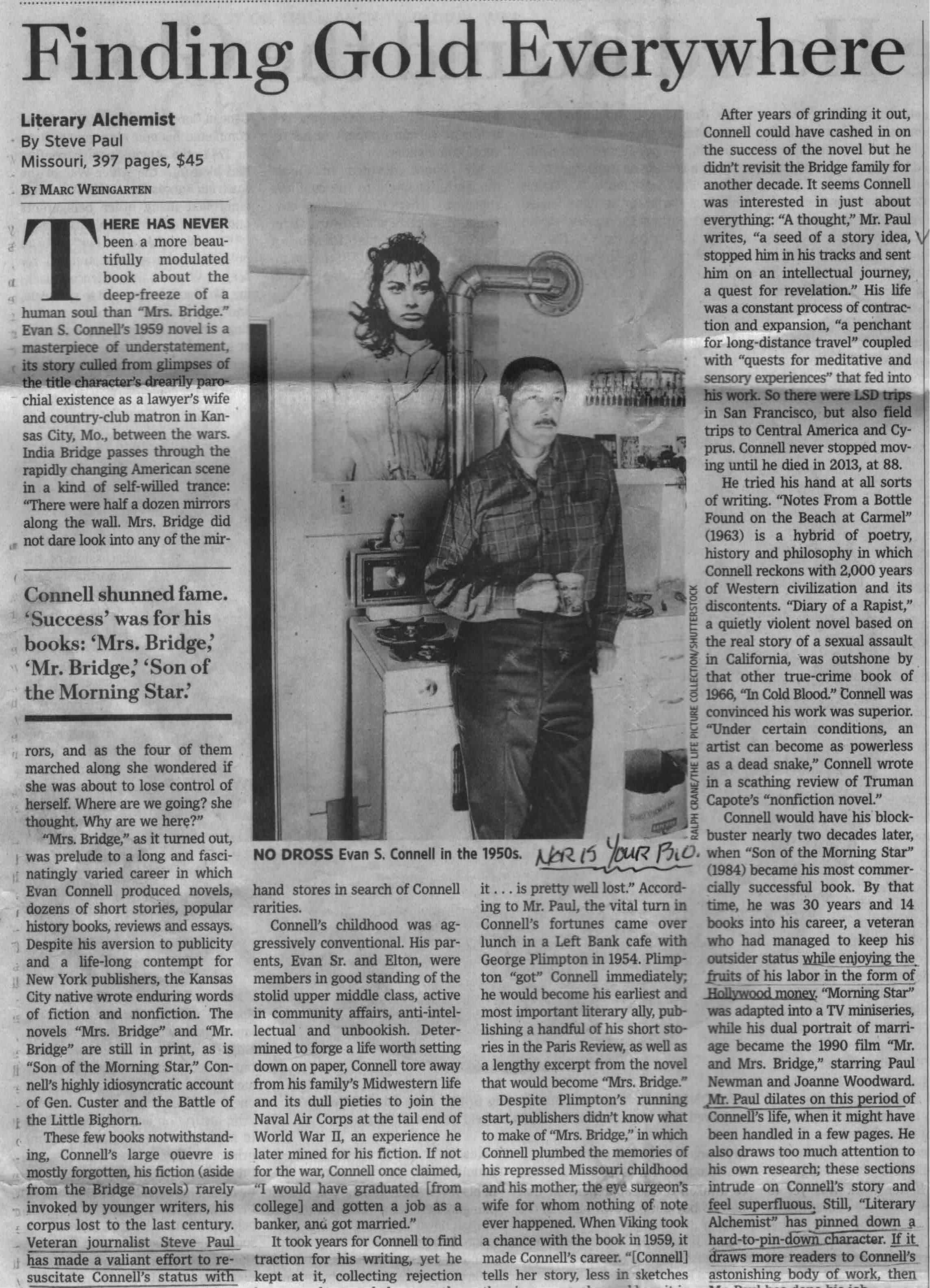
Wall Street Journal, Jan. 8-9, 2022

Response to the book has been generally rewarding. Positive reviews have appeared in such wide-ranging places as the University of Kansas Alumni Magazine, the Wall Street Journal, American Scholar, the Star-Tribune of Minneapolis (Kathleen Rooney’s gracious review of Dec. 26, 2021, has also been picked up by numerous smaller papers around the country). Notable was an essay that sprawled over five pages in the January 2021 Harper’s. The author, Gemma Sieff, had interviewed Connell in 2011 and used the occasion of my book to revisit her experience with him and his works. I can’t argue with her highly positive words about Literary Alchemist.

I don’t usually put a lot of stock in reviews posted on Amazon. Though most are well-meaning, it’s rare to find a passionate and knowledgeable contributor (at least in my experience). An exception is Elizabeth Broun’s mini-review, which she posted in January. Elizabeth is former director of the Spencer Museum at the University of Kansas and the Smithsonian Museum of American Art. Here’s her take:

After first discovering "Mrs. Bridge" decades ago, I've eagerly anticipated each new Connell publication as a unique exciting experience, each book unlike any other. When Connell turned from fiction to historical reflections --- "Son of the Morning Star," "The Alchemist's Journal," a book on the crusades, and another on Goya --- the pattern of his work began to emerge. Connell captures the fatal forgetfulness of modern life --- the horrors of WWII and Vietnam, the atrocities of religious righteousness, the inhumanity between colonizers and indigenous people ---as told by contemporary witnesses to all this. His observations are offered without condescension and in prose that has an affecting musicality. There's no one who can write like Connell across such a spectrum of current and historical worlds, from a personal vantage point that resonates with readers. Yes, my own interests center on history and art, so I'm partial ... but Connell speaks to all of us about ourselves.

Steve Paul's biography---Connell's first comprehensive biography---is blessedly straightforward, full of specific facts, free of pontificating, and insightful in linking the myriad threads of Connell's complicated private life and art. He writes with clarity and plenty of detailed information, so I can make my own more informed understanding of this complex author, according to my personal reading of his works.

After just finishing Paul's book, I've ordered 8 of Connell's books, many of which I once owned but eventually gave away and want now to re-read, to add to the 6 remaining on my shelf. I know now how my 2022 will start!

Well, boy howdy, thank you. The best news I’ve had has come from numerous people who report that my book has sent them back to Connell’s work.

Some of the most startling receptions have come to me privately in letters from people who who knew Connell in one way or another at various stages of his life. I cherish a letter that came from Jane Vandenburgh, who was a close friend of Connell’s, having been girlfriend of then married to his longtime editor, Jack Shoemaker. Jane’s reaction to the book was visceral; she started rereading the Bridge novels; she got over an early resistance to Son of the Morning Star and now considers it “one of the best histories of anything I’ve ever read.” Ultimately, she told me, “It’s astonishing really how vital he becomes in your beautiful book, how he figures hapticly forth in his physical presence.”

Yes, I couldn’t help but to be moved.

I’m grateful for the opportunity to have chatted with veteran biographer Carl Rollyson for his weekly podcast, “A Life in Biography.” Carl is biographer of Marilyn Monroe, Sylvia Plath, William Faulkner and many others. In a teaser to my appearance, Carl called Literary Alchemist “an impeccable state-of-the-art biography.” You can find the hour-long program via your usual podcast portal or here: https://podcasts.apple.com/us/podcast/a-lively-talk-with-steve-paul-about-literary/id1508239647?i=1000549376164

Overall, I wish there’d been a few more reviews. Maybe others will come down the road. This is a tough time for author tours and events, but I’ll be doing a virtual conversation for the Santa Fe Public Library, much like the one we did at the KC library in early December. Santa Fe is scheduled for 5:30 p.m. (Central)/4:30 (Mountain) on March 24. I’ll also be on a panel at the Unbound Book Festival in Columbia, MO, the weekend of April 22-24; details to come. And other events are in the works.

If anyone actually finds and reads this post, and has read Literary Alchemist, I’d be glad to hear from you.

.

The Early Word Is In....And Encouraging.

The Missouri Writer Phong Nguyen reviewed Literary Alchemist for KC Studio magazine and found much to like:

https://kcstudio.org/chronicling-the-great-and-necessary-contradictions-of-an-artist/

I’m also grateful for a brief but positive review, which appeared Nov. 1 in Booklist, the review journal of the American Library Association. The review struck me as nicely attuned to the details of the book, giving me the impression that the critic actually read it closely. The review sits behind a paywall, so I’ve copied the text here:

Literary stars rise and fall. Reputations are often burnished when an impassioned biographer finds the perfect subject, as exemplified by Steve Paul’s (Hemingway at Eighteen, 2017) absorbing and thorough life of Evan S. Connell. Connell was born into an affluent Kansas City family in 1924, the son of an eminent doctor and a society matron. He matriculated at Dartmouth before dropping out to become a navy pilot in WWII. Connell once claimed to have “the dullest life of any writer,” false modesty that Paul quickly dispels. Connell cut a debonair, mustachioed Clark Gable-like figure. Charismatic, he loved women but remained a lifelong bachelor. His one true love was his craft. He travelled the world, studied creative writing with Wallace Stegner, ran a literary journal, and later experimented with LSD. Best known for his novels Mrs. Bridge and Mr. Bridge, Connell also wrote prize-winning stories, essays, reviews, and best-selling biographies. Paul’s impressive research and close reading of Connell’s oeuvre illuminates the many autobiographical connections between the artist’s life and work. This should reestablish Connell in the pantheon of literary arts.

— Bill Kelly

A Connell Timeline: Tracing Key Moments in Life and Work

Connell Timeline

Brief milestones in the life and work of a writer. For the details see my book, Literary Alchemist: The Writing Life of Evan S. Connell (University of Missouri Press, December 2021)

Aug. 17, 1924: Evan Shelby Connell Jr. is born to Dr. Evan Shelby Connell and (Ruth) Elton Williamson Connell in Kansas City, Missouri. The family lives at 210 W. 66th Street in a Brookside district neighborhood developed by J.C. Nichols.

May 1937: Graduates from Border Star Elementary School, which promoted an intensive reading program.

1939: The Connell family moves to 1515 Drury Lane (later renumbered 2215 Drury, after incorporation of Mission Hills, Kansas).

1941: Graduates from Southwest High School and leaves Kansas City for Dartmouth College in New Hampshire. Transcripts reveal him as no more than an average student.

Summer 1942: After flunking chemistry at Dartmouth, takes makeup chemistry courses at William Jewell College in Liberty, Missouri, north of Kansas City.

December 1942: Registers for the military draft: 6-foot-2, 155 pounds.

ESC with his sister, Barbara Connell Zimmermann, 1945.

ESC with his sister, Barbara Connell Zimmermann, 1945.

September 1, 1943: Inducted into the U.S. Naval Air Corps in Mt. Vernon, Iowa.

1943-1945: Naval flight training in Albuquerque, Memphis, Pensacola, Florida, and elsewhere, followed by instructor training in New Orleans. Promoted to Ensign in May 1945. Concludes service August 20, 1945 to November 24, 1945, as flight instructor at the Naval Air Station in Glenview, Illinois.

February 1946: Enrolls for spring semester at the University of Kansas in Lawrence, where he studies English, writing, and art and cements his decision not to follow in his father’s medical footsteps. Among his professors is Ray B. West, editor of the Western Review literary journal.

1946-1947: Serves as art director, writer and illustrator for The Bitter Bird, a campus humor magazine.

April 1947: Connell’s first published short story, “A Cross to Bear,” appears in Foreign Service, a veterans magazine published by the VFW in Kansas City. Receives $35.

October 1947: Receives bachelor’s degree in English from Kansas.

1947-1948: Encouraged by Ray West, ESC successfully applies to a new creative writing workshop led by Wallace Stegner at Stanford University in California.

1949: ESC’s short story “I’ll Take You to Tennessee” appears in Tomorrow magazine and the O. Henry Prize annual collection.

1949-1950: Spends a year in Columbia University graduate school in New York, emphasizing creative writing and art.

1950: Settles in Los Angeles for a while trying to write for movies. 

1951: Moves to Santa Cruz, California, continues to write stories and takes a job reading gas meters. Wins another O. Henry award for his story “I Came from Yonder Mountain.”

February 1952: Travels to Europe, where he spends nearly two years wandering and “loitering” (his phrase) for longer spells in Barcelona and Paris.

Fall 1952: In Paris, ESC meets Max Steele, another American writer, beginning a long friendship. Of Connell, Steele notes in a letter to his mother: “He’s a strange, silent, extremely lonesome person who can write like no one else.”

Spring 1953: A group of American writers in Paris, including George Plimpton, William Styron, and Peter Matthiessen launch a literary journal, The Paris Review.

September 1953: Plimpton takes a Connell story for the third issue of The Paris Review—“Cocoa Party,” a standalone section of a failed novel.

January 1954: After leaving Europe and spending time in New York and Kansas City, settles in San Francisco. Works on a novel about a timid matron named India Bridge and takes a temporary job as a shipyard clerk.

This Paris Review issue contained “The Beau Monde of Mrs. Bridge”

This Paris Review issue contained “The Beau Monde of Mrs. Bridge”

1954: ESC’s agent Elizabeth McKee reports several rejections of the India Bridge novel.

Spring-summer 1955: Travels to Kansas City, around the West and spends summer in Denver. In a letter to Max Steele: “Spent all afternoon at the Custer battlefield going over the maps and routes and almost felt my two drops of Indian blood. What a pageant that must have been that day.”

Fall 1955: Returns to San Francisco. Paris Review publishes excerpts of ESC’s novel under the title, “The Beau Monde of Mrs. Bridge.” Another story, “Fisherman from Chihuahua,” which had appeared earlier in The Paris Review, is collected in Best American Short Stories, 1955.

1956: Submits another novel to his agent—The Patriot, based on his Naval Air Corps experience. Learns that Viking Press has agreed to publish his books.

1957: Best American Short Stories, 1957, includes “Arcturus.” ESC often noted that his story of generational tension was inspired by Thomas Mann’s novella, Disorder and Early Sorrow.

April 1957: Viking publishes ESC’s first book, a story collection, The Anatomy Lesson and Other Stories.

Summer 1957: San Francisco poet, publisher and bookstore owner Lawrence Ferlinghetti on trial for obscenity in case involving Allen Ginsberg’s Howl.

1958: Contact, a San Francisco literary and culture magazine based in Sausalito, releases first issue, including excerpts from ESC’s novel, now titled Mrs. Bridge. Among Contact’s advisory editors and contributors are ESC mentors Wallace Stegner, Ray B. West, and Walter Van Tilburg Clark. Contact’s values are decidedly more restrained than the freewheeling Beats, who were redefining the city’s cultural renaissance.

July 1958: ESC’s mother, Elton Connell, dies in Kansas City, at age 60. She is rightly seen as a model, at least in part, for his fictional India Bridge.

January 1959: Viking publishes Mrs. Bridge to generally admiring reviews and an eventual designation as a National Book Award finalist.

Fall 1959: The Patriot undergoing extensive revisions. ESC takes LSD in a controlled experiment conducted by a Los Angeles psychiatrist.

September 1960: Though there’s much to recommend in its parts, The Patriot is published to largely disappointing reviews.

Author photo by Ruth Bernhard, 1963.

Author photo by Ruth Bernhard, 1963.

December 1962: Contact 13 devotes most of the issue (85 pages) to ESC’s unusual book-length work in verse, Notes from a Bottle Found on the Beach at Carmel. It’s a meditation in non-linear fragments on the decline of Western civilization. Viking reissues it as a book a few months later, then severs ties with ESC.

March 1963: In Seventeen magazine, Philip Roth, who’d won the National Book Award for fiction in 1959, recommends Mrs. Bridge and nine other notable novels for teen-age readers.

Summer 1963: After the departure of its founding publisher, ESC and two fellow editors take on responsibility of keeping Contact alive.

January 1965: Letter from singer and actress Gale Garnett confirms budding relationship with ESC.

March 1965: Simon and Schuster publishes ESC story collection, At the Crossroads.

Summer 1965: Contact suspends publication after 21 issues and soon closes.

November-December 1965: Gale Garnett spends a month performing at the hungry i in San Francisco and lives on a houseboat in Sausalito.

January 1966: ESC notably pans Truman Capote’s In Cold Blood in a book review for the San Francisco Chronicle.

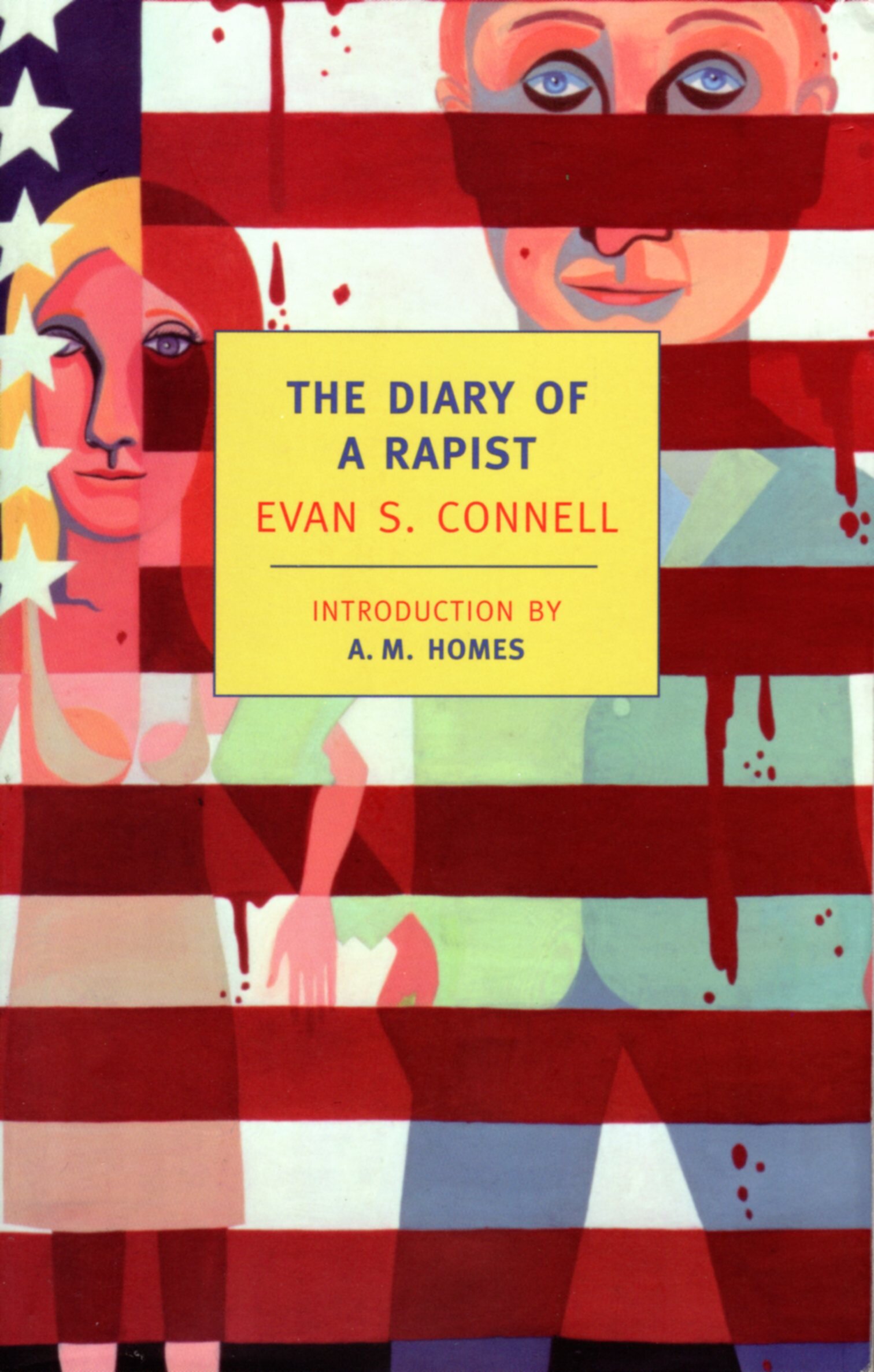
May 1966: ESC novel The Diary of a Rapist is published, sparked in part by a true-crime case in California and his own onetime job as a clerk in a state unemployment office.

Connell crossed paths more than once with the poet Allen Ginsberg, including at this Sausalito boat party, 1963.

Connell crossed paths more than once with the poet Allen Ginsberg, including at this Sausalito boat party, 1963.

Spring-summer 1966: Travels to Europe with Gale Garnett, including a visit in Ireland with Garnett’s friend, the film director John Huston.

Fall 1966: Continues travels alone through Europe, the Middle East and Asia.

November 29, 1966: Makes first notes for a novel centering on Walter Bridge.

March 1967: After return to San Francisco, begins first draft of Mr. Bridge.

June 1968: After recent assassinations and racial violence in the U.S., ESC submits two new chapters with racial undertones to the Mr. Bridge manuscript.

Fall 1968: New Mexico Quarterly publishes excerpts from a followup volume to Notes from a Bottle.

March 1969: Alfred A. Knopf publishes Mr. Bridge.

Summer 1969: Gale Garnett leaves San Francisco to settle in Toronto.

August 1969: Travels to South America for two months, at least in part to pursue his new interest in collecting pre-Columbian art and artifacts.

October 1969: A Life magazine profile of Connell is downgraded to limited distribution in only San Francisco and European editions ostensibly because of the underwhelming performance of Mr. Bridge.

1971: Spends four months traveling to South Pacific, India, Africa, and Europe.

August 1971: Visits Kansas City with Hollywood producer Abby Mann to scout locations for a planned, though soon abandoned, movie adaptation of Mrs. Bridge.

Spring-summer 1972: Travels to Europe.

September 1972: Moves from San Francisco to Sausalito.

Spring 1973: Serves as a judge for National Book Award in fiction. The panel’s debates result in a rare award to two writers—John Barth for Chimera and John Williams for Augustus, which was ESC’s favorite. Afterward, travels to Europe.

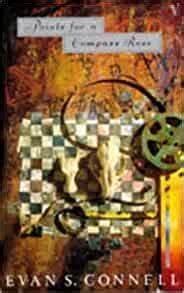
May 1973: Knopf publishes Points for a Compass Rose, ESC’s second book of kaleidoscopic “Notes.”

January 1974: Annie Dillard writes a laudatory essay for Harper’s about Points for a Compass Rose and its predecessor.

May 1974: Dr. Evan S. Connell Sr. dies in Kansas City. ESC had visited him in the hospital but does not return for funeral.

September 1974: Knopf publishes The Connoisseur, a novel deriving from ESC’s new passion for collecting and revolving around a recurring character in his fiction named Karl Muhlbach.

April 1976: A second Muhlbach novel, Double Honeymoon, fails to generate enthusiasm at Knopf and is published by Putnam.

Self-portrait, c. 1976

Self-portrait, c. 1976

1977: Turns away from fiction and begins writing a series of historical essays.

June 1979: Publishes A Long Desire, first of two collections of historical essays.

August 18, 1979: One of ESC’s best friends and an editorial colleague at Contact, the writer Kenneth Lamott, dies at 54.

September 1980: North Point Press, a new literary publisher based in the Bay Area, publishes Saint Augustine’s Pigeon, a collection of ESC’s selected short stories, and plans to reprint and promote the Bridge novels and other books.

1981: Travels to Little Bighorn territory and works on expanding a planned essay into a larger project about Gen. George Armstrong Custer and the fatal battle. By late summer, reports his manuscript had grown to 500 pages.

November 1983: North Point outbids New York publishers for Son of the Morning Star.

March 1984: Travels to Honolulu, Guam and Micronesia, including Truk and Ponape.

Fall 1984: North Point publishes Son of the Morning Star, which becomes a surprise bestseller, goes through multiple printings, and earns a lasting reputation for its storytelling style and measured, human-detail-driven approach to historical tragedy.

March 1985: Contract negotiations lead to agreement to produce a television film adaptation of Son of the Morning Star.

February 1987: Talks under way for movie production based on the Bridge novels. Actress Joanne Woodward, who has been angling for years to take India Bridge to the big screen, is involved in the project.

May 1987: Receives literature award from American Academy and Institute of Arts and Letters.

May 1989: Moves to Santa Fe, New Mexico.

September-November 1989: Merchant Ivory production of “Mr. and Mrs. Bridge” under way in Kansas City with Woodward and her husband, Paul Newman, in the principal roles.

November 1990: Kansas City premiere and theatrical release of “Mr. and Mrs. Bridge.” 

December 1990: William Turnbull, publisher of North Point Press, announces its impending closure.

February 1991: ABC network airs two-part “Son of the Morning Star.”

May 1991: One of North Point’s last books is ESC’s The Alchymist’s Journal, a novel channeling the arcane voices of medieval philosophers and scientists.

1995: ESC’s Collected Stories includes 56 previously published works of short fiction.

August 1996: Begins research and writing toward a historical novel about the Crusades.

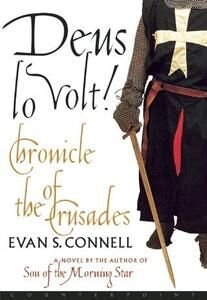
May 2000: Deus Lo Volt! Chronicle of the Crusades recounts religious warfare of the Middle Ages.

September 2000: Receives the Lannan Foundation’s Literary Award for Lifetime Achievement (and $100,000).

ESC TPR 2014.jpeg

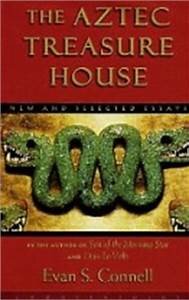
September 2001: The Aztec Treasure House repackages two earlier volumes of essays reflecting ESC’s idiosyncratic, thoroughly researched and slyly humorous approaches to far-flung historical subjects.

February 2004: In Francisco Goya, ESC weaves a meditation on the life and legacy of an artist.

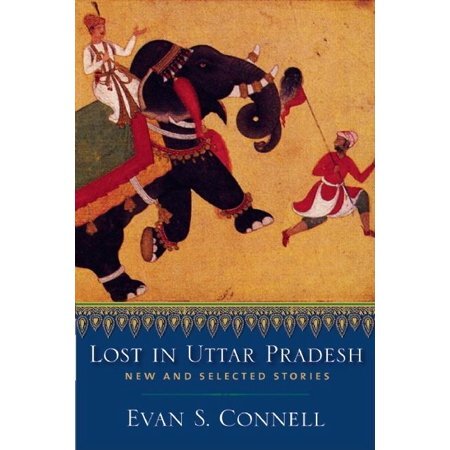
July 2008: Story collection Lost in Uttar Pradesh reprises some greatest hits and adds a handful of previously uncollected pieces.

March 2009: Following double knee replacements and other health complications, moves to an assisted-living facility in Santa Fe. Finds the situation not conducive to writing.

January 10, 2013: ESC dies at 88.

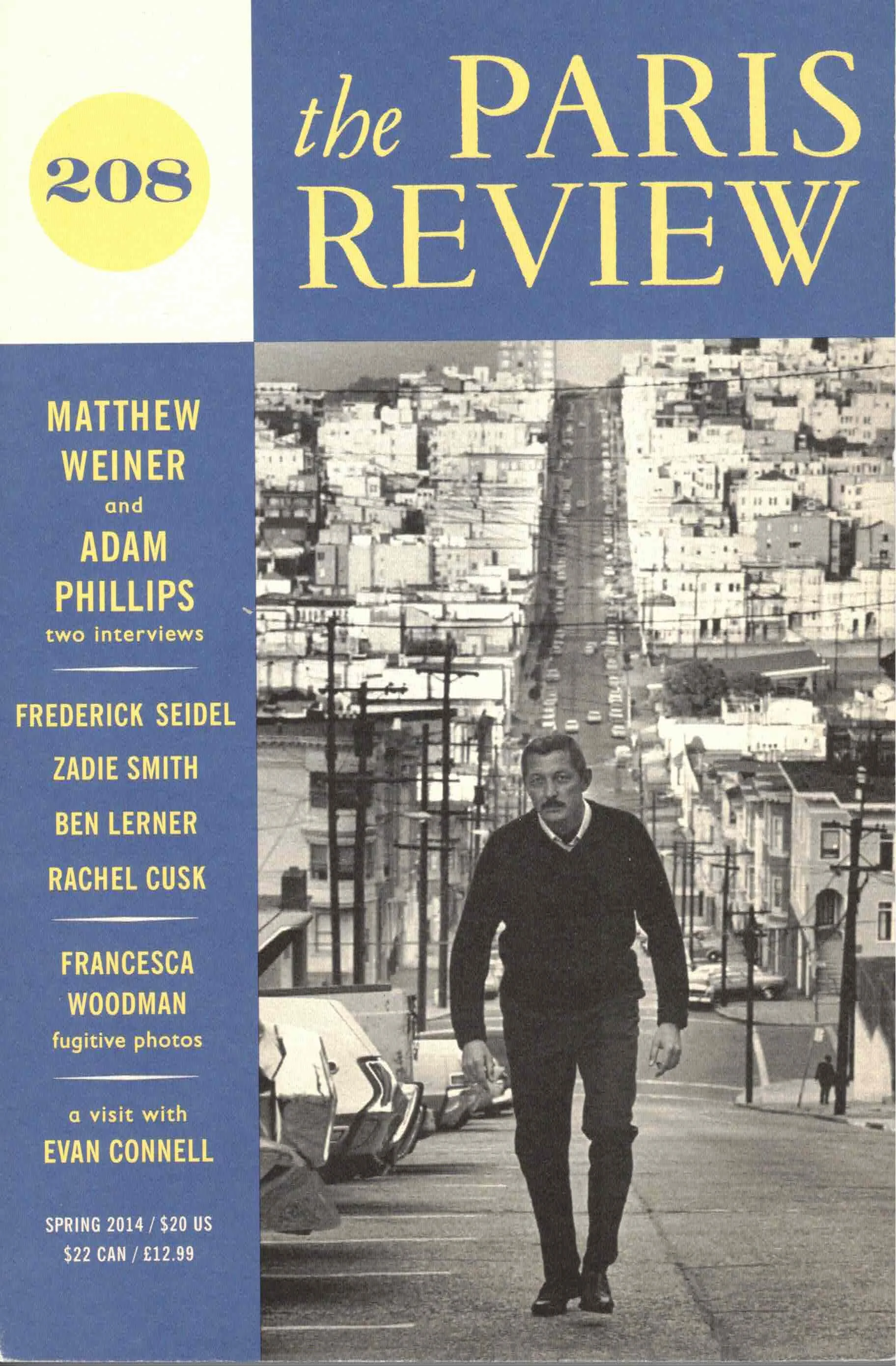
2014- : Connell tributes appear from time to time, often by contemporary writers still inspired by the minimalist glories of Mrs. Bridge. In 2014, The Paris Review published an interview with him conducted in 2011. In 2018-2019, an AMC series called “Lodge 49” (now streaming on Hulu) paid subtle homage to Connell.

Connell’s essay collection The White Lantern (1980) makes a cameo appearance In an episode of the streaming series “Lodge 49.” Series creator Jim Gavin credits Connell for inspiration, including a series theme related to alchemy.

Connell’s essay collection The White Lantern (1980) makes a cameo appearance In an episode of the streaming series “Lodge 49.” Series creator Jim Gavin credits Connell for inspiration, including a series theme related to alchemy.

Evan Connell: A Brief Introduction

Literary Alchemist Cover.jpeg

The Story Center at the Mid-Continent Public Library asked me to present a program on Connell for its series marking the Missouri Bicentennial. Connell, of course, was a Missouri native, born in Kansas City. He reveals a bit of his Missouri heritage in at least one early book, though in general he left Kansas City far behind as he settled in San Francisco, Sausalito, and, finally, Santa Fe, N.M. In any case, I put together a slide show. Many of the images will appear in Literary Alchemist: The Writing Life of Evan S. Connell, which is scheduled to come out by the end of 2021. And I strung together a series of brief capsules on aspects of Connell’s life and work, which I offered as a few dozen things you will learn about Connell in the book. Here is a link to the FB live program. The show is also expected to live on the Story Center’s YouTube channel.

https://www.facebook.com/mystorycenter/videos/232424875190652


Remembering Web Schott and his Connell Friendship

I was saddened to hear of the recent death of Webster Schott, who became an important source and sounding board for my Connell biography. I wrote about him for KC Studio magazine. The piece appears in the March-April 2021 print issue and online here:

http://kcstudio.org/on-the-passing-of-literary-men-and-the-making-of-biographies-evan-s-connell/