I first posted this piece on August 1, 2026, on my Substack site. It carried a subtitle: “How an Unexpected Project in Biography Might Begin.” I’ve made some investigatory progress since then, but I’m holding off on expanding the piece until more details emerge and as I experiment with aspects of the narrative that might result.
By Steve Paul
(c) 2026
Gale Zoe Garnett, a pop singer and actress who came to prominence in the 1960s, is something of a mystery woman who played a large role in the life of the chameleonlike writer Evan S. Connell, whose biography I spent more than four years researching and writing.
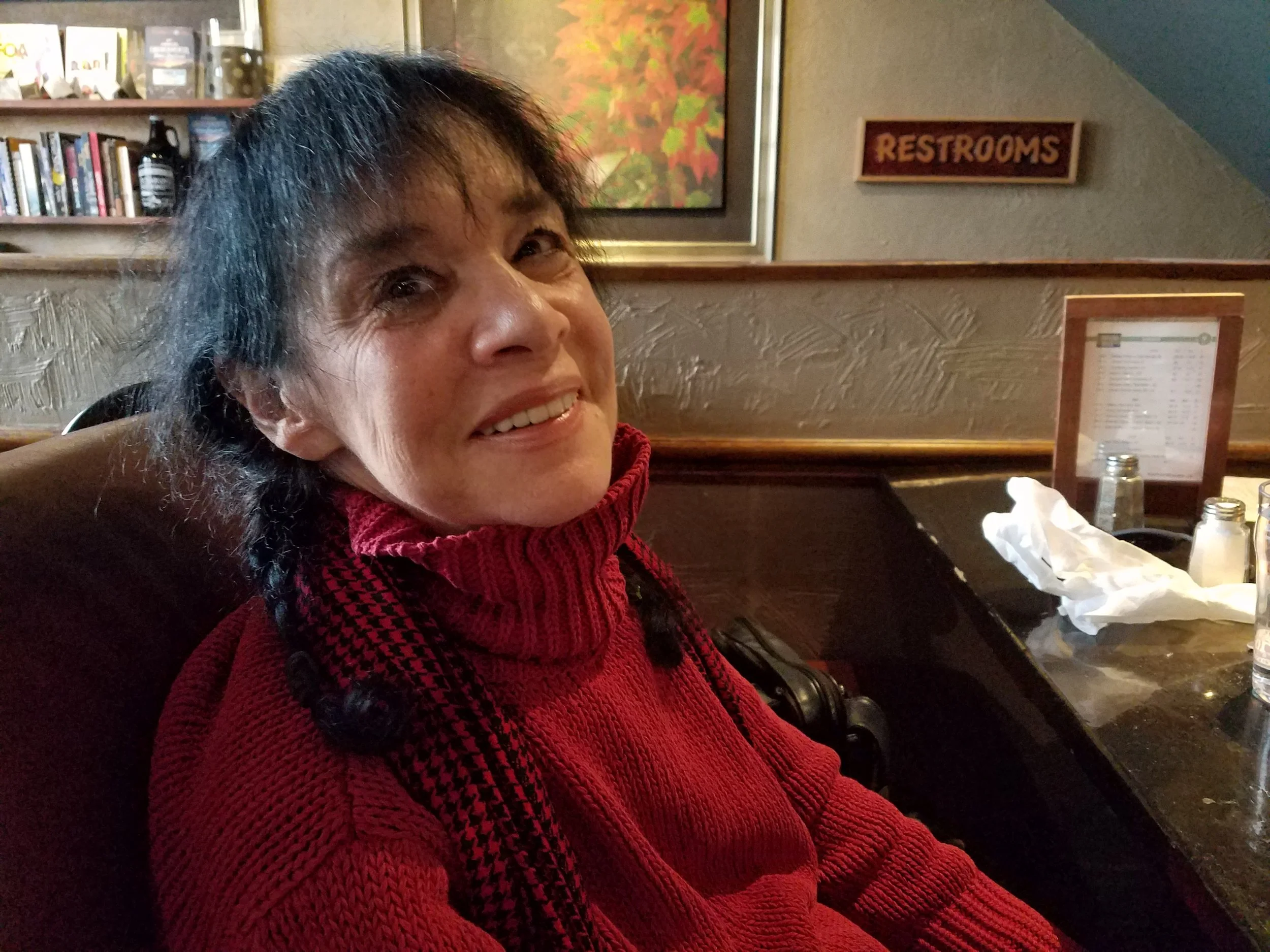
Gale Zoe Garnett, Toronto, 2017
In October 2017 I met up with Garnett in Toronto and took her out to lunch twice for interviews as I ratcheted up my project. Connell (1924-2013) was the author of a landmark twentieth-century novel, Mrs. Bridge, and a landmark work of biography and nineteenth-century history, Son of the Morning Star.
Garnett, now going by Zoe, was friendly, a bit opaque, and protective of her own life and of her memories of a man who had captivated her attention more than five decades when she was in her late teens and early twenties. In 1964 she caught the ears of millions with her pop-folk hit song about fanciful love—“We’ll Sing in the Sunshine.” She had a minor career in television and movies, and eventually she wrote at least three novels and a volume or two of poetry.
Transcribing the recordings of our conversations involved piecing together threads that started in one place then took seamless looping detours before returning (if they did) to the story lines I wanted to follow in the moment of her monologue. So what do you remember of that New Year’s Eve party at Pamela Mason’s in Hollywood?, I’d say in an effort to pull her back from elsewhere.
Just a few months after those interviews, in early 2018, my attempts to follow up with Zoe went unanswered. I began to worry about her. She had seemed frail, though bright-eyed, but I didn’t really have a clue about her existence. She’d dangled the possibility of meeting at her apartment, where, she said, there might be letters and other objects connected to Evan. She gave me directions to her place, but she put it off and it didn’t happen.
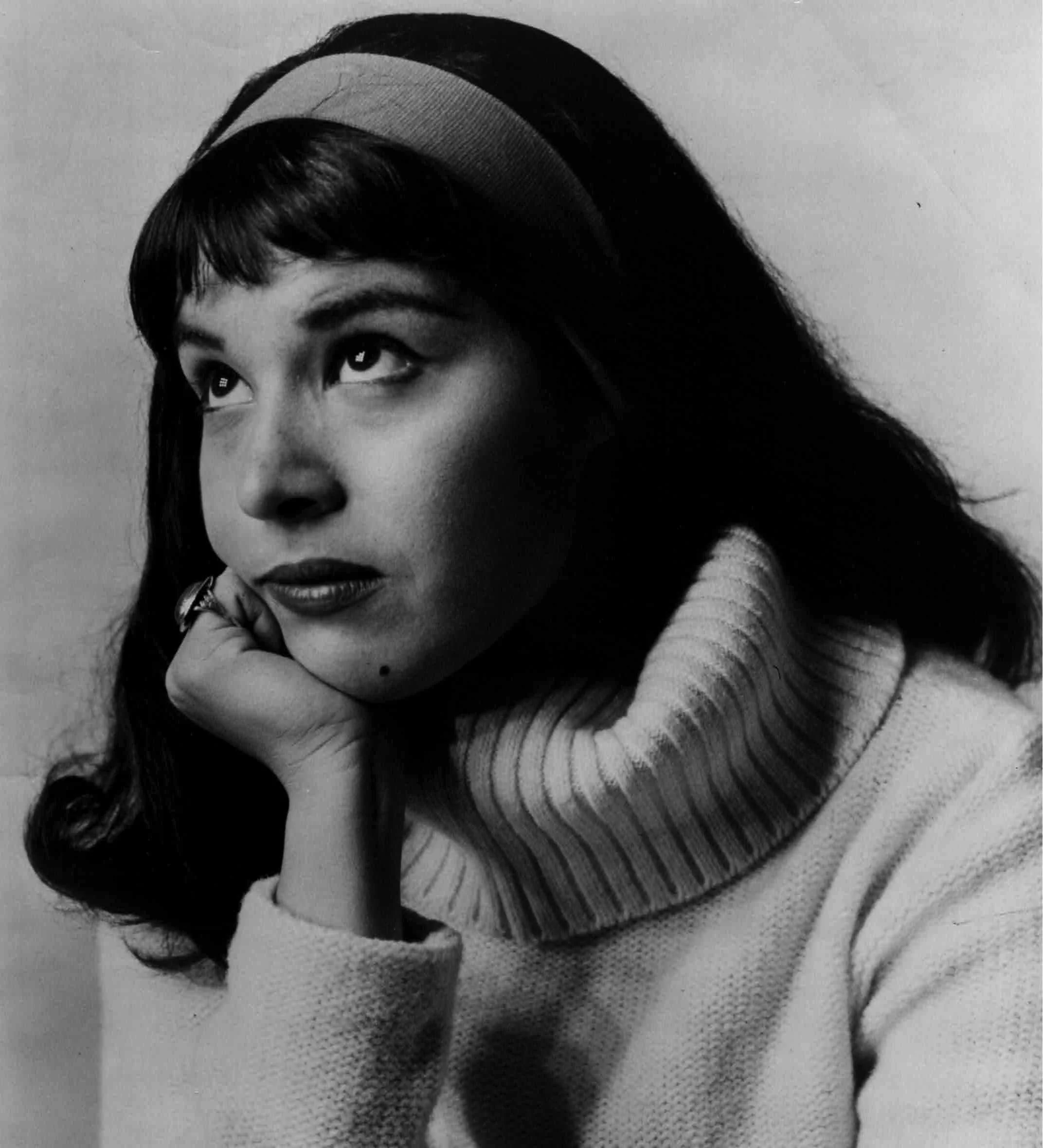
Gale Garnett, publicity photo, circa 1964.
She allowed me to take her photograph in one of the restaurants where we met (above) but was concerned that the result might not measure up to her reputation. She’d been a pop culture beauty with an exotic, dark-haired, olive-skinned look, leading Hollywood casting directors to put her in roles of various ethnic identities. Her sultry speaking style was distinctive enough that she stood in as the English-speaking voice of Italian actress Claudia Cardinale in The Pink Panther (1963) with David Niven and Peter Sellers.
Over the years I tried to find someone who knew of her and her fate—contacts in Toronto and elsewhere, the Canadian Writers Union, an organization in Visby, Sweden, where, Zoe told me, she had a living-writing studio. I got nowhere and ultimately concluded that her silence was not a personal rebuke to me but was owing to the fact that she had fallen off the grid and not voluntarily.
I\ suppose I could’ve tried harder over the years, but I’d moved on to other things. Such as finishing the Connell book and starting another. it was only recently, nearly nine years after seeing her in person, that an answer began to emerge.
Attending an international conference of the Ernest Hemingway Society in Toronto gave me an opportunity to try searching for Zoe again on her turf. Surely, I thought, some of the Toronto writers and scholars at this thing might have crossed her path. But no and no again.
One night, though, a featured speaker was Barry Callaghan, a Canadian writer, editor, and publisher. He was the son of Morley Callaghan, a journalist and writer who was a Hemingway contemporary. Callaghan père suffered the fate of being known less for his own books than for a famous boxing episode when he pummeled Hemingway’s nose in the presence of F. Scott Fitzgerald. His literary fate was partly sealed in the early 1960s, not long after Hemingway’s death, when his memoir, That Summer in Paris, was roundly and probably unfairly panned by Norman Mailer in the first issue of the New York Review of Books (“Punching Papa,” February 1, 1963).
After Callaghan’s talk, I managed to get in a few words as he greeted well-wishers and sold copies of his books and his father’s.
Yes, indeed, Callaghan knew Zoe. He and other friends used to see her frequently and would look after her. “She was destitute,” he told me, “and in bad shape.” Without pinning down details, he thought that she had been put somewhere but he’d lost track and had no idea where that might be.
I didn’t want to let that be the end of the road.
A few days later I called Gabriela Campos, Barry Callaghan’s daughter-in-law who with her husband runs his Exile publishing house. Campos had recalled seeing Gale at a book launch party for someone. But, again, how long ago was that?
Probably early 2018, she told me when I reached her by phone while waiting for a plane at the Toronto airport. Exile had published Garnett’s third novel, Savage Adoration, and she and the Callaghans maintained good relations. “We were close to her,” Campos said. “She was very fun and nice, but we lost contact with her.” Mailings of the Exile magazine began being returned as undeliverable. The publishers assumed that she was spending more time in Europe, but really didn’t know.
Campos referred me to another Toronto publisher who might know more. And indeed he did. Marc Côté, of Cormorant Books, responded quickly to my email inquiry. He’d known Zoe for more than 20 years. In 2018, he said, she underwent surgery for a brain tumor, which, of course, explains our lost connections. Two or three years later, she suffered a stroke. Her mental faculties were in obvious decline to the point that she became a ward of the province of Ontario.
In emails, Côté recounted his deep friendship with Zoe and we discussed her relationships with the likes of movie director John Huston and former Canadian prime minister Pierre Elliott Trudeau. We also bantered about the mystery of her age, which in the public and private records is all over the place.
She had explained her connection with Connell and others as well as the confusion of her birth year in our 2017 interview:
“I just always liked older men, because they knew stuff. I didn’t have a chance to go to university or even upper level, the collegiates, because I had to support myself. There was no choice. I was it and because my father had died when I was 12 and a half and my mother went off with a man called Nigel. So I had to hold it together, which meant a lot of lying about my age, a lot of bogus papers. To this day, I’ve got five ages on the internet. It was just, I had to.”
In 2000, shortly after Trudeau died, the byline of Gale Zoe Garnett appeared above a remembrance of Trudeau, with a revelatory aside, published in the Globe and Mail, one of Canada’s leading newspapers. She knew him for 20 years or so, and their relationship had been no secret. “He was a brilliant father,” she wrote, “the best I’ve ever seen (and I, for my own reasons, study fathers constantly).”
So, down this rabbit hole I’ve gone—retrieving my extensive notes from the Connell project and her many letters to Connell and Huston, revisiting her record albums I’d found along the way, reconsidering the wealth of material in the transcription of our interviews.
Connell was the strong and silent type. Handsome as all get out, he’d had a good run of girlfriends and never married. Garnett was the love of his life, his publisher, Jack Shoemaker, told me. Zoe once told Shoemaker that while visiting Evan near the end of his life, the epically laconic writer said, “You know, I love you.” “Why did you never tell me?” she replied. “I thought you knew.”
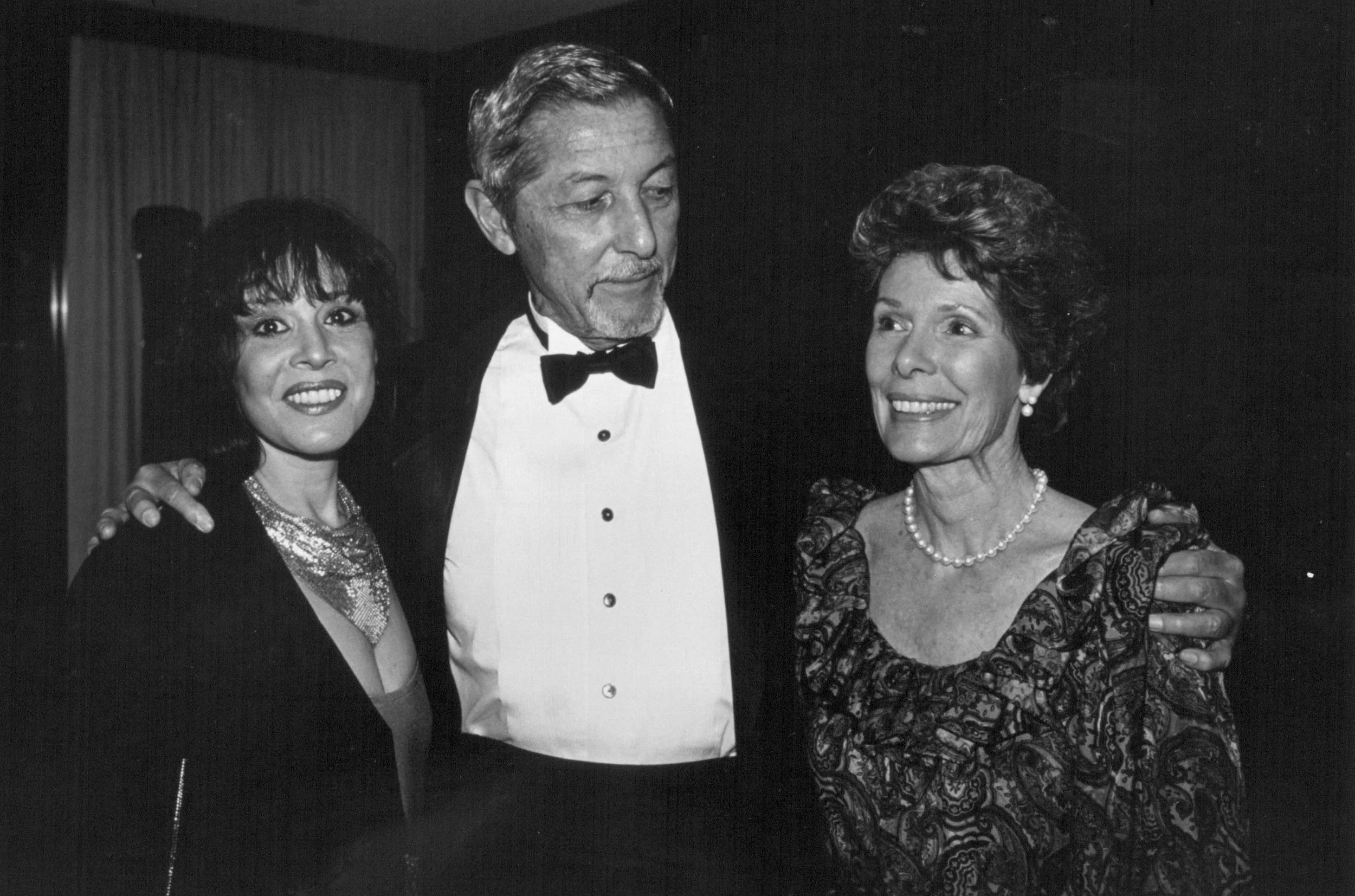
Garnett with Evan S. Connell and his sister, Barbara Zimmermann, before the Kansas City premiere of the movie Mr. and Mrs. Bridge, 1990. Photo courtesy of Janet Zimmermann.
In 1989, Zoe spent a couple of months in Kansas City, Connell’s original hometown. Connell had gotten her a role in the Merchant-Ivory movie Mr. and Mrs. Bridge, which was based on his two novels about a mid-twentieth century American family. In addition to the workings of the film production, I’d gathered some odd details that never made it into my book. For one thing, some locals took them to see the Rolling Stones at Arrowhead Stadium. I can’t imagine Connell enjoying it, but Zoe, the onetime rocker and Sausalito radio host, probably did.
Where is all this heading? Do I need another book-length project right now? Does Gale Zoe Garnett, a fascinating woman who lived the proverbial unfiltered life, deserve a full-fledged treatment?
I much regret the lost opportunities as well as Zoe’s sad and troubling fate. But the writing impulse has been unleashed, and I feel as if, now that the haunting gap has been at least partly filled, I might owe her story more of my time.
Steve Paul’s book Literary Alchemist: The Writing Life of Evan S. Connell was published by the University of Missouri Press in 2021. He is president of Biographers International Org.